First Seen
2023-05-10T21:03:42+00:00
simple-description (qwen3.5_2b-q8_0)
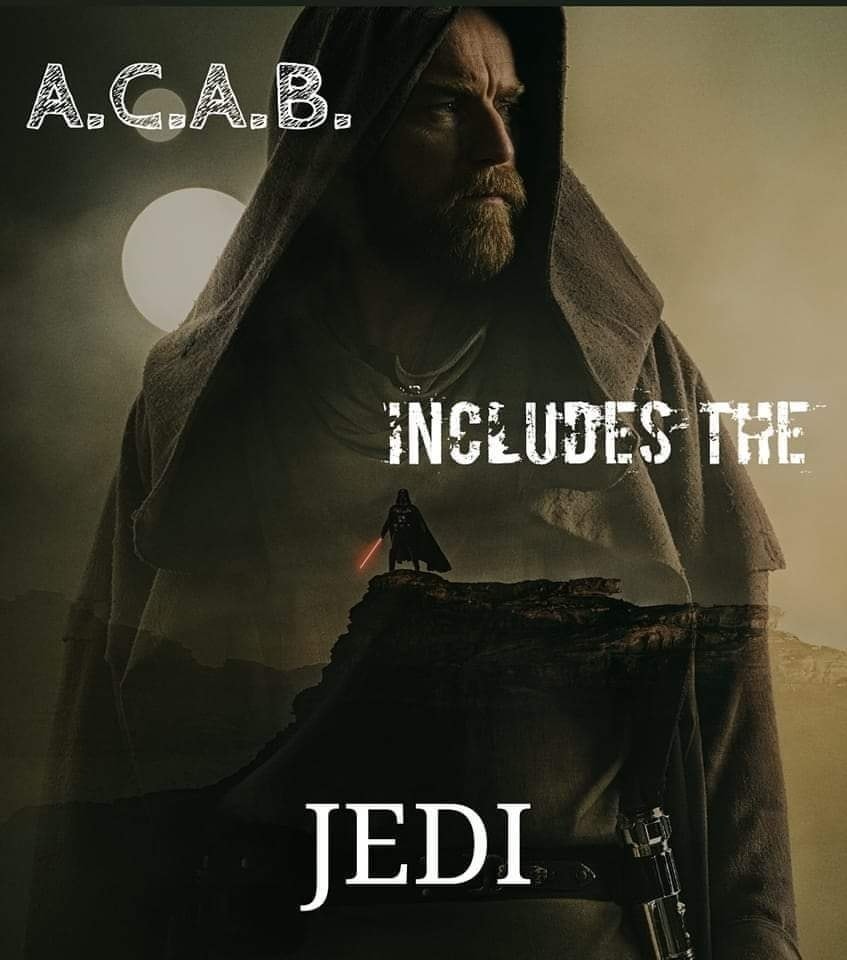
This Star Wars fan meme re-imagines the character Obi-Wan Kenobi by superimposing a small silhouette of Darth Vader inside his hooded robe. The text at the bottom reads "Includes The Jedi," linking this visual element to the text at the top, which says "A.C.A.B." (an acronym for Alcoholics Anonymous). The joke implies that the organization is considered "the Jedi" within the story.
simple-description (llama3.2-vision_11b)
This meme is a humorous image of Obi-Wan Kenobi from the Star Wars franchise, with a caption "I am a Jedi, like my father before me" overlaid on a picture of the character. The image is a play on the original Star Wars movie, where Obi-Wan says this line, but in this meme, the character's face is Photoshopped to look like a rapper, with a gold chain and a hip-hop style haircut. The meme is a lighthearted and humorous take on the classic Star Wars character, poking fun at the idea of a Jedi becoming a rapper.
detailed-analysis (gemma3-27b-vision)
Okay, let's break down this image with the requested theoretical lenses. It’s a complex composition, and the text overlays are significant.
Visual Description
The image is a digitally manipulated portrait featuring a man with a full beard against a backdrop blending a landscape and what appears to be a Star Wars aesthetic. The man is dramatically lit from the side, casting strong shadows and highlighting his facial features. He's wrapped in a flowing, dark garment, creating a sense of mystery and perhaps a monastic or shrouded figure.
The background is a dark, layered scene. There's a depiction of a rocky, mountainous landscape, with a possible silhouette of a castle or fortress. Overlaid onto this is a hazy, muted image reminiscent of Star Wars' landscapes or castles. A red lightsaber hilt is visible at the bottom, and a smaller one appears in the background.
The image is heavily text-layered. At the top is the acronym "A.C.A.B." in all-caps. Centrally, the phrase “INCLUDES THE” is displayed in a bold, distorted font. At the bottom, in a similar font style, appears "JEDI." The entire composition conveys a sense of deliberate construction and visual tension.
Foucauldian Genealogical Discourse Analysis
This image is rich for a Foucauldian analysis. "A.C.A.B." – "All Cops Are Bastards" – immediately introduces a discourse of power, control, and resistance. The association with "Jedi" is deliberately jarring.
- Discourse & Power/Knowledge: The image constructs a discourse that conflates law enforcement (represented by the A.C.A.B. slogan) with a perceived power structure (the Jedi Order). Foucault argues that power doesn’t simply repress but also produces knowledge and subjectivities. This image proposes a knowledge – that those in positions of authority, even those seemingly ‘good’ (Jedi), are fundamentally implicated in systems of oppression.
- Genealogy: A genealogical approach would trace the historical emergence of both the A.C.A.B. slogan and the romanticized image of the Jedi. It would examine how the meanings of ‘law enforcement’ and ‘heroic figure’ have been constructed and changed over time, and how this image re-codes those meanings. It suggests a lineage of authority figures extending from police to Jedi, and implies a fundamental similarity in their operations.
- Subjectification: The image seeks to subjectify the viewer by positioning them within this critique. By drawing parallels between seemingly disparate power structures, it asks us to reconsider our automatic assumptions about authority, justice, and the role of the "hero."
Critical Theory
From a Critical Theory perspective (drawing heavily from the Frankfurt School and thinkers like Adorno & Horkheimer), the image participates in a deconstruction of dominant narratives and a critique of ideology.
- Culture Industry: The appropriation of Star Wars imagery, a cornerstone of mass culture, can be seen as a tactic to disrupt and critique the "culture industry". The image subverts the often uncritical consumption of popular culture, inserting a message of resistance.
- Ideology Critique: The image performs an ideology critique. It challenges the seemingly benevolent image of the Jedi, exposing the potential for even 'good' power structures to be complicit in systems of oppression. It suggests that ideology functions to mask underlying power dynamics.
- Negative Dialectics: The image functions through "negative dialectics" – by presenting a juxtaposition (A.C.A.B./Jedi) that breaks down conventional understandings and reveals contradictions. It’s not offering a simple solution but prompting critical reflection.
Marxist Conflict Theory
From a Marxist perspective, the image highlights the inherent conflicts within systems of power and the struggle between opposing classes or ideologies.
- Power & Class: The "A.C.A.B." slogan explicitly references conflict between the marginalized and those who uphold the law – a classic conflict between the proletariat and the ruling class. The association with the Jedi expands this conflict to the realm of myth and narrative.
- Ideological Control: The Jedi, as representatives of an established order, can be viewed as agents of ideological control, maintaining the status quo. By linking them to the police, the image suggests that all authority figures serve the interests of the ruling class.
- Revolutionary Potential: The image subtly hints at revolutionary potential. By challenging the legitimacy of both police and Jedi, it opens up space for alternative visions of justice and resistance.
Postmodernism
The image exhibits several traits associated with postmodernism:
- Pastiche & Intertextuality: The blending of the "A.C.A.B." slogan with Star Wars imagery is a clear example of pastiche – the mixing of styles and references. This intertextuality creates layers of meaning and invites multiple interpretations.
- Deconstruction of Grand Narratives: The image challenges the "grand narrative" of the heroic Jedi, exposing its potential for complicity in oppressive systems. It suggests that there are no simple heroes or villains, only complex power dynamics.
- Simulacra & Hyperreality: The image can be seen as a "simulacrum" – a copy without an original. It’s a representation of representations, creating a hyperreality where the line between reality and fiction is blurred. The image is not about literal police or Jedi, but about the ideas we have about them.
Queer Feminist Intersectional Analysis
This is where things become more complex. While not explicitly queer or feminist, we can find some connections:
- Deconstructing Authority: The image’s challenge to authority (police and Jedi) can be understood through a queer feminist lens as a rejection of hierarchical power structures. Queer and feminist theories often critique systems of domination and control.
- Intersectional Critique: The “A.C.A.B.” slogan is linked to movements for racial justice and police accountability, which are inherently intersectional. It acknowledges how police brutality disproportionately impacts marginalized communities.
- Disrupting Heroic Masculinity: The Jedi Order, while diverse in some portrayals, has historically been dominated by masculine ideals of heroism. The image subtly disrupts this, implying that even these 'heroic' figures are implicated in oppressive systems. By questioning the archetype of the Jedi, the image opens up space for alternative models of leadership and resistance.
Important Note: Interpretation is subjective. These are just potential readings based on the theoretical frameworks outlined. The artist’s intent could be different, and multiple interpretations are valid.
simple-description (llama3.2-vision)
The meme is a play on the Star Wars franchise, specifically the character Darth Vader. The image features a photo of Darth Vader, but with his iconic breathing sound effect replaced with the sound of a cat meowing, implying that Vader is now a cat. The text "I find your lack of cat-ness disturbing" is written above the image, a humorous twist on the original "I find your lack of faith disturbing" line from the Star Wars franchise.
tesseract-ocr
AGAB. * | INGLUDES | JEDI. ri