First Seen
2024-01-31T22:37:36.944368+00:00
simple-description (qwen3.5_2b-q8_0)
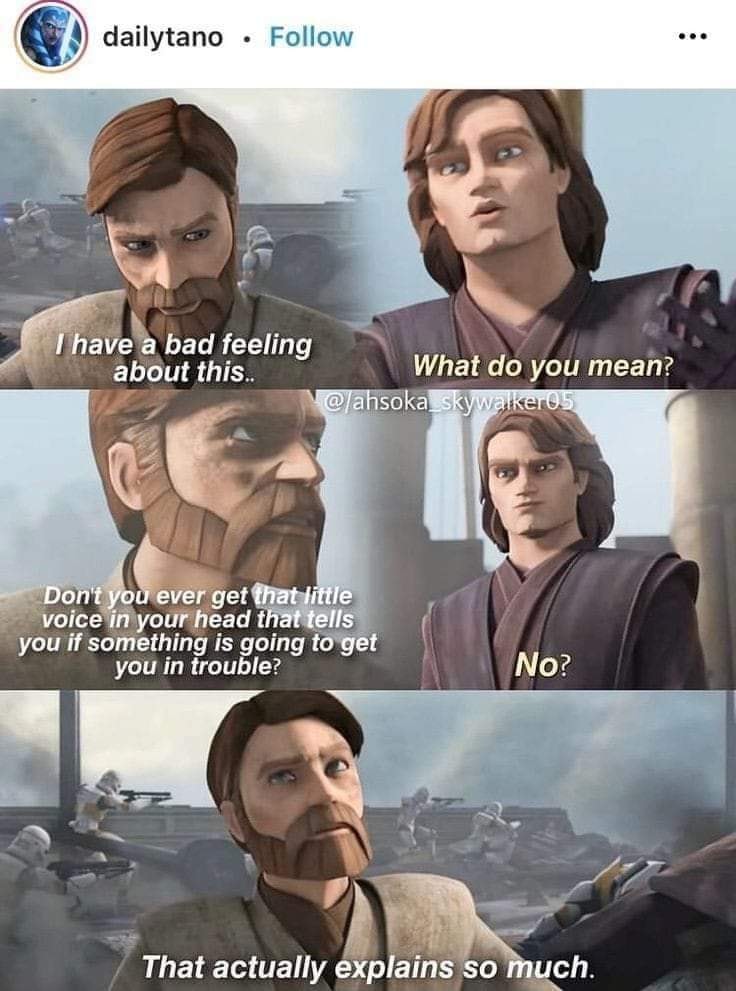
This Star Wars meme depicts a dramatic interaction between Obi-Wan Kenobi and Anakin Skywalker during a battle scene. In the first panel, Obi-Wan says, "I have a bad feeling about this.." while Anakin skeptically asks, "What do you mean?" In the following panels, Obi-Wan reveals that he is constantly worried, "Don't you ever get that little voice in your head that tells you if something is going to get you in trouble?" while Anakin just answers, "No?" The meme concludes with Obi-Wan realizing Anakin is paranoid, ending with the caption, "That actually explains so much."
simple-description (llama3.2-vision_11b)
The meme is a screenshot from the Star Wars movie "Attack of the Clones" where Obi-Wan Kenobi says "This is why you fail" to Anakin Skywalker. The meme is used to express frustration or disappointment when someone's plan or idea is not working out as expected.
detailed-analysis (gemma3-27b-vision)
Okay, let's break down this Star Wars: The Clone Wars meme through several critical theory lenses.
Visual Description
The image is a multi-panel meme using screenshots from the animated Star Wars: The Clone Wars series. The panels feature Anakin Skywalker and Ahsoka Tano in various expressions and dialogue exchanges.
- Panel 1: Anakin looks concerned, saying "I have a bad feeling about this..." (a classic Star Wars trope).
- Panel 2: Ahsoka looks quizzical, responding "What do you mean?"
- Panel 3: Anakin elaborates, asking "Don't you ever get that little voice in your head that tells you if something is going to get you in trouble?"
- Panel 4: Ahsoka, with a straight face, replies "No?"
- Panel 5: Anakin's face is a mixture of revelation and something akin to understanding. He says, "That actually explains so much."
The overall visual style is the animated, slightly stylized aesthetic of The Clone Wars. The meme relies on juxtaposition for comedic effect, leveraging the characters' established personalities and the audience's familiarity with Star Wars conventions. The watermark "@ahsoka_skywalker05" indicates where the meme originated and suggests a fan account dedicated to the character of Ahsoka Tano.
Foucauldian Genealogical Discourse Analysis
This meme can be analyzed through a Foucauldian lens by looking at the discourse surrounding notions of intuition, "the Force," and the shaping of selfhood within the Star Wars universe.
- The Discourse of "Bad Feelings": The phrase "I have a bad feeling about this" is a repeated motif throughout the Star Wars saga. Foucault would argue this isn't just a quirk of the characters, but a discourse in itself. This discourse positions intuition, or a pre-cognitive sense of danger, as a valid (and often correct) form of knowledge. It’s a mechanism for exercising power within the narrative. Anakin, as a Jedi and often a leader, is positioned as someone whose "bad feelings" carry weight.
- The Normalization of the Force: The Force, as a pervasive energy field, becomes the basis for internalizing premonitions. The discourse of the Force normalizes this type of internal voice or feeling as an inherent part of being.
- Ahsoka as the Disruptor: Ahsoka’s “No?” is a disruption of this normalized discourse. She doesn't experience the internal voice that Anakin assumes is universal. This isn’t a failure on her part, but a highlighting of the constructed nature of the discourse itself. It reveals the idea of the "internal voice" isn't a natural phenomenon, but a constructed understanding of what a Jedi, or one sensitive to the Force, should experience. Her lack of the 'little voice' is an anomaly that, upon realization, radically re-frames Anakin's understanding of her personality and motivations. The punchline implies that Ahsoka’s sometimes seemingly reckless or unconventional behavior can be attributed to not being burdened by this internalized caution.
Critical Theory
From a general Critical Theory perspective, the meme engages with the concept of ideology.
- Internalized Norms as Ideology: The expectation that a Force-sensitive individual should have a “bad feeling” acts as an ideological norm within the Star Wars universe. It's a subtle, unspoken rule that shapes how characters perceive and react to situations.
- Ahsoka’s Resistance: Ahsoka’s denial challenges that norm, exposing it as a constructed belief rather than an inherent truth. This can be read as a moment of deconstruction, where an accepted reality is questioned.
- The "Explanation" as Normalization: Anakin’s realization that this explains so much is actually a re-normalization of Ahsoka’s behavior, but within a new framework. Her unconventionality isn't seen as a flaw, but as a direct consequence of lacking this particular internalized "warning system". This subtly reinforces the idea that she is fundamentally different.
Queer Feminist Intersectional Analysis
While not overt, an intersectional reading can be applied:
- Ahsoka as a Disruptor of Jedi Masculinity: The Jedi Order, especially as depicted in The Clone Wars, is heavily coded as patriarchal and masculine. Ahsoka, as Anakin’s Padawan, often challenges those norms, exhibiting a different kind of strength and autonomy. Her lack of the "internal voice" can be seen as another way she deviates from the expectations placed upon Jedi, especially those associated with intuition and emotional resonance (which are often coded as feminine).
- Rejection of Internalized Constraint: The “little voice” could be read as a metaphor for internalized societal expectations or constraints. Ahsoka's rejection of it can be seen as a refusal to be governed by those internal forces. This aligns with queer and feminist concepts of breaking free from limiting norms.
- Differing Ways of Knowing: The meme highlights a differing way of knowing. Anakin relies on a subjective, internal premonition, while Ahsoka operates based on different criteria – observation, analysis, and perhaps a more pragmatic approach. This difference isn’t presented as a deficit, but simply a different mode of being.
Let me know if you'd like any of these analyses expanded upon!
simple-description (llama3.2-vision)
This meme is a screenshot of a scene from the TV show "Star Wars: The Clone Wars" where Anakin Skywalker (a young adult at the time) is trying to understand the complexity of the Force. The scene is captioned with the phrase "I don't like it" and the character Obi-Wan Kenobi responds with "That's what you said about the Death Star".
tesseract-ocr
(a> @ dailytano - Follow oe s es J , NaF = ‘a ‘ 4 . ‘ » I have'a bad feeling ‘ Ae iie What do you mean? m- Behe) PIRETOE & ~ ‘ # ep) (4 are. Se elie ERT c ( you if something is going t. you in trouble? No? 4 4 i? = ate a Oo mee ’ = Vin )\.. That actually explains so Much.