First Seen
2023-05-10T21:03:42+00:00
simple-description (qwen3.5_2b-q8_0)
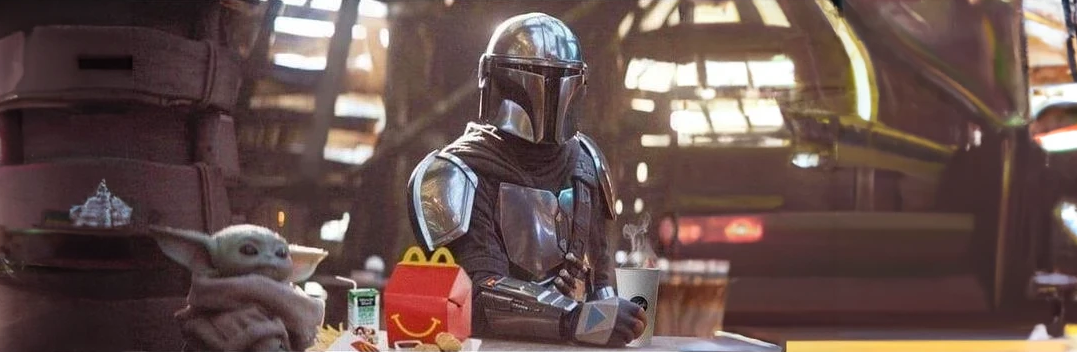
This meme features the Mandalorian character (Doth) and Baby Yoda sitting together in a fast-food setting. In the Star Wars - Queer context, this scene highlights Doth's identity as a queer ally, using the visual of them sharing a meal to represent a queer-friendly environment. The only text visible in the image is the McDonald's logo (golden arches) and the words 'McMeal Box' printed on the red container in the foreground.
simple-description (llama3.2-vision_11b)
The meme is a screenshot from the Star Wars franchise, specifically from the movie "The Mandalorian". In the image, the character of "The Mandalorian" is sitting at a table with a child, Grogu, who is playing with a toy. The text overlay on the image reads "Grogu's first day of school".
detailed-analysis (gemma3-27b-vision)
Okay, let's break down this image with the requested theoretical lenses. This is a meme/photomanipulation, so our analyses will necessarily address the absurdity inherent in the juxtaposition.
Visual Description
The image depicts the Mandalorian, Din Djarin, in a classic bar setting – seemingly a cantina similar to those from Star Wars. However, instead of traditional galactic beverages and snacks, the scene is populated with McDonald's products. Specifically, there's a Happy Meal box in front of Din Djarin, french fries, a McDonald's drink, and seemingly a plush Baby Yoda/Grogu toy. The background is a blurred, gritty cantina interior. The lighting is somewhat dim, and the composition draws attention to the contrast between the high-tech, futuristic Mandalorian armor and the mundane, fast-food items. The contrast is intentional and comical.
Foucauldian Genealogical Discourse Analysis
This image lends itself well to a Foucauldian analysis focused on power/knowledge and the construction of reality. The image playfully disrupts established discourses. The Star Wars universe establishes a particular set of rules, aesthetics, and forms of consumption. The introduction of McDonald's, a symbol of hyper-capitalist, globalized American culture, immediately throws those rules into question.
- Disrupting the Discourse: The image challenges the constructed reality of the Star Wars universe. It asks: what if the galactic empire also craved fast food? This disruption exposes the arbitrary nature of those boundaries.
- Power and Normalization: McDonald's is a powerfully normalized institution. Its products, branding, and presence are ubiquitous. By inserting it into the Star Wars context, the image highlights how even in the most fantastical settings, capitalist structures can seep in and become ‘normal’. It suggests that certain power structures (in this case, those associated with consumerism) are pervasive and resilient.
- Genealogy: We can trace the ‘genealogy’ of this image. It doesn’t emerge in a vacuum. It’s a product of the merging of two distinct cultural domains, both of which have developed their own systems of power/knowledge. The image is a “break” in the historical continuity of meaning, forcing us to confront the absurdity of the combination.
Marxist Conflict Theory
From a Marxist perspective, this image is a potent representation of commodification and the inescapable reach of capitalism.
- Capitalism's Universalization: The image demonstrates how capitalism (represented by McDonald's) will infiltrate even the most remote and seemingly self-contained worlds. It's a visual metaphor for globalization and the homogenization of culture.
- Alienation: The image can be interpreted as showing the alienation of even the ‘hero’ within a consumerist system. The Mandalorian, a character often seen as embodying a rugged, independent spirit, is now depicted consuming a mass-produced, standardized product.
- Ideology: McDonald's, as a powerful brand, functions as an ideological state apparatus (to borrow from Althusser). The image suggests that even in the furthest reaches of the galaxy, the values and products of capitalist ideology will prevail. It asks whether the Mandalorian, even in his fight against the Empire, is still trapped within a system of exploitation and consumption.
Postmodernism
This image embodies many Postmodern characteristics:
- Pastiche and Intertextuality: The image is a clear example of pastiche—a blending of distinct styles and sources. It combines elements of science fiction (Star Wars) with the banal reality of fast food advertising. It’s intertextual, relying on the viewer’s familiarity with both universes.
- Deconstruction of Grand Narratives: Star Wars traditionally presents a grand narrative of good vs. evil. The image throws a wrench into that narrative. It undermines the mythic quality of the Star Wars universe by introducing a mundane, capitalist element.
- Simulacra and Simulation: The image is itself a simulation. It's a digitally manipulated image that doesn’t ‘exist’ in the Star Wars universe. It's a copy of a copy, a hyperreality where the distinction between the ‘real’ and the ‘simulated’ becomes blurred.
- Playfulness and Irony: The meme form itself is inherently playful and ironic. It isn’t meant to be taken seriously, but rather to disrupt expectations and invite laughter.
Queer Feminist Intersectional Analysis (Less Direct, but Possible)
This is the most tenuous lens, but some connections can be made.
- Disruption of Masculinity: The Mandalorian is often presented as a stoic, hyper-masculine figure. The image can be seen as subtly disrupting that image by associating him with something traditionally considered “childish” or “unheroic” (a Happy Meal). This plays with the performance of masculinity.
- Commodification of Childhood: The Happy Meal is often marketed to children, and its presence underscores the commodification of childhood. This connects to feminist concerns about the ways in which children (particularly girls) are socialized into consumer culture.
- Subversion of Expectations: The image inverts expectations. The Mandalorian is meant to be a warrior and bounty hunter. Seeing him sit at a bar with a Happy Meal breaks with that stereotype.
Let me know if you'd like me to expand on any of these analyses, or explore a different theoretical framework.
simple-description (llama3.2-vision)
This meme is a screenshot from the Star Wars franchise, specifically from the TV series "The Mandalorian". It shows the character "The Child" (also known as "Baby Yoda") sitting in a high chair, eating a meal of fries and nuggets from McDonald's, with a box of McDonald's fries and a Happy Meal toy on the table in front of him. The text "I find your lack of fries disturbing" is written in a font that resembles the Star Wars franchise's font.
tesseract-ocr
es sae - TE ie > | 3 ae) i... i i ; = A L a en ; . Ft a) i a . ; % ; rie ke fp pr 4 a4