First Seen
2023-05-10T21:03:42+00:00
simple-description (qwen3.5_2b-q8_0)
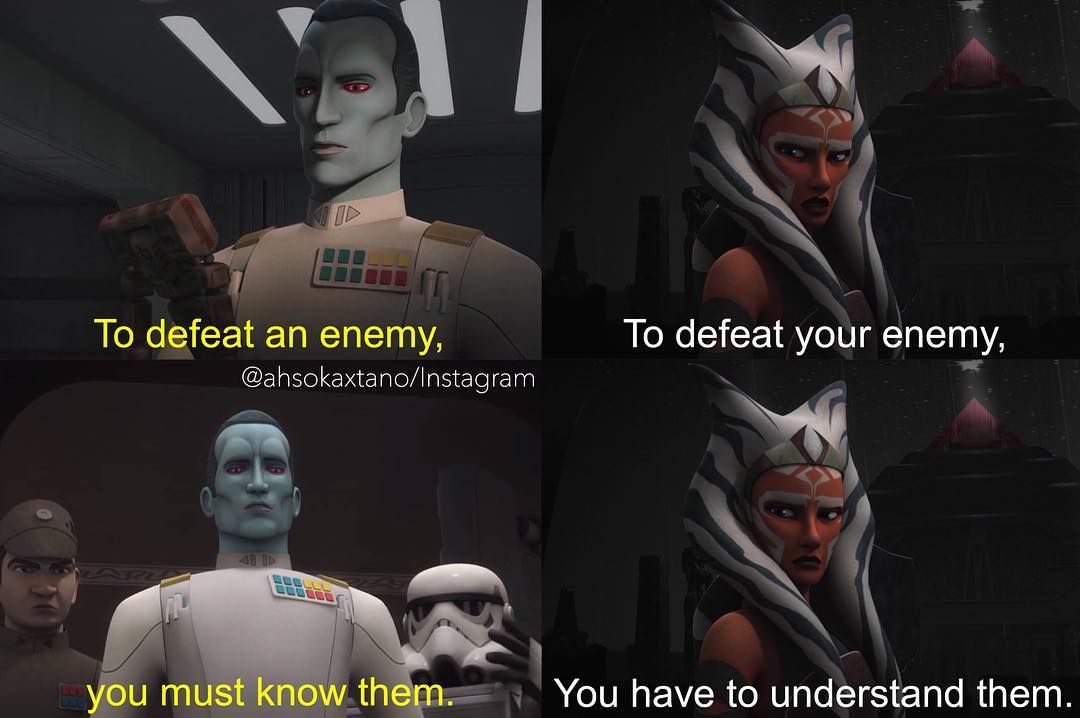
This Star Wars meme uses Thrawn and Ahsoka to frame a humorous lesson about overcoming fear. The top-left panel shows Thrawn stating, "To defeat an enemy, you must know them," while the bottom right panel adds the punchline, "You have to understand them." The joke implies that the real battles are fought against your own past mistakes or internal doubts.
simple-description (llama3.2-vision_11b)
The meme is a screenshot from the Star Wars series, featuring Grand Admiral Thrawn, a character known for his strategic thinking. The text overlay reads: "To know your enemy, you must become your enemy. To defeat your enemy, you must destroy your enemy. To defeat your enemy, you must become your enemy." This quote is often used to illustrate the complexity of Thrawn's approach to strategy, where he seeks to understand his enemies' motivations and strengths in order to defeat them.
detailed-analysis (gemma3-27b-vision)
Okay, here's an analysis of the image, broken down by the requested theoretical lenses. Note that some sections will be brief or non-existent if the theory doesn't strongly apply.
Visual Description
The image is a split-screen meme juxtaposing two characters from the Star Wars universe. On the left is Grand Admiral Thrawn, a blue-skinned Imperial officer, in a darkened control room with other Imperial officers. He’s depicted in a thoughtful, observant pose. The lighting is dramatic, emphasizing his intensity. On the right is Ahsoka Tano, a former Jedi Padawan, with a fierce expression. She's rendered in a similar darkened setting, but with a more dynamic pose suggesting action.
The meme text overlays the image. “To defeat an enemy, you must know them” is written below Thrawn, and “To defeat your enemy, you have to understand them” appears below Ahsoka. The creator's Instagram handle, @ahsokaxtano, is also displayed. The composition directly contrasts the characters, highlighting the different methodologies they represent.
Foucauldian Genealogical Discourse Analysis
This image is fertile ground for a Foucauldian reading. The core contrast highlights a discourse around strategy, power, and how knowledge is used to exert control.
- Knowledge/Power Nexus: Both characters advocate a form of knowledge acquisition as central to defeating an enemy. However, the subtle difference in wording ("know" vs. "understand") hints at differing approaches to how that knowledge is produced and applied. Thrawn’s emphasis on knowing suggests objective analysis, collecting data about strengths, weaknesses, and tendencies. This is a classic Foucauldian example of knowledge being inextricably linked to power; knowing the enemy is wielding power over them.
- Genealogy of Strategy: A genealogical approach would explore the historical development of strategic thinking within the Star Wars universe, and beyond. Thrawn represents a more traditional, potentially colonial/imperialistic strategy – cataloging, classifying, and dominating through superior knowledge. Ahsoka, as a former Jedi, implies a different genealogy— one rooted in empathy, seeking inner understanding, and potentially even a form of reconciliation or de-escalation (though within a larger conflict).
- Discursive Formation: The very form of the meme—a direct comparison with text—constructs a discourse around the ‘right’ way to defeat an enemy. It asks the viewer to position themselves within this discourse, favoring one approach over the other.
Critical Theory
The image opens space for a Critical Theory reading as it addresses issues of power dynamics, ideology, and domination.
- Imperialism/Colonialism: Thrawn embodies a particularly chilling efficiency as an imperial strategist. His philosophy of "knowing" the enemy is reminiscent of colonial projects aimed at classifying and controlling subjugated populations. The emphasis on understanding an enemy's art, culture, and history, while seemingly benign, is ultimately a tool for domination. He isn’t seeking to coexist with those he conquers; he seeks to exploit their weaknesses.
- The "Other": Both characters deal with defining the “other.” Thrawn views the Rebels as objects to be analyzed and overcome. Ahsoka's approach, while still involving conflict, suggests a greater recognition of the inherent complexity and agency of those considered “enemies.”
- Critique of Enlightenment Rationality: Thrawn’s approach can be seen as a hyper-rational, almost detached mode of understanding. A Critical Theory lens might question the ethics of such pure rationality when applied to conflict, suggesting that it can dehumanize and justify violence.
Marxist Conflict Theory
This is relevant, but perhaps not the strongest lens. The image reveals power dynamics and inherent conflicts, but lacks a strong class-based analysis.
- Conflict as Inevitable: The core premise—defeating an enemy—immediately places the image within a framework of conflict. Marxist theory emphasizes conflict as inherent in systems of power, especially around control of resources and ideology.
- Power Structures: The contrast between Thrawn (representing the Imperial regime) and Ahsoka (a former Jedi, who often fights against the Empire) demonstrates a clear power imbalance and the clash of competing ideologies.
- Ideological Struggle: The contrasting approaches to understanding the enemy can be read as representing competing ideologies. Thrawn’s approach supports an ideology of domination, while Ahsoka’s implies a more nuanced and potentially less exploitative approach.
Postmodernism
The image touches on postmodern themes of subjectivity, deconstruction, and questioning grand narratives.
- Challenging Absolutes: The meme itself is a playful deconstruction of strategic thought. It suggests that there isn't one "right" way to defeat an enemy, and that both approaches have merit (or, at least, deserve consideration).
- Deconstructing Strategy: The image implicitly critiques the idea of a unified, objective "strategy." Each character's approach is shaped by their own experiences, values, and perspectives.
- Subjectivity of Understanding: The difference between "knowing" and "understanding" emphasizes the subjective element of perceiving and interacting with the "enemy."
Queer Feminist Intersectional Analysis
This lens is the most subtle application, but still present.
- Challenging Dominant Narratives: Ahsoka's character as a female Jedi who left the Order challenges traditional power structures and gender roles within the Star Wars universe. Her emphasis on understanding could be interpreted as a more empathetic and relational approach, contrasting with the traditionally masculine and dominating approach often embodied by Thrawn.
- Multiple Layers of Oppression: The conflict within the Star Wars universe isn't simply about good vs. evil. It involves multiple layers of oppression, including political control, cultural domination, and systemic injustices. A queer feminist lens would encourage a deeper exploration of these intersections.
- Relationality and Care: Ahsoka's approach to understanding the enemy, which could be argued, is rooted in care for all life. The feminist viewpoint of relationships and the care that’s woven into it is present in Ahsoka’s quote.
Hopefully, this detailed breakdown provides a comprehensive analysis of the image through the requested theoretical lenses. Let me know if you'd like me to expand on any particular section or explore a different theoretical framework!
simple-description (llama3.2-vision)
This meme is a play on the classic Star Wars quote "Do. Or do not. There is no try." It shows a character from the Star Wars universe, Grand Moff Tarkin, saying "Do. Or do not. There is no try." But instead of the original character, it is a character from the Star Wars universe, Grand Moff Tarkin, saying "Do. Or do not. There is no try." But the character is replaced with a Stormtrooper, and the quote is rewritten to say "Do. Or do not. There is no shot."
tesseract-ocr
4 | : ” a PL To defeat an enemy, To defeat your erred 7 @ahsokaxtano/Instagram < ij - oe ‘ wes ; e 7 . = KY y ti i" j . or N a) b lumen W.them== » You have to understand them.