First Seen
2023-09-22T20:32:03+00:00
simple-description (qwen3.5_2b-q8_0)
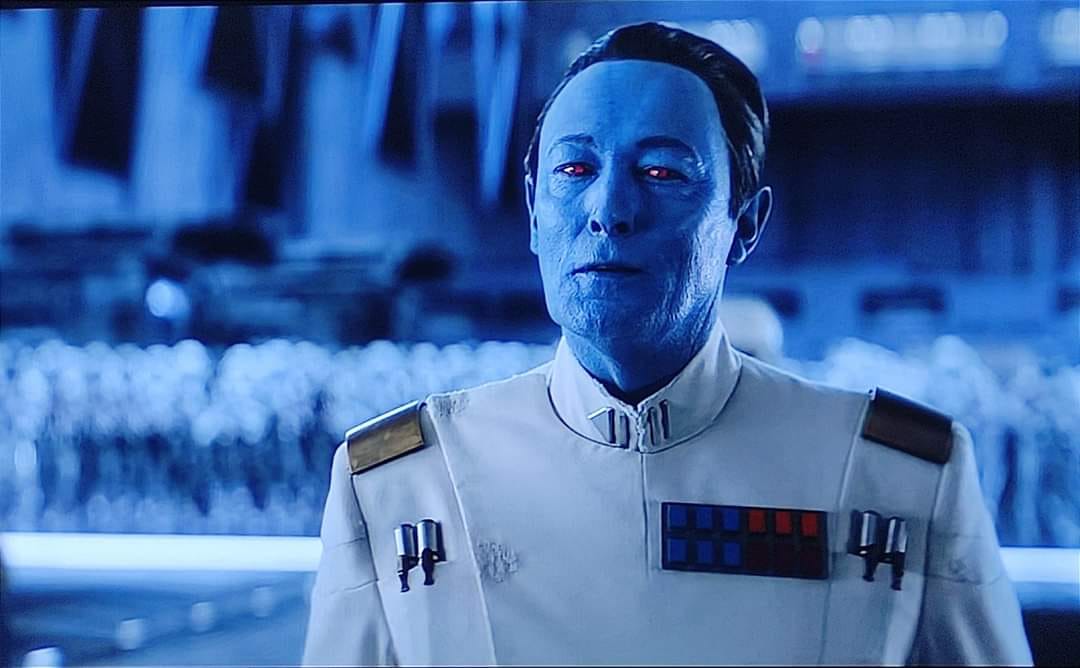
This meme is a play on the internet joke about the blue-skinned general from Star Wars being dead. Because the general looks so mysterious and powerful, people play on the idea that he is a genius who has gone missing. It works because of his glowing red eyes and the 101 unit number on his chest, adding to the sense of his elite status.
simple-description (llama3.2-vision_11b)
The meme is an image of Grand Moff Thrawn from the Star Wars franchise, with a caption that says "When you're trying to explain the plot of The Last Jedi to your grandma." The image is a humorous representation of Thrawn's intellectual and analytical nature, as he is known for his strategic thinking and ability to understand complex situations. The caption is a play on the idea that Thrawn would be the perfect person to explain the complex plot of The Last Jedi to someone who is unfamiliar with it.
detailed-analysis (gemma3-27b-vision)
Okay, let's analyze the image of Grand Moff Tarkin from Star Wars: Rogue One through the lenses you requested. Keep in mind that some of these theories won’t apply as strongly as others, and interpretations can be subjective.
Visual Description
The image presents Grand Moff Tarkin, a human character from the Star Wars universe, digitally recreated using CGI. He is a middle-aged man with a pale complexion, sharp features, and a distinctively severe expression. His eyes are a vibrant, unnatural red – a key element of his digitally recreated appearance, and a significant visual cue indicating his role and cold demeanor.
He is dressed in the crisp, immaculate white uniform of an Imperial Grand Moff – a high-ranking officer in the Galactic Empire. The uniform is adorned with multiple shoulder boards and rank insignia, highlighting his authority and status. The background is a vast hangar bay filled with rows upon rows of white Stormtroopers, emphasizing the sheer power and organization of the Empire.
The image is bathed in a cool, blue tone, enhancing the sterile, clinical, and oppressive atmosphere. The lighting focuses sharply on Tarkin’s face, drawing the viewer’s attention to his expression and highlighting the digital reconstruction. The overall effect is one of coldness, control, and calculated menace.
Foucauldian Genealogical Discourse Analysis
Michel Foucault's work on power and discourse is highly applicable. Tarkin is a manifestation of panoptic power. His presence within the Imperial structure and, especially, before ranks of Stormtroopers, is a visual representation of constant surveillance. The sheer scale of the Imperial army shown highlights how thoroughly controlled space and subjects are.
- Discourse of Order & Control: The Imperial uniform and the rigid lines of Stormtroopers represent a discourse of order, discipline, and absolute control. Tarkin embodies this discourse, acting as its primary agent and interpreter. This isn't simply about physical force, but about a system of knowledge and belief that legitimizes domination.
- The Body as a Site of Control: The Stormtroopers’ uniform (identical bodies) represent a way to normalize and control bodies. Tarkin, as their commander, controls these bodies through the structuring of that discourse. His digital reconstruction, ironically, is also a demonstration of controlling/manipulating the very image of a body.
- Genealogical Analysis: We can trace the genealogy of Imperial power back through historical analogies – Roman emperors, totalitarian regimes, etc. Tarkin, as a figure representing that power, is a specific articulation of a longer historical lineage of authoritarianism. His absolute, uncompromising authority is a characteristic element of this lineage.
Critical Theory (Frankfurt School)
The image resonates with themes explored by the Frankfurt School, particularly the concept of instrumental reason.
- Instrumental Reason & Domination: Tarkin represents the ultimate expression of instrumental reason – prioritizing efficiency, control, and achieving objectives (galactic domination) regardless of ethical considerations or human cost. His unemotional demeanor and focus on strategic goals emphasize this. The Destruction of Alderaan is the perfect demonstration of this.
- The Culture Industry & Propaganda: The Imperial uniform, the regimented Stormtroopers, and the imposing hangar bay can be seen as elements of the “culture industry” – a system designed to manufacture consent and reinforce the power structure. The image itself, as a promotional tool within the Star Wars franchise, participates in this process.
- Alienation & Dehumanization: While primarily experienced by the victims of the Empire, Tarkin's own focus on the abstract goal of order can be seen as a form of self-alienation. He has become so fixated on the system that he has lost touch with any sense of empathy or humanity.
Marxist Conflict Theory
From a Marxist perspective, the image embodies the core conflict between the ruling class and the oppressed.
- Class Warfare: The Empire (represented by Tarkin and the Stormtroopers) is the ruling class, possessing all the means of production (starships, weaponry, resources) and exercising absolute control over the galaxy. The Rebellion represents the oppressed class, fighting for liberation.
- Ideology & False Consciousness: The image contributes to the Empire’s ideology – presenting its power as legitimate and necessary for maintaining order. The Stormtroopers, as unthinking soldiers, are a visual representation of “false consciousness” – accepting the ruling class’s worldview without questioning it.
- Means of Production and Control: Tarkin, as an Imperial officer, directly controls the "means of production" – the military forces and resources that maintain the Empire’s dominance. His authority is rooted in his control over these material resources. The vast hangar bay visually reinforces this control.
Postmodernism
While Star Wars itself isn't inherently a postmodern work, we can still apply some postmodern lenses to this image.
- Simulacra & Simulation: Tarkin's digital resurrection—a character brought back through CGI—is a perfect example of a simulacrum. It's a copy of a copy, an imitation that has become more "real" than the original, potentially blurring the lines between authenticity and representation. This is particularly poignant given his iconic portrayal by Peter Cushing in the original film.
- Hyperreality: The pristine, exaggerated visuals of the Imperial hangar bay – and the digitally perfected appearance of Tarkin – contribute to a hyperreality – a simulated world that feels more compelling and “real” than actual reality.
- Deconstruction of Authority: The image could also be “deconstructed” – questioning the very notion of authority and the legitimacy of the Empire's power. The visual spectacle – the massive army, the imposing uniform – might be seen as a way to mask the underlying vulnerability and moral bankruptcy of the regime.
Queer Feminist Intersectional Analysis
This is the least directly applicable lens, but there are some possibilities.
- The Performance of Masculinity: Tarkin embodies a hyper-masculine archetype – cold, ruthless, and controlling. This performance of masculinity is used to reinforce his authority and maintain the Empire’s power structure. This is particularly relevant in a world (the Star Wars universe) where many powerful figures are male.
- Patriarchal Structures: The Empire is arguably a patriarchal system – power is concentrated in the hands of male figures like Tarkin. While the Star Wars universe has strong female characters, the dominant power structure is undeniably male-centered.
- Control of Bodies and Reproduction (Metaphorical): The Empire's attempt to control the galaxy can be interpreted as a metaphorical attempt to control bodies and reproduction – to impose its own order and prevent deviation from its norms. (Although this is a broader application, as it's applied to an entire galaxy rather than individuals.)
Hopefully, this breakdown is helpful! It’s important to remember that these are just interpretations, and other readings are also valid. Let me know if you'd like me to elaborate on any of these points.
simple-description (llama3.2-vision)
The meme is a screenshot of the character Grand Moff Tarkin from the Star Wars franchise. The image shows Tarkin's stern expression, but his face has been replaced with a comically exaggerated, cartoonish "angry face" with a red, flushed complexion and a scowl. The text "I find your lack of faith disturbing" is written above the image, a reference to one of Tarkin's iconic lines from the Star Wars films.
tesseract-ocr
eat = - pe HH iit | nn a | : 4