First Seen
2023-10-12T08:03:09+00:00
simple-description (qwen3.5_2b-q8_0)
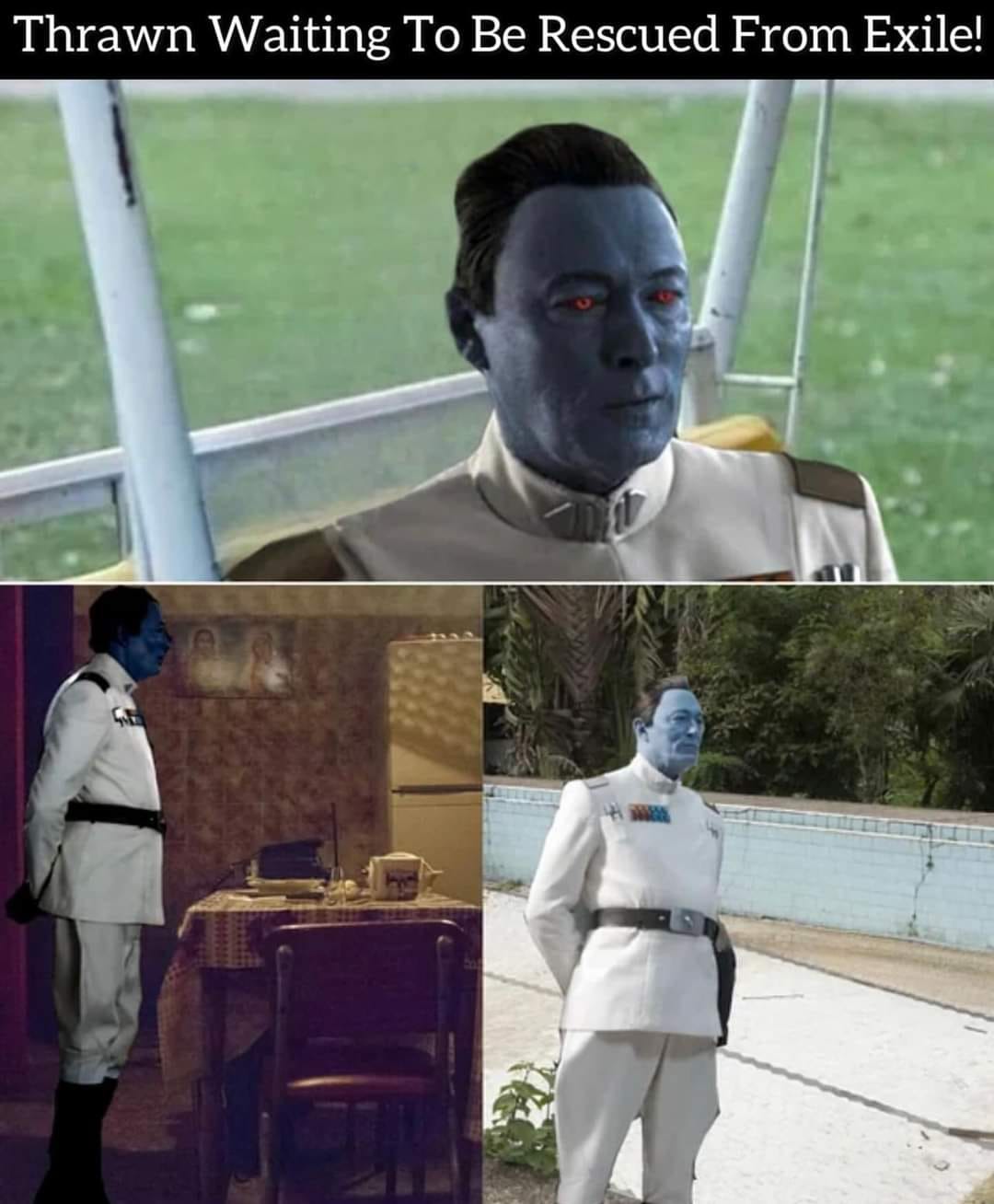
This meme features the Sith Lord Elysiah Thrawn from Star Wars: The Clone Wars. The image is divided into three parts: a close-up of Thrawn in a command position on a ship, followed by a split view of him standing in a house and then standing on a road outside. The text overlay reads "Thrawn Waiting To Be Rescued From Exile!", humorously implying that he is currently a fugitive in exile and desperately hoping for a rescue mission.
simple-description (llama3.2-vision_11b)
This meme is from the Star Wars category, specifically referencing Grand Admiral Thrawn, a character from the series. The image shows a photo of Thrawn in his Imperial uniform, with a caption that reads "Thrawn: I have a plan to rescue the Rebel Alliance" and a subsequent image of him standing alone in a room, captioned "Thrawn: I have a plan to rescue myself from this awkward photo shoot".
detailed-analysis (gemma3-27b-vision)
Okay, let's break down the imagery of Grand Admiral Thrawn "waiting to be rescued" through the lenses you requested. Given the image, not every category will be strongly applicable, but I'll aim to provide thoughtful analysis where it makes sense.
Visual Description
The image is a composite of three panels. The top panel is a close-up portrait of Grand Admiral Thrawn, a character from Star Wars. He is depicted with blue skin, red eyes, and a composed, almost stoic expression. He is wearing a crisp, white Imperial officer uniform, suggesting authority and formality. The background is blurred, seemingly suggesting a contained indoor location.
The lower two panels show Thrawn standing in various outdoor locations – one in a drab, almost derelict room with a table and what appears to be a shrine or decorative arrangement, the other in a leafy, overgrown exterior location. He still wears his Imperial uniform, creating a striking contrast with the surroundings, indicating a state of displacement or exile. The composition implies waiting or anticipation. The overall impression is one of dignified confinement or a powerful figure out of place.
Foucauldian Genealogical Discourse Analysis
The image lends itself well to a Foucauldian reading. Thrawn's uniform and demeanor signify a discourse of Imperial power and control. The Imperial uniform isn’t just clothing, it performs authority, embedding a system of control over space and subordinates. His exile, however, disrupts this discourse. The crumbling, derelict environments in the lower panels become sites where the discourse of the Empire is weakened and countered by the 'natural' disorder of the jungle setting.
The genealogy of this power is visible in the contrast between the clean uniform and the decaying setting. The image asks us to consider how power operates through spatial control, visual representation, and the creation of 'order' – and how that order can be undone. The 'rescue' aspect suggests a return to the establishment of that order. The image prompts a questioning of the historical conditions that allowed this figure of power to fall into such a state, and how the 'rescue' narrative potentially restores the power dynamics.
Critical Theory
Applying critical theory, we can see the image as demonstrating the concept of alienation. Thrawn, once a high-ranking officer in a vast empire, is now physically and symbolically removed from that power structure. His elegant uniform juxtaposed against the crude natural environments highlights this disconnect. The image can be interpreted as a representation of the anxieties associated with loss of control, displacement, and the erosion of established hierarchies.
The implied 'rescue' could be read as a restoration of the status quo, potentially critiquing the inherent conservatism of power structures. If Thrawn represents an oppressive system, his return isn’t necessarily a positive outcome; it signifies the perpetuation of that oppression. This interpretation invites us to question the narrative of 'rescue' and consider who benefits from the restoration of power.
Marxist Conflict Theory
From a Marxist perspective, Thrawn embodies the ruling class – specifically, the military and political elite of the Empire. His exile represents a temporary disruption to the established power dynamics of class conflict. The environments he's shown in represent a 'fall from grace'—a stripping of his resources and privilege.
The implication of a 'rescue' can be seen as an attempt by the ruling class to reassert its dominance. The imagery suggests a desire to reclaim power, reinstate hierarchies, and continue the exploitation inherent within the Imperial system. The decaying environments could be interpreted as symbols of the Empire’s own potential decay or the resistance of subjugated groups. The 'rescue' then represents a reaction against that decay—a force attempting to restore the established order through means of force.
Postmodernism
A postmodern reading focuses on the fragmentation and deconstruction of meaning within the image. The jarring juxtaposition of Thrawn’s pristine uniform with the decaying environments creates a sense of dislocation and undermines the notion of a coherent, unified Imperial identity. The idea of a 'rescue' itself becomes a self-referential trope, calling attention to the constructed nature of narratives and the arbitrary assignment of meaning.
The image challenges grand narratives – specifically, the idea of a strong, monolithic Empire and the heroic trajectory of its leaders. By presenting Thrawn in a state of vulnerability and displacement, the image subverts expectations and questions the very foundations of Imperial authority. The composition feels self-aware, almost mocking the idea of a clear-cut 'good' versus 'evil' narrative.
Queer Feminist Intersectional Analysis
While less explicitly present, this lens can still offer insights. One could interpret Thrawn's isolation and displacement as a metaphor for marginalized identities. His 'otherness' (blue skin, unique strategic mind) already sets him apart from the predominantly human Imperial hierarchy. His exile could be seen as a symbolic representation of systemic exclusion and the silencing of voices that challenge the status quo.
The focus on rescue—a traditionally patriarchal trope—could be deconstructed to question the agency and self-determination of marginalized individuals. Is being 'rescued' by a dominant power structure truly empowering, or does it merely reinforce existing power dynamics? This interpretation suggests that true liberation requires dismantling the systems of oppression rather than seeking integration within them. However, this interpretation requires more information about the context of the story and the way Thrawn is portrayed to be fully realized.
Let me know if you'd like me to elaborate on any of these interpretations, or if you'd like me to explore other analytical lenses.
simple-description (llama3.2-vision)
This meme is a screenshot of a character from the TV show "Star Wars Rebels" named Thrawn. The image shows Thrawn, a blue-skinned alien with a serious expression, looking out a window with a faintly amused tone on his face. The text "I've been waiting 40 years for this" appears at the top of the image, implying that Thrawn has finally been rescued from exile, a reference to the "Darth Vader" song "I've Been Waiting" by 2Pac.
tesseract-ocr
Thrawn Waiting To Be Rescued From Exile! i _— , : ey me _§ rad an 7? “1 - : gE = — ail toe a S mS i i) . : : mf . ES Sere tC ae ba 7 —— ‘ ame ae : ? . a ; ) o CF ar pee ' , ean ‘ ae {