First Seen
2024-02-21T22:38:30.996481+00:00
simple-description (qwen3.5_2b-q8_0)
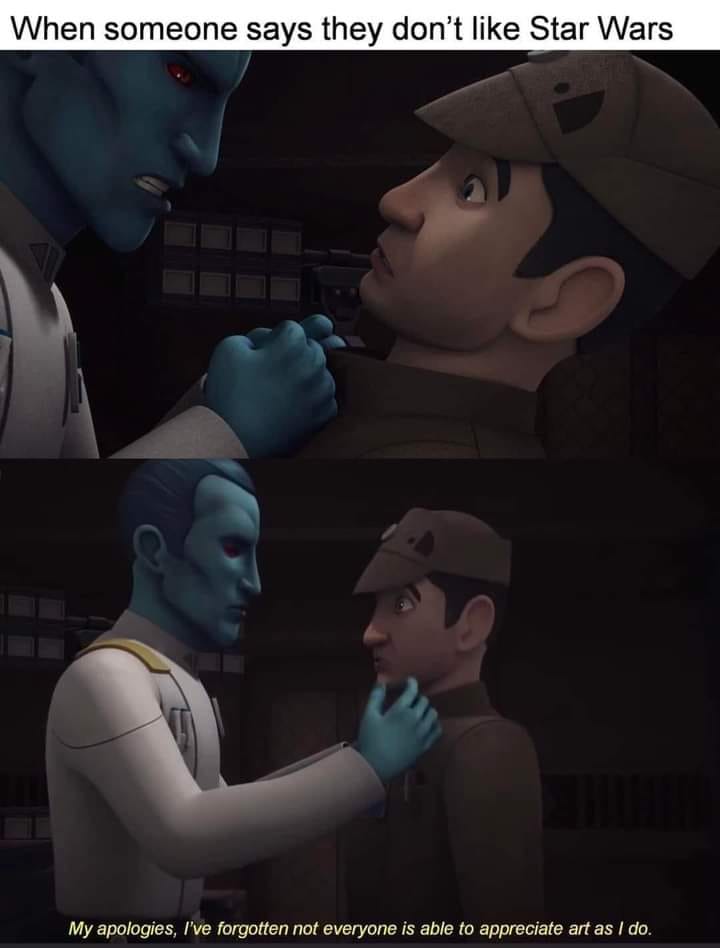
This meme humorously explains the story where the blue-skinned Sith Lord Thrawn has trouble seeing his own face, making it hard for other fans to appreciate his art. The image depicts a scene where he sternly confronts a Star Wars fan in the top panel, but then softens his demeanor to apologize and explain that he has been struggling to see his own work appreciated. The text overlay reads: "When someone says they don't like Star Wars" and concludes with, "My apologies, I've forgotten not everyone is able to appreciate art as I do."
simple-description (llama3.2-vision_11b)
The meme features a screenshot from the Star Wars: The Clone Wars animated series, where Grand Admiral Thrawn is reacting to a fan's statement that they don't like Star Wars. The image shows Thrawn's disapproving expression, with a caption that reads "When someone says they don't like Star Wars" and a quote from the character's response: "I don't like it when people say they don't like it. I don't like it. I don't like it. I don't like it."
detailed-analysis (gemma3-27b-vision)
Okay, let's break down this meme using the requested theoretical frameworks. It's a surprisingly complex meme given its simple format, and not all sections will be equally robust.
Visual Description
The meme depicts a two-panel still from Star Wars: The Clone Wars animated series. The characters are Commander Cody (a clone trooper) and a blue-skinned alien, presumably a member of the Council (though the specific alien is not explicitly defined). In the first panel, Cody looks with a somewhat neutral expression, while the alien looks down upon him in seeming judgement. The second panel presents a close-up of Cody, now looking downwards, with the alien’s hand placed upon his forehead, in a gesture of assumed correction. A text caption at the bottom reads "My apologies, I've forgotten not everyone is able to appreciate art as I do." The humor relies on the implication that disliking Star Wars is a failure of aesthetic understanding, portrayed through this condescending physical interaction. The lighting is low and dramatic, enhancing the intensity of the scene.
Foucauldian Genealogical Discourse Analysis
This meme demonstrates a power dynamic rooted in discourse. The assertion that disliking Star Wars is akin to lacking aesthetic appreciation isn't a neutral statement; it's a construction of meaning designed to normalize a particular taste and to position those who hold differing views as “other” or deficient.
- Power/Knowledge: The meme embodies the interplay of power and knowledge described by Foucault. The "speaker" (implied to be the meme creator/sharer) wields power by defining the criteria for "good" taste (aesthetic appreciation) and applying it to judge others. This power isn’t simply repressive, but productive; it shapes the discourse around Star Wars fandom and creates hierarchies within it.
- Genealogy of Taste: One could trace a "genealogy" of this meme’s logic. It's built upon the long-standing (and often elitist) idea that certain art forms (like classical music, literature, or in this case, Star Wars) are inherently superior and require a specific sensibility to understand. The meme taps into a history of aesthetic judgment and the social implications of taste.
- Discursive Formation: The meme participates in the "discursive formation" surrounding Star Wars fandom. It reinforces the idea that Star Wars isn't just entertainment, but a cultural object worthy of serious consideration and appreciation, even a sort of 'high art'. This elevates the fandom into a group with defined 'rules' around what constitutes proper engagement with the franchise.
Critical Theory
From a Critical Theory perspective (drawing on thinkers like Adorno and Horkheimer), the meme can be seen as a reflection of, and contribution to, the “culture industry.”
- Commodification of Taste: Star Wars, as a highly commodified franchise, has become more than just a set of stories. The meme suggests that liking Star Wars is part of being “cultured”, implying an internalisation of the values promoted by the culture industry.
- False Consciousness: The meme subtly suggests that those who dislike Star Wars are somehow deficient, which could be interpreted as reinforcing a form of “false consciousness”. It masks the fact that taste is subjective and influenced by a multitude of factors, presenting it as an objective quality.
- Loss of Authenticity: The intense devotion implied in the meme (and the condescension toward dissenters) can be linked to a critical theory understanding of the loss of authenticity in modern culture. The franchise is so over-saturated and heavily branded that genuine, individual engagement can be subsumed by fan expectations and the pressures of “proper” fandom.
Marxist Conflict Theory
While not immediately obvious, Marxist Conflict Theory can be applied.
- Cultural Capital: Liking Star Wars can be seen as a form of “cultural capital.” Possessing knowledge of the franchise, appreciating its subtleties, and identifying with its values can provide social status and belonging within certain groups. Disliking it, then, represents a lack of that cultural capital.
- Class and Taste: Historically, access to "high culture" (and therefore the development of "refined" taste) has been linked to class. Though Star Wars is undeniably a popular, mass-produced franchise, the meme's implication that it requires 'artistic appreciation' positions it, however subtly, within that realm, creating a symbolic (and perhaps subconscious) class distinction.
- Ideological Hegemony: The meme contributes to the ideological hegemony of the franchise, normalizing its dominance in the cultural landscape and subtly discouraging dissent.
Postmodernism
From a Postmodern perspective:
- Deconstruction of Taste: The meme ironically deconstructs the very idea of “good” taste. It presents a subjective preference (liking Star Wars) as an objective standard of aesthetic judgment.
- Hyperreality: The intensity of fandom surrounding Star Wars has arguably created a “hyperreality” – a simulation of reality where the franchise is more real than real. The meme feeds into that hyperreality by treating the franchise as an object of serious intellectual and aesthetic engagement.
- Irony & Self-Referentiality: The meme is inherently ironic. It uses a dramatic image from a science fiction franchise to make a claim about “artistic appreciation,” highlighting the absurdity of the situation.
Queer Feminist Intersectional Analysis
This is the least robust application, but possible.
- Gatekeeping & Exclusion: The condescending tone of the meme participates in "gatekeeping" within fandom. It creates an exclusive atmosphere that implicitly excludes those who don’t conform to the "correct" way of appreciating Star Wars. This can disproportionately affect marginalized groups, who may already face barriers to entry in traditionally male-dominated fan spaces.
- Performance of Masculinity: The chosen image features male characters (Cody and a member of the Council), and the gesture of correction can be interpreted as a performance of patriarchal authority. The meme reinforces a power dynamic where certain figures are positioned as arbiters of taste.
- Intersectionality of Taste: Taste isn't formed in a vacuum. Factors like class, gender, race, and sexuality all influence an individual's preferences. The meme ignores the complex interplay of these factors, presenting taste as a purely aesthetic judgment.
It's important to remember that these are interpretations, and the meme is open to multiple readings. The strength of each theoretical application varies, but it demonstrates how even seemingly simple cultural artifacts can be analyzed through complex critical lenses.
simple-description (llama3.2-vision)
This meme is a humorous take on a common scenario where someone claims to dislike Star Wars, but is actually a huge fan. The image shows a character from the Star Wars universe, Kylo Ren, being forced to admit his love for the franchise. The text overlay reads: "When someone says they don't like Star Wars" and "I don't like Star Wars, I hate it, I loathe it, I abhor it, I despise it, I... pauses... I love it."
tesseract-ocr
When someone says they don’t like Star Wars ed Y My apologies, I've forgotten not everyone is able to appreciate art as | do.