First Seen
2024-04-18T04:13:38.999717+00:00
simple-description (qwen3.5_2b-q8_0)
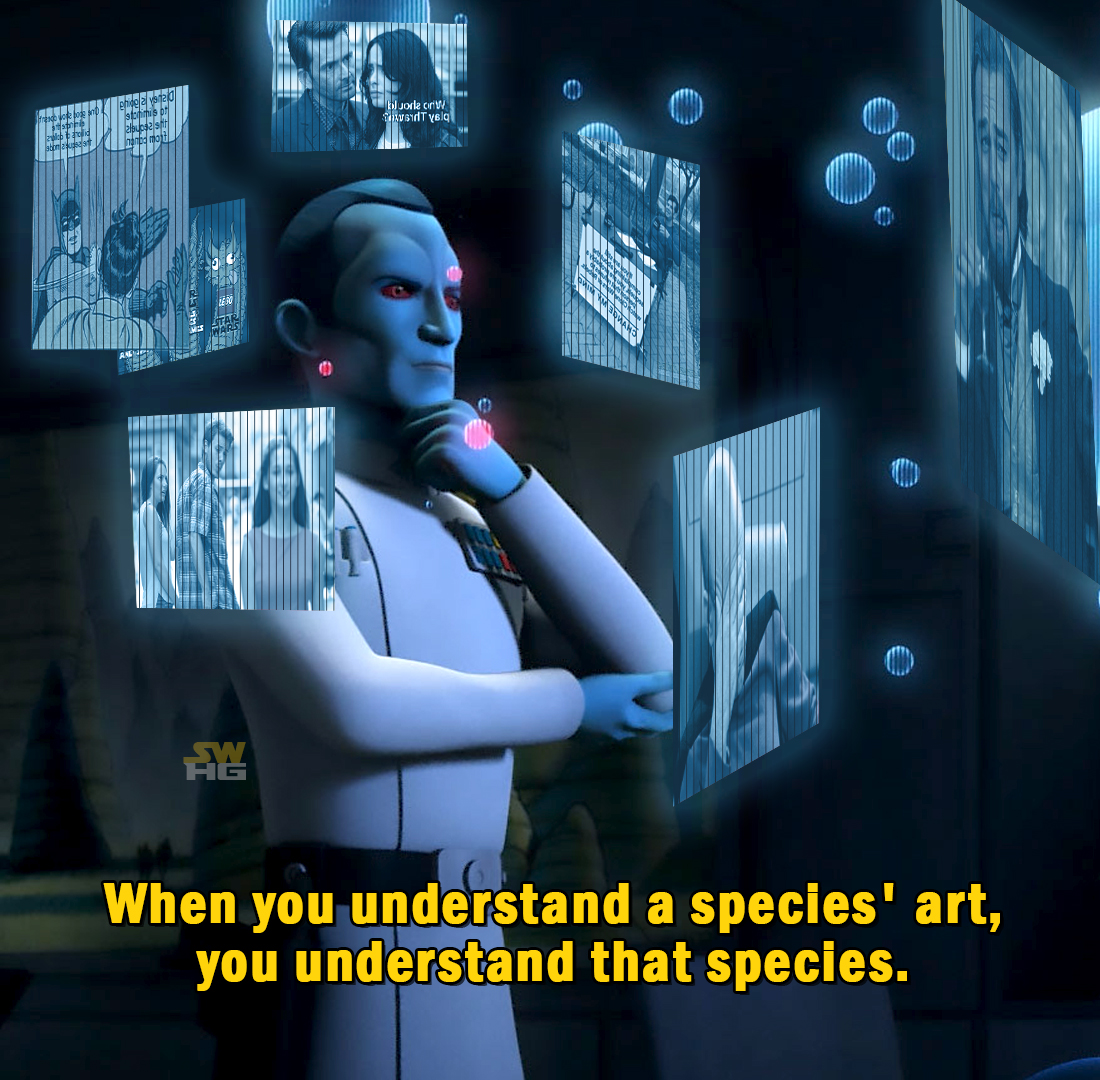
This image features Admiral Thrawn from Star Wars: The Clone Wars staring intently at a cluster of floating holographic screens. These screens display various forms of media, including scenes from The Lord of the Rings, comic book adaptations of Batman, and other characters like Harrison Ford. The yellow text at the bottom reads, "When you understand a species' art, you understand that species." The meme suggests that the visual "art" of a species—how they communicate, tell stories, and create visual language—is the fundamental key to understanding their culture, humanity, and history.
simple-description (llama3.2-vision_11b)
The meme is a still image from the Star Wars character Grand Admiral Thrawn, with a quote "When you understand the art, you understand the artist." The image shows Thrawn, a blue-skinned alien with a calm expression, surrounded by various art pieces. The quote is overlaid in a simple font, implying that Thrawn's understanding of art is also an understanding of the artists who created it.
detailed-analysis (gemma3-27b-vision)
Okay, let's break down this image using the frameworks you've requested. Note that some frameworks will be more applicable than others.
Visual Description
The image features a digitally rendered scene of a droid (likely from Star Wars: The Clone Wars) immersed in a complex, futuristic environment. The droid appears to be a tactical droid, characterized by its tall, slender build, blue coloration, and distinctive head with a red "eye" (sensor). The environment is dominated by vertical, blue glowing lines resembling a matrix or digital waterfall, with multiple illuminated screens displaying blurred images of human faces (possibly portraits or photographs). The overall atmosphere is high-tech, slightly somber, and suggestive of data analysis or surveillance. A logo ("SW") and some writing appear in the bottom left corner, confirming the image’s association with Star Wars. Below the droid, text reads, "When you understand a species’ art, you understand that species."
Foucauldian Genealogical Discourse Analysis
This image is ripe for a Foucauldian analysis. The droid's immersion in the "matrix" of faces and data streams evokes the concept of surveillance and the panopticon. The droid is not simply observing these faces; it is embedded within a system of knowledge production that categorizes and potentially controls them. The blurred faces suggest that this knowledge is fragmented, incomplete, and subject to interpretation.
The image can also be viewed through the lens of discourse. The droid’s study of “art” (represented by the faces and visual data) is not a neutral act; it's a process of constructing meaning about another species. This meaning is always tied to power relations. The droid, as a representative of a controlling power (the Separatists, in this case), is using art to define and ultimately control the species being observed. The very act of “understanding” through art becomes an exercise of power. The genealogy of this understanding would reveal how this droid's "knowledge" is shaped by its specific historical and political context.
Critical Theory
The image prompts questions central to critical theory, particularly those related to representation and othering. The droid, as a non-human entity, is attempting to "understand" a human species. This raises the question: is it even possible for one species to genuinely understand another? Is the droid's interpretation necessarily shaped by its own perspective, creating a distorted or incomplete representation? The blurred faces can be seen as a metaphor for the ways in which dominant groups often flatten or essentialize the identities of marginalized groups.
Furthermore, the image hints at the commodification of culture. The droid's study of art could be interpreted as an attempt to extract and utilize cultural knowledge for strategic purposes. This raises ethical concerns about the exploitation of art and culture by those in power.
Marxist Conflict Theory
While not the most direct fit, a Marxist reading can focus on the underlying power dynamics. The droid's study of art might be interpreted as a form of ideological control. The droid, as a representative of the Separatist forces, could be using art to justify its actions or to demonize its opponents (the Republic). The faces on the screens could represent individuals who are seen as either allies or enemies, and the droid's interpretation of their art would inevitably be shaped by these political biases. The droid’s analysis might function as a tool to maintain and expand the power of the Separatist regime.
Postmodernism
The image exhibits postmodern elements. The fragmented nature of the visuals—the blurred faces, the cascading lines—suggests a rejection of grand narratives and stable meaning. The blurring of boundaries between human and machine, and the emphasis on simulation and representation, are also characteristic of postmodern thought. The image doesn't offer a clear, objective truth about the human species; it presents a fragmented, subjective interpretation. It is a visual representation of the idea that knowledge is always provisional and contingent.
Queer Feminist Intersectional Analysis
This framework is less directly applicable, but can be layered onto the image to yield interesting insights. The idea of “understanding” a species can be examined through the lens of epistemic violence. The droid, as a product of a patriarchal and perhaps colonial power structure, is attempting to define another species, potentially silencing or misrepresenting their experiences and perspectives. The blurring of faces could also symbolize the erasure of individual identities, particularly those of marginalized groups. If we consider the species as diverse, then the droid’s monolithic "understanding" could be seen as a form of oppression. The droid’s “knowledge” might be inherently biased by its own position of power and its limited understanding of the complexities of human experience.
I hope this multi-layered analysis is helpful. Let me know if you’d like me to delve deeper into any of these frameworks.
simple-description (llama3.2-vision)
This meme is a photo of a character from the Star Wars franchise, specifically Grand Admiral Thrawn, looking at a holographic display of various Star Wars characters and planets. The text overlayed on the image reads: "When you understand a species' art, you understand that species." The meme is likely referencing the character's ability to understand and appreciate the art and culture of different species, as seen in the Star Wars: The Old Republic video game.
tesseract-ocr
wae y c.\e " | wa i ri " | | | i ad } as Vey, a ‘| | he i z ore |) Pe wii. i q i " \ > | ' f | i | i h ‘ , | I) =) | | | P| i ley L, Mea ry TENT a species’ art, yh .; that species.