First Seen
2023-05-10T21:03:42+00:00
simple-description (qwen3.5_2b-q8_0)
This meme plays on the famous "Courage to Mistake" quote attributed to the Jedi, which means you shouldn't hide errors. Since Grand Admiral Thrawn is a Sith Lord and a villain from the dark side, fans joke that he shouldn't make mistakes at all. It is a clever pun highlighting that Thrawn's power allows him to handle errors without them being considered mistakes.
simple-description (llama3.2-vision_11b)
The meme is an image of Grand Admiral Thrawn from the Star Wars franchise, with a quote overlayed on top of it. The quote reads: "The greatest trick the devil ever pulled was convincing the world he didn't exist. But I am very much alive." However, the image itself is not a direct quote from the Star Wars universe, but rather a meme that uses the quote as a reference to a fictional character.
detailed-analysis (gemma3-27b-vision)
Okay, here's an analysis of the image, broken down into sections based on the requested theoretical frameworks. I'll indicate if a section isn't applicable to the image's content.
Image Description:
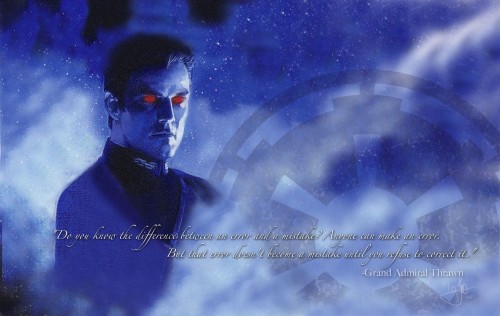
The image features Grand Admiral Thrawn, a character from the Star Wars universe, prominently displayed in a dramatically lit, space-themed composition. He is depicted in a three-quarter profile, looking slightly down and to the right. His eyes glow a bright, intense red, creating a striking and somewhat menacing effect. He's wearing a dark, high-collared uniform with what appear to be epaulettes. The background is dominated by swirling blue nebulas and stylized geometric patterns, resembling a galactic backdrop. The color scheme is predominantly blue, with contrasting red from his eyes and subtle white highlights. A quote is prominently displayed at the bottom, attributed to Thrawn: "Do you know the difference between an error and a mistake? Anyone can make an error, but that error doesn't become a mistake until you refuse to correct it." The overall aesthetic is dark, sophisticated, and evokes a sense of intellectual power and strategic thinking.
Foucauldian Genealogical Discourse Analysis:
This image, and the quote it presents, provides fertile ground for a Foucauldian analysis. The quote itself functions as a discourse – a system of thought, language, and practices that construct a particular way of understanding something. In this case, the discourse revolves around concepts of error, mistake, and correction.
- Power/Knowledge: Thrawn, as a high-ranking Imperial officer, embodies a particular form of power. His articulation of the difference between error and mistake isn't just a semantic distinction; it’s a claim about how power operates and how one should approach problem-solving. Correcting errors is not simply about achieving a desired outcome, but about maintaining control and authority – a strategic imperative for an Imperial leader. He positions himself as someone who understands this fundamental principle, thereby legitimizing his authority.
- Genealogy: A genealogical tracing could explore how the idea of strategic correction evolved within Imperial ideology. The Empire likely promoted a culture of ruthlessly eliminating perceived weaknesses (errors) to maintain its power. Thrawn’s quote can be seen as a distillation of this mindset.
- Disciplinary Power: The quote implicitly suggests a disciplinary regime. Refusal to correct an error is not simply a failure, it's a transgression that justifies intervention or even punishment. Thrawn's gaze, in the image, could be interpreted as a form of surveillance – a constant reminder that failures will be observed and addressed.
Critical Theory (Frankfurt School)
The image can be read through the lens of Critical Theory, focusing on themes of domination and ideology.
- Instrumental Reason: Thrawn, embodying a cold, calculating intellect, exemplifies instrumental reason – the use of logic and efficiency as ends in themselves, divorced from ethical considerations. The quote prioritizes "correction" as a purely strategic act, ignoring the potential for compassion or understanding.
- Culture Industry: The image itself, as a piece of fan art or promotional material, participates in the "culture industry." It creates a mythology around Thrawn, reinforcing his image as a brilliant, complex figure – potentially obscuring the brutality of the Empire he serves. It's a commodification of a character.
- Enlightenment Dialectic: The quote twists the enlightenment ideals of reason and progress. Instead of using reason to liberate, it's used to maintain control and enforce obedience. It inverts the idea of learning from mistakes into an act of resistance.
Marxist Conflict Theory:
This image, while not directly depicting class struggle, can be analyzed through a Marxist lens focusing on power dynamics within a hierarchical structure.
- Dominant Ideology: Thrawn represents the ruling class (the Imperial Navy), and his statement serves to reinforce the ideological framework that justifies their power. The distinction between error and mistake serves to justify ruthless efficiency and the suppression of dissent. Those who make errors are seen as needing "correction" (control).
- Power and Control: The entire visual composition emphasizes Thrawn's dominance and authority. The dramatic lighting, his intense gaze, and the stark background all contribute to a sense of power.
- False Consciousness: The image could be interpreted as contributing to a "false consciousness" among those who admire Thrawn. They may be drawn to his intelligence and strategic brilliance, while overlooking the moral implications of his actions and the oppressive nature of the Empire.
Postmodernism:
The image can be examined through a postmodern framework, particularly regarding the deconstruction of meaning and the blurring of boundaries between "good" and "evil".
- Deconstruction of Heroism: Thrawn is not a traditional "hero," but a complex antagonist. The image doesn't simply portray him as evil; it emphasizes his intellect and strategic thinking. This challenges the simplistic binary of good versus evil.
- Simulation & Hyperreality: The image is a representation of a fictional character within a fictional universe. It’s a layer of simulation on top of another. This can be seen as reflective of broader postmodern concerns about the loss of "authentic" experience.
- Meta-narratives: The image plays with the Star Wars meta-narrative. Thrawn, a relatively recent addition to the Star Wars canon, offers an alternative perspective on the conflict.
Queer Feminist Intersectional Analysis:
This analysis is less directly applicable to the image on its face. The image and quote don’t explicitly address gender, sexuality, or intersectional issues. However, it is possible to apply an intersectional lens to analyze the fan community surrounding the character.
- Fandom and Identity: Fan communities can become spaces for marginalized groups to find belonging and express their identities. The way fans interpret and engage with Thrawn may reveal their own experiences and perspectives.
- Subversion of Traditional Power Structures: The character, because of the way fans interact with him, can be used to subvert the original power structures of the Star Wars universe. (though this is less about the image and more about the broader fan discourse)
I hope this multi-layered analysis is helpful! Let me know if you'd like me to elaborate on any particular theoretical framework.
simple-description (llama3.2-vision)
The meme is a screenshot of a Star Wars character, likely Darth Vader, with a caption that reads: "I find your lack of faith... disturbing." The image is a play on the classic Star Wars line, but with a humorous twist, as the character is actually saying "I find your lack of memes... disturbing."
tesseract-ocr
: a PERS GM oth ae 4 OO gee ce Z — Cl oe gs : MM RL cs 51 cuba take Alynce is Oe tod off GEE hat or de atic fc ge” * « : ea