First Seen
2023-05-10T21:03:42+00:00
simple-description (qwen3.5_2b-q8_0)
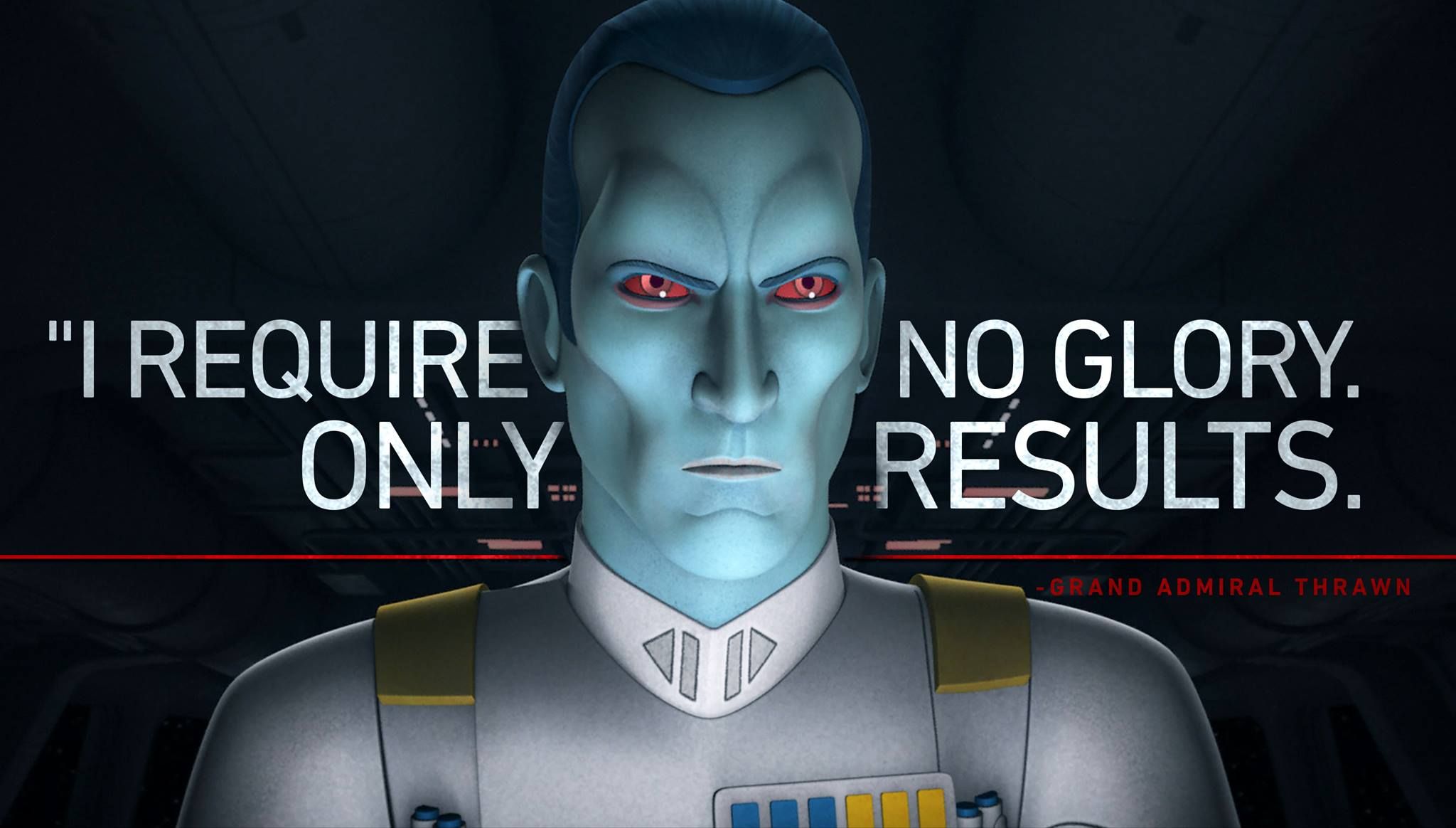
This is a funny meme from the Star Wars: The Clone Wars show featuring Grand Admiral Thrawn. He is delivering the line: "I REQUIRE NO GLORY. RESULTS." The joke is that he is humorously stating that a general doesn't care about the fame or celebration of a victory; they just want to win the battle itself.
simple-description (llama3.2-vision_11b)
The meme is an image of Grand Admiral Thrawn, a character from the Star Wars franchise, with a quote overlay that reads "I only know one thing and it's not about hope". The image is a humorous take on Thrawn's character, known for his intelligence and strategic thinking, but in this meme, he's reduced to a simplistic and clichéd phrase, poking fun at his character's complexity. The meme is likely used to express skepticism or disillusionment with overly simplistic or optimistic ideas.
detailed-analysis (gemma3-27b-vision)
Okay, let's break down this image of Grand Admiral Thrawn, utilizing the frameworks requested. Some frameworks will be more applicable than others, and I'll explain when that's the case.
Image Source: This is a promotional image for Star Wars Rebels depicting Grand Admiral Thrawn, a character known for his strategic brilliance and calculated ruthlessness.
Visual Description
The image is a medium close-up of Grand Admiral Thrawn’s face and upper body. His skin is a distinct blue, and his eyes are a piercing red. He's depicted in the Imperial uniform, a dark-colored outfit with gold accents and rows of service medals. The lighting is dramatic, emphasizing the planes of his face and suggesting a sense of power and intensity. The background is blurred and dark, appearing to be an Imperial ship’s interior. The image is overlaid with the quote "I REQUIRE ONLY NO GLORY. RESULTS." in bold, white lettering, with “– Grand Admiral Thrawn” below. The overall effect is designed to project an image of cold, calculating competence and a focus on pragmatism over idealistic pursuits.
Foucauldian Genealogical Discourse Analysis
This framework really shines in analyzing Thrawn and his statement. Michel Foucault was interested in how discourses (systems of thought, language, and practice) create power relations and shape our understanding of the world.
- Discipline and Panopticism: Thrawn represents a very disciplined form of power. He isn't driven by emotional outbursts or grandstanding, but by a meticulous, analytical approach. This is similar to the “panoptic” structure Foucault described – a system where individuals internalize surveillance and self-regulate to avoid punishment or disapproval. Thrawn's efficiency and focus on outcomes could be seen as a kind of internalized discipline applied to the entire Imperial force.
- Genealogy of 'Results': The emphasis on “results” over "glory" is telling. A genealogical investigation might ask how the concept of "results" became prioritized within the Imperial discourse. This could tie into the Empire's attempt to create a utilitarian system of control, valuing demonstrable efficacy over traditional notions of honor or heroism. The quote suggests a rejection of the Jedi’s often performative heroism.
- Power/Knowledge: Thrawn's power is directly tied to his knowledge. He doesn't rely on the Force, but on understanding his opponents' art, culture, and psychology. This aligns with Foucault's idea that power and knowledge are inseparable - knowledge is a form of power, and power shapes what is considered knowledge. The Imperial Academy’s emphasis on data and analysis would support this.
Critical Theory (Frankfurt School)
This is a good lens, especially if we consider the Empire as a representation of instrumental rationality.
- Instrumental Rationality: Critical Theorists like Max Horkheimer and Theodor Adorno critiqued the dominance of "instrumental rationality" – the idea that everything has a purpose and can be calculated for maximum efficiency. Thrawn embodies this perfectly. He doesn't care why something is done, only that it is done effectively. This can lead to dehumanization, as anything not contributing to the goal is disregarded.
- Domination and Control: The Empire, as a whole, is a system of domination. Thrawn's focus on results is a means of maintaining and expanding that domination. He's not interested in liberation or empowerment, but in control.
- Reification: The Empire, and Thrawn within it, treat individuals and cultures as "objects" to be analyzed and manipulated for strategic gain. This is a form of reification - turning people into things - and a key element of the Empire’s oppression.
Marxist Conflict Theory
While less central than the previous analyses, Marxist frameworks can still be applied.
- Class Struggle (Simplified): The Star Wars universe demonstrates a conflict between the Empire (representing a ruling class seeking to maintain power and control resources) and the Rebellion (representing those struggling against oppression). Thrawn is a key figure in the Empire’s efforts to maintain that hierarchy.
- Ideology: The Empire's ideology, though not explicitly stated, is based on order, control, and the suppression of dissent. Thrawn's quote could be seen as reinforcing this ideology – it implies that individual ambition or glory are irrelevant, only obedience to the established order matters.
- Means of Production/Control: The Empire controls the means of production (ships, weapons, resources) and, crucially, the means of control. Thrawn's strategic genius allows the Empire to maintain its dominance over these means, effectively exploiting resources and populations for its own benefit.
Postmodernism
Postmodernism can be applied, but with caution, as Star Wars is fundamentally a narrative with a clear "good vs. evil" dichotomy. However:
- Rejection of Grand Narratives: The Empire attempts to create a grand narrative of order and control, but Thrawn's pragmatism can be seen as undermining this. He doesn't believe in inherent "good" or "evil," only in effective strategy. This is a postmodern rejection of absolute truth.
- Simulacra and Simulation: (Jean Baudrillard) One could argue that the Empire's power is based on simulations of control—projecting an image of invincibility and order that masks underlying vulnerabilities. Thrawn understands these simulations and uses them to his advantage.
- Deconstruction: Thrawn "deconstructs" his enemies' tactics, breaking down their strategies to understand their weaknesses. This aligns with the postmodern practice of challenging established systems of thought.
Queer Feminist Intersectional Analysis
This is the most challenging application, but offers interesting possibilities.
- Disrupting Traditional Power Structures: Thrawn, as a non-human, challenges the predominantly human power structure of the Empire, even if he ultimately serves it. This can be seen as a disruption of the assumed "natural" order.
- Performance of Masculinity: The Imperial uniform and Thrawn’s stoic demeanor perform a specific, highly controlled form of masculinity. This can be analyzed through a feminist lens, examining how this performance reinforces patriarchal power structures.
- Intersectional Oppression: While Thrawn is a figure of power, examining the perspectives of those under Imperial control reveals intersecting forms of oppression – based on species, gender, class, and other factors. However, this requires moving beyond the image itself and considering the broader narrative. The focus here would be on how Thrawn contributes to systems of oppression affecting marginalized groups.
Hopefully, this provides a nuanced breakdown of the image and its possible interpretations using the requested frameworks. Let me know if you'd like me to elaborate on any specific section.
simple-description (llama3.2-vision)
This meme is an image of the character General Grievous from the Star Wars franchise, with a quote from the character in the background. The quote reads: "I find your lack of faith disturbing."
tesseract-ocr
"T REQUIRE |e Le NO GLORY. ONLY: — RESULTS.