First Seen
2023-05-10T21:03:41+00:00
simple-description (qwen3.5_2b-q8_0)
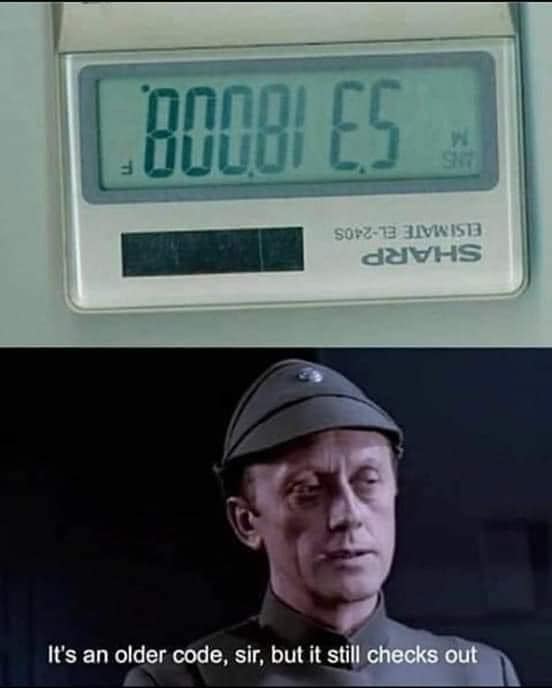
The image features a digital thermometer from the Star Wars franchise (specifically the Revenge of the Sith movie meter) with the text "ESTIMATE EL-240S" and "SHARP ESTIMATE EL-240S". The display shows a temperature reading of 53.18°F.
At the bottom of the image, the text reads:
"It's an older code, sir, but it still checks out."
This text is a Star Wars reference play on the temperature scales used in the movie franchise.
The Explanation:
* "It's an older code": This refers to the traditional Celsius temperature scale (often associated with the historical Star Wars temperature meter or the "older system"). In this context, it implies a standard, historical temperature reading.
* "Star Wars": The display shows a temperature in Fahrenheit (53.18°F). In the Star Wars context, the "Revenge of the Sith" meter uses a specific Fahrenheit scale that spans from -134°F to 127°F, distinct from standard Celsius.
* "It still checks out": This phrase suggests that while the "code" (Celsius scale) reads a lower value (historical), when converted to the Star Wars specific Fahrenheit scale, the reading (53.18°F) represents a significant temperature, although it is technically cool (a lukewarm day), confirming the validity of the reading despite the confusing scale.
The joke plays on the confusion of temperature scales, suggesting that a low number on the "code" scale translates to a valid, albeit seemingly unrelated, temperature on the "Star Wars" meter.
simple-description (llama3.2-vision_11b)
The meme is an image of a Star Wars character, Grand Moff Tarkin, with a quote overlayed on top of it. The quote reads: "This is the way the [file] ends." It's a play on the famous Star Wars quote "This is the way the [file] ends. Not with a bang, but a whimper" by T.S. Eliot, but with a humorous twist referencing a file ending in a programming context.
detailed-analysis (gemma3-27b-vision)
Okay, let's break down this meme with a critical lens, applying the requested theoretical frameworks where relevant.
Visual Description
The meme is a two-panel image. The top panel depicts a digital scale displaying a significant and arguably alarming number (800.05). The scale appears old, indicated by the pixelated display and faded color. The bottom panel features a still from Star Wars: The Empire Strikes Back depicting Grand Moff Tarkin, a high-ranking Imperial officer, looking somewhat dubious. Below Tarkin's image is the text, "It's an older code, sir, but it still checks out." The juxtaposition is designed to be humorous, equating the potentially concerning scale reading with an antiquated but functional system.
Foucauldian Genealogical Discourse Analysis
This meme is very ripe for Foucauldian analysis. The scale, a tool of measurement, embodies power/knowledge. Michel Foucault argued that knowledge isn't neutral, but inextricably linked to power. This scale defines "weight" and creates a discourse around "healthy" or "unhealthy" weight.
- Discourse of the Body: The scale participates in the historical discourse surrounding bodies, normalizing certain weights and pathologizing others. The high number displayed on the scale evokes anxiety around body image and health.
- Genealogy of the Scale: We could trace the genealogy of the scale – how measuring devices evolved, how the concepts of "weight" and "BMI" became dominant, and how this data became a component of medical and social control.
- Power Dynamics: The scale exercises power by categorizing and judging. It creates a system where individuals are positioned as "overweight," "underweight," or "normal." The meme leverages this with a potentially concerning result.
Tarkin's line, "It's an older code, sir, but it still checks out," is crucial. It suggests a tolerance for even antiquated systems as long as they function to reinforce the established order. The "code" can be interpreted as the historical, cultural, and medical discourses that define “weight.” The fact that it "checks out" is disturbingly suggestive that even problematic systems are acceptable as long as they maintain control.
Critical Theory
From a broader Critical Theory perspective, the meme critiques the instrumental rationality of modern systems. The scale is a tool designed to optimize and control (in this case, body weight), but it becomes a source of anxiety and potentially harmful self-assessment.
- The Culture Industry: We can see the scale as part of the culture industry, producing and perpetuating standards of beauty and health that are often unattainable and contribute to feelings of inadequacy.
- Alienation: The focus on numerical measurement alienates us from our bodies, reducing us to data points rather than holistic beings.
- Ideology: The scale reinforces the ideology that "more" is often better (in terms of health), creating a constant need to improve and measure oneself.
Marxist Conflict Theory
While subtle, a Marxist reading is possible. The emphasis on self-optimization and control through measurement can be linked to the pressures of capitalist society.
- Commodification of the Body: The pursuit of an "ideal" body weight is often driven by consumer culture, with industries profiting from diet products, exercise equipment, and cosmetic procedures.
- Social Stratification: Body image standards can contribute to social stratification, where individuals who conform to these standards are privileged, while those who do not face discrimination and marginalization.
- False Consciousness: The acceptance of these standards can be seen as a form of false consciousness, where individuals internalize ideologies that are detrimental to their well-being.
Postmodernism
A postmodern reading would focus on the breakdown of grand narratives and the rejection of objective truth.
- Deconstruction of "Health": The meme implicitly questions the notion of "health" as a fixed or objective concept. What constitutes "healthy" weight is culturally constructed and subject to change.
- Simulacra and Simulation: The scale reading, and the anxiety it provokes, can be seen as a simulacrum—a representation that has no original. The number itself has no inherent meaning, but is assigned meaning by societal conventions.
- Irony and Parody: The juxtaposition of the alarming scale reading with Tarkin’s calm acceptance is ironic. It parodies the tendency to rely on outdated and potentially flawed systems.
Queer Feminist Intersectional Analysis
This is where the meme gets interesting. The scale inherently participates in patriarchal and heteronormative beauty standards.
- Body Policing: Scales play a role in the historical and ongoing body policing of women, where their bodies are subject to scrutiny and judgment based on societal expectations.
- Intersectional Oppression: The impact of body image standards is compounded for individuals who experience other forms of oppression, such as race, class, and disability. The scale does not account for diverse body types and needs.
- Rejecting Normativity: A queer feminist analysis would challenge the notion that there is a "normal" or "ideal" body weight, celebrating body diversity and resisting the pressure to conform. The meme, with its ironic acceptance of a questionable reading, can be seen as a subtle challenge to these norms.
In conclusion, the meme, while seemingly simple, is surprisingly rich in potential meanings. It highlights the ways in which seemingly neutral tools can participate in systems of power, control, and oppression. It also invites us to question the narratives that shape our understanding of bodies, health, and normalcy.
simple-description (llama3.2-vision)
This meme is a screenshot of a character from the movie "Star Wars: The Force Awakens" (K-2SO, a reprogrammed Imperial droid) responding to a piece of code that looks like gibberish. The text overlay on the image reads: "It's an old code, but it still checks out." The meme is likely used to express skepticism or confusion when encountering unfamiliar or outdated technology.
tesseract-ocr
tte on Bits cca It's an eer code, sir, ts ies)