First Seen
2023-05-10T21:03:41+00:00
simple-description (qwen3.5_2b-q8_0)
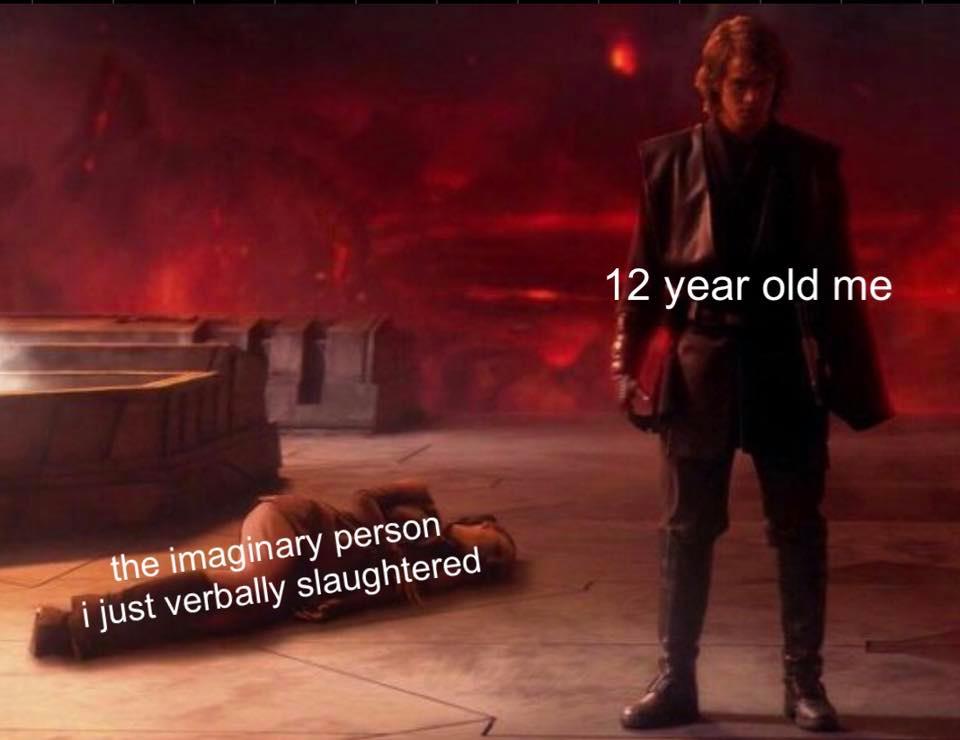
This Star Wars meme features Anakin Skywalker and Ahsoka Tano. It jokes about the character Anakin playing a role, suggesting he verbally "slaughtered" the imaginary person he portrayed in a script. The text on the image reads: "12 year old me" and "the imaginary person i just verbally slaughtered."
simple-description (llama3.2-vision_11b)
The meme is a screenshot from the Star Wars film "A New Hope," where a young Luke Skywalker confronts Darth Vader. The image shows Luke standing over Vader's lifeless body, with Vader's iconic line "No, I am your father" written below. In the context of the meme, the image is used to illustrate the idea that a person's inner child is the part of themselves that they've been avoiding or ignoring, much like Luke's confrontation with his father's dark past.
detailed-analysis (gemma3-27b-vision)
Okay, let's break down this image with the requested theoretical lenses. Given the image and captions, several lenses apply quite powerfully.
Visual Description
The image depicts Darth Vader, the iconic villain from Star Wars, in a dramatic, imposing pose. He is standing in a dimly lit, red-hued room that appears to be an interrogation space. The lighting is very directional, casting strong shadows and highlighting his dark, sleek armor. The overall effect is one of menace and power. In the foreground, we see a partially obscured figure, presumably representing a victim of verbal abuse based on the added text. The caption "the imaginary person I just verbally slaughtered" is directed at this figure, and the caption “12 year old me” is directed at Darth Vader.
Foucauldian Genealogical Discourse Analysis
This image lends itself strongly to a Foucauldian analysis.
- Power/Knowledge: The image visualizes the operation of power through discourse. Darth Vader doesn't necessarily use physical force in the image; he stands as the embodiment of power, and the caption indicates that power is exercised through verbal "slaughter." Foucault argued that power isn't simply repressive; it produces knowledge and subjects. The "imaginary person" is created/defined through the act of verbal domination.
- Discourse & Subjectivity: The discourse (verbal abuse) shapes the subjectivity of the "imaginary person" and, potentially, the speaker ("12 year old me"). The act of verbal violence creates a power dynamic where one individual asserts dominance by diminishing another. The speaker’s identity may have been built, in part, through performing this domination.
- Genealogy: We can trace the "genealogy" of this power dynamic. The image alludes to the historical and cultural context of bullying, power imbalances, and the normalization of aggressive behavior, potentially stemming from societal expectations of masculinity or competition.
Critical Theory
The image is very strong when viewed through a Critical Theory lens.
- Dominant Ideology: The image suggests a critique of dominant ideologies that allow for/encourage abusive behavior, particularly in childhood. The casual use of the term "slaughter" indicates a normalization of violent language and a devaluation of the "imaginary person's" agency and worth.
- Power Relations: The image explicitly highlights unequal power relations. Darth Vader represents a figure of absolute power, and the "imaginary person" is rendered helpless and victimized. This reinforces the idea that power structures are often built on domination and exploitation.
- Hegemony: The act of “verbal slaughter” can be seen as an attempt to establish hegemonic control. By diminishing the other, the speaker seeks to assert their dominance and maintain their position within a power structure.
Marxist Conflict Theory
While not as overtly Marxist as some images, conflict theory can be applied:
- Class/Power Struggle: The image represents a micro-level power struggle. The "imaginary person" can be seen as representing the oppressed, while Darth Vader/the speaker represents the oppressor.
- Ideological Control: The act of "slaughtering" could be seen as an attempt to impose the speaker's ideology on the "imaginary person," suppressing their own thoughts and beliefs.
- Alienation: The "imaginary person" is alienated from their own voice and agency, effectively silenced by the speaker's power.
Postmodernism
Postmodern analysis focuses on deconstruction and challenging grand narratives.
- Deconstruction of Identity: The image suggests the fluidity and constructed nature of identity. The "imaginary person" is, literally, a figment of the speaker’s imagination, highlighting the constructed nature of self and other.
- Challenge to Authority: By presenting Darth Vader as a perpetrator of verbal abuse, the image subverts the traditional heroic narrative and questions the legitimacy of power structures.
- Simulacra and Simulation: The “imaginary person” can be seen as a simulacrum – a copy without an original. The speaker is directing aggression at a projection, suggesting a detachment from reality and a reliance on constructed representations.
Queer Feminist Intersectional Analysis
This lens is potent, though requires a bit more interpretation.
- Power & Gender Performance: Darth Vader, as a traditionally masculine figure, embodies power often associated with toxic masculinity. The act of "slaughtering" could be interpreted as a performance of dominance rooted in patriarchal expectations.
- Silencing & Marginalization: The "imaginary person" represents someone who is being silenced and marginalized by the speaker's power. This can be linked to the broader experiences of those who are historically oppressed and marginalized.
- Intersectionality: It is important to recognize that the "imaginary person" may experience multiple forms of oppression based on their intersectional identities (e.g., race, class, sexual orientation, gender identity). The act of verbal abuse may be amplified by these intersecting systems of power.
I hope this detailed breakdown is helpful! Let me know if you'd like me to elaborate on any of these analyses.
simple-description (llama3.2-vision)
This meme is a humorous take on the idea of being haunted by one's own past. The image depicts a scene from the Star Wars franchise, where Anakin Skywalker (Darth Vader) is standing over the body of a young Padawan learner. The text overlayed on the image reads "In 2-3 sentences, describe this meme for someone who cannot see it. Include any text that appears in the image."
In reality, the meme is a play on the phrase "I'm not a child, I'm a highly trained killer" and is captioned "I was a 10 year old in a 30 year old's body".
tesseract-ocr
43 , LJ bp "= i sit : vt | — Dea . fe Ls .& f > 4 = _— Ce j Secale Wectaies ee = a