First Seen
2023-05-10T21:03:41+00:00
simple-description (qwen3.5_2b-q8_0)
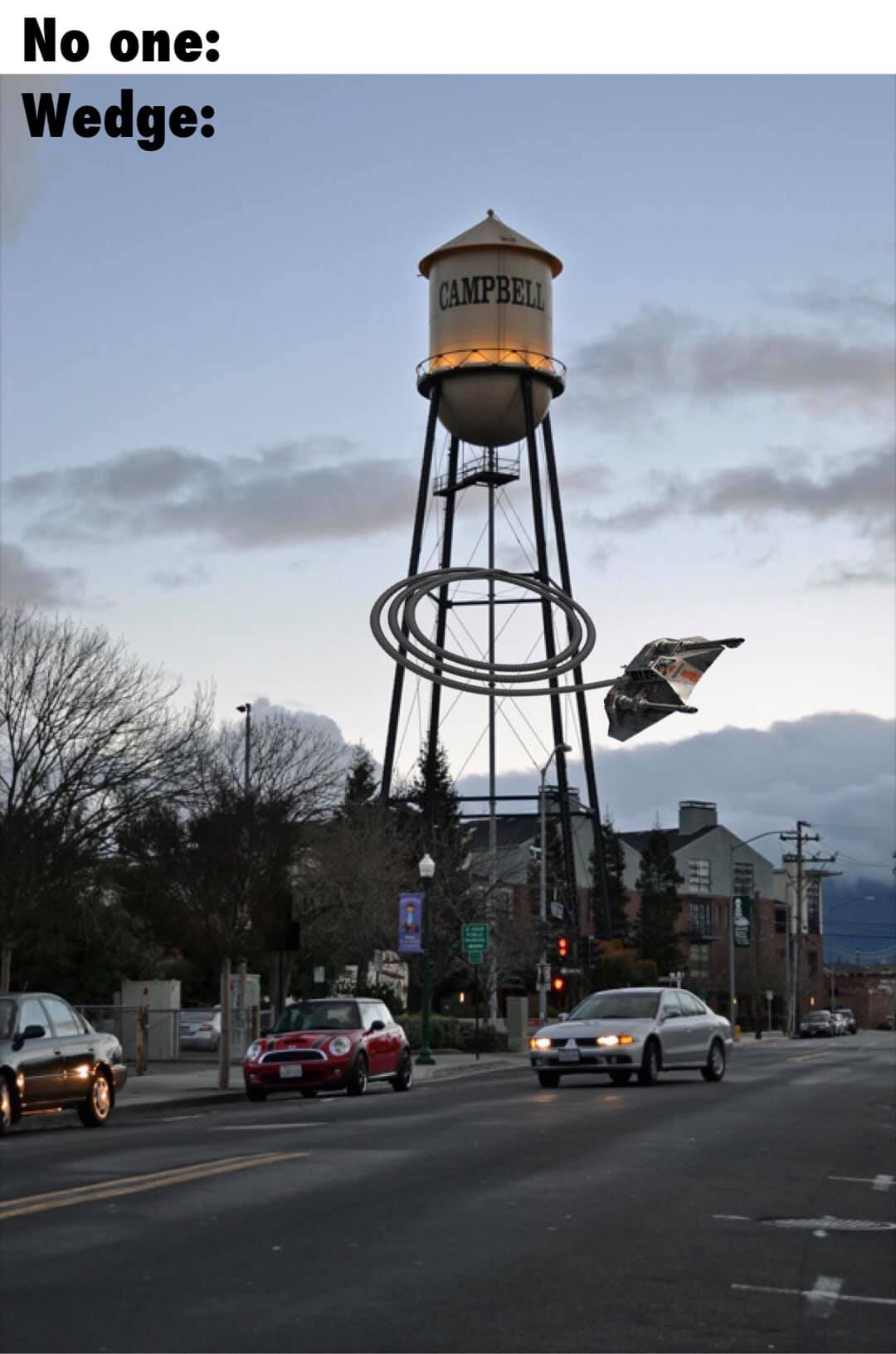
This Star Wars meme features the bounty hunter Wedge Antilles, the bounty hunter. The text "No one: Wedge" is a play on the famous "No one is no one" internet phrase, jokingly attributing it to Wedge. In the background, you can see the real-life Campbell, Washington water tower with a large spiral structure and an X-Wing spaceship orbiting it, creating a surreal mix of reality and space travel.
simple-description (llama3.2-vision_11b)
This meme is from the Star Wars category and is a play on the phrase "I am your father" from the Star Wars film. The image depicts a scene from the movie, but with a twist: the character of Yoda is holding a sign that says "I am your father" and is standing in front of a building that says "Dagobah". The meme is poking fun at the idea that Yoda is a wise and powerful Jedi master, but is also somehow connected to the character of Darth Vader, who is also a master of the dark side.
detailed-analysis (gemma3-27b-vision)
Okay, here's an analysis of the image, broken down into the requested sections, where applicable. It's important to note that applying these frameworks can be interpretive, and multiple readings are possible.
Visual Description
The image depicts a street scene dominated by a large water tower labeled “Campbell.” The water tower is constructed of a lattice of metal supports, giving it a skeletal, industrial aesthetic. It is tan/beige in color, and it tapers as it rises. A slightly torn American flag is partially visible, flapping near the top of the structure. The sky is overcast and a muted grey, suggesting a cloudy day.
Below the tower is a typical American street scene with traffic: a white van, a red sports car, and a white sedan are visible. There is a traffic light. The buildings in the background are a mix of low-rise commercial and residential structures, typical of a small to medium-sized American town. The overall impression is one of a somewhat subdued, ordinary landscape, with the water tower serving as a notable landmark.
Foucauldian Genealogical Discourse Analysis
The water tower itself functions as a potent symbolic object that can be analyzed through a Foucauldian lens. Initially, it represents power/knowledge. The tower’s height and positioning exert a spatial dominance, implying control (of water, and by extension, resources and the population).
A genealogical investigation would trace the historical emergence of water towers like this. They arose alongside the burgeoning field of public health and urban planning in the 19th and early 20th centuries. This development was intertwined with discourses around sanitation, hygiene, and the control of disease – discourses that were productive in defining and normalizing standards of public health. The tower isn't just about practical water storage; it embodies the technologies of power employed to regulate the population.
The slightly tattered American flag introduces a further layer. It represents a discourse of nationalism, a constructed narrative about belonging and identity. The flag's state—not pristine, but slightly torn—suggests an erosion of those narratives, or perhaps a complex, imperfect relationship with them. Examining how this image speaks about American identity and civic life reveals the power relations embedded within that imagery.
Marxist Conflict Theory
From a Marxist perspective, the image highlights several aspects of class and economic relations.
The water tower, while seemingly neutral, represents infrastructure – a crucial component of the means of production. Access to clean water is fundamental for sustaining the labor force. The tower, therefore, indirectly supports the capitalist system by enabling production.
The cars in the foreground symbolize consumerism and the individual's participation in the capitalist economy. The fact that they are relatively modern vehicles suggests a certain level of economic prosperity within the town.
While the image doesn’t explicitly depict overt class conflict, it can be interpreted as representing the material conditions of life within a capitalist society. The quiet, orderly scene could be seen as a facade concealing underlying economic inequalities.
Postmodernism
The image lends itself to a postmodern reading in several ways. The water tower, an object originally intended for a utilitarian purpose, is rendered hyperreal by the photograph – its image is detached from its function and presented as a spectacle.
The juxtaposition of the industrial water tower and the everyday street scene creates a sense of fragmentation. It is an ordinary American landscape, but the tower introduces a discordant element.
The slightly tattered American flag, as mentioned before, contributes to the postmodern sensibility. It disrupts the cohesive narrative of national identity, hinting at a lack of fixed meaning or truth. The image can be seen as a deconstruction of the American landscape—a questioning of its supposed authenticity.
Critical Theory
From a critical theory perspective, the image can be seen as reinforcing certain social norms and ideologies. The town's “ordinariness” and lack of visible diversity or social unrest contribute to a sense of ideological hegemony. The image appears to naturalize a particular way of life, obscuring underlying power dynamics.
The water tower, as a symbol of public infrastructure, can be interpreted as representing the state's capacity for surveillance and control. It is a constant, looming presence, subtly reminding citizens of the authority of the government.
The image may reproduce a comforting, idealized vision of American small-town life, masking the social and economic problems that may exist beneath the surface.
Disclaimer: These analyses are based on interpretation and are open to debate. Different readings are possible depending on one's theoretical framework and perspective.
simple-description (llama3.2-vision)
This meme is a play on the phrase "In a world..." often used in movie and book introductions, but with a humorous twist. The image shows a small town with a giant, monstrous, and seemingly impossible object (a giant robot or a spaceship) hovering above it. The text at the top reads "In a world where...".
tesseract-ocr
No one: Wedge: (ie a. a) ma UL SS fy BY We QT Wy i Wy, / SS a i FA ay On hile, he di le ee) LM é [ = =] _* a4 My = st fae si a HY ‘ll r aR ‘a wa , ‘ a j >) i ees - * aes = - a ——