First Seen
2023-05-10T21:03:41+00:00
simple-description (qwen3.5_2b-q8_0)
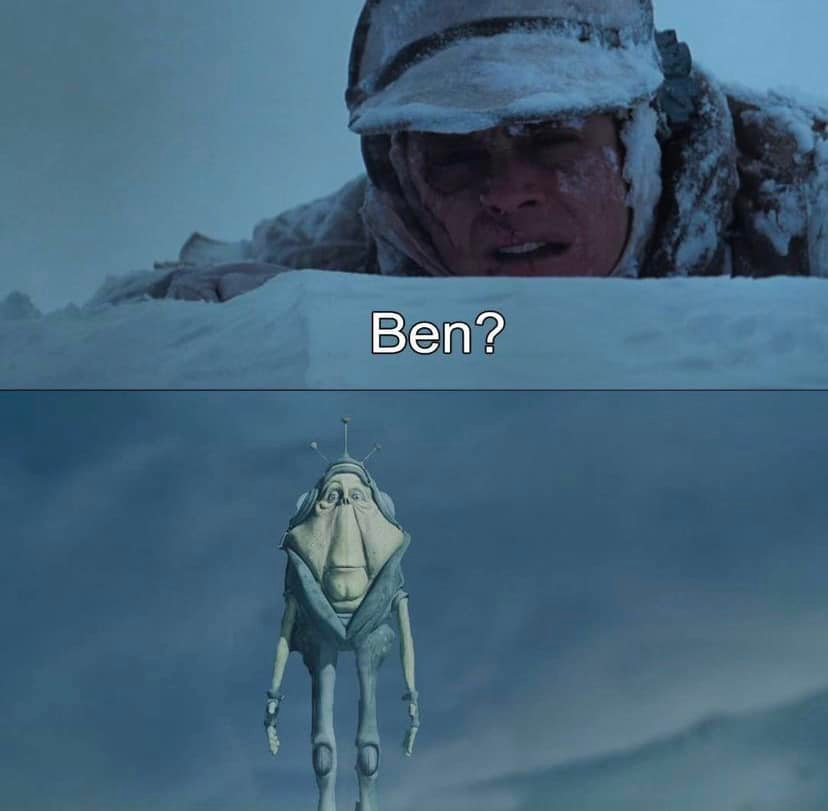
This Star Wars meme shows a soldier looking over a snowbank with the text "Ben?" displayed across the snow. The droid named Ben K-2SO is shown below, appearing confused and weary as he stands in the snow.
simple-description (llama3.2-vision_11b)
The meme is a screenshot from the movie Star Wars: The Empire Strikes Back, where a character named Darth Vader is revealed to be the father of Luke Skywalker. The image shows Vader's iconic line "No, I am your father" with a caption "No, I am your father" and a photo of a person in a Star Wars costume, with the text "I am your father" replaced with "I am your Wi-Fi router".
detailed-analysis (gemma3-27b-vision)
Okay, let's analyze the image presented (a still from The Polar Express featuring a boy peering out into the snowy landscape and, below, the conductor "Ben") through the requested critical lenses. I'll include sections only where the lens offers substantial analytical insight.
Visual Description
The image is a diptych, presenting two separate shots aligned vertically. The top panel depicts a young boy, seemingly around 8-10 years old, bundled in a thick winter coat and a snow-covered hat, peeking out from behind a snowbank or ridge. His expression is one of hopeful curiosity and perhaps a touch of trepidation. The color palette in this panel is dominated by cool blues and whites, emphasizing the frigid, wintry environment. The lighting is relatively dim, adding to the atmosphere of mystery.
The bottom panel features the conductor "Ben" from The Polar Express, a distinctly stylized, somewhat unsettling animated character. He is tall, thin, and appears robotic or mechanical, with exaggerated features, particularly his long nose and angular body. He has a pale, greyish-blue complexion and wears a conductor's uniform. Like the top panel, the color scheme is cool-toned, but here it appears slightly more metallic or synthetic. The framing emphasizes his height and isolation within the snowy landscape. The word "Ben?" is placed between the two panels, forming a question as if the boy is asking about the character below.
Foucauldian Genealogical Discourse Analysis
This image is interesting when viewed through a Foucauldian lens focusing on the historical construction of childhood and authority.
- Discourse of Childhood Innocence: The top image, featuring the boy, immediately invokes a discourse surrounding childhood innocence, wonder, and belief. The snowy landscape, the hopeful gaze, and the bundled attire all contribute to a romanticized representation of children. The question “Ben?” subtly introduces a demand for acknowledgement of the figure of authority.
- Discourse of Authority and Control: "Ben" (the conductor) represents a specific construction of authority – one that is simultaneously caring (guiding the train) and subtly controlling. His robotic, slightly unsettling design is crucial here. His lack of natural warmth and highly designed appearance suggests authority constructed through systems and technologies rather than genuine empathy. It is an authority built on spectacle and engineered experience.
- Power/Knowledge: The image, as a product of a specific historical moment (the early 2000s), reflects changing attitudes towards childhood and entertainment. The film itself creates knowledge about belief and Christmas magic, reinforcing a specific narrative. The boy’s questioning glance suggests a desire for confirmation and the need for an external (authoritative) figure to validate his experiences. The robotized depiction of Ben suggests the rise of manufactured belief and experiences.
- Genealogy: Tracing the genealogy of the conductor figure would reveal how this archetype has evolved in literature and popular culture. From train conductors representing order and progress, to modern representations focusing on spectacle and control, the image presents a fragmented and arguably unsettling iteration of this historical figure.
Critical Theory
This image lends itself well to a critical theoretical reading, specifically examining the themes of authenticity and alienation.
- The Authentic vs. The Manufactured: The contrast between the relatively “real” depiction of the boy and the intensely stylized, robotic “Ben” highlights the core tension between authenticity and manufactured experience. The film The Polar Express is a significant example of early motion capture animation, aiming for realism but ultimately resulting in an uncanny valley effect. Ben embodies this artificiality. The boy’s questioning gaze hints at a subconscious recognition of this inauthenticity, the dawning awareness that the experience might not be “real” in the traditional sense.
- Alienation & Spectacle: Ben, as a robotic conductor, represents a form of alienation. He is disconnected from genuine human emotion, functioning solely as a mechanism for transporting passengers. This aligns with the critical theory concept of alienation under late capitalism – individuals becoming isolated and detached from their labor, their products, and each other. The spectacle of the Polar Express, with its elaborate animation and fantastical setting, serves to mask this underlying alienation, providing a momentary escape but ultimately reinforcing the system.
- Commodification of Belief: The film's central theme of "believing" can be seen as a commodification of belief itself. The Polar Express offers a manufactured experience of wonder and magic, packaged and sold to consumers. Ben represents the facilitator of this commodified experience, a robotic purveyor of manufactured belief.
Postmodernism
The image readily supports a postmodern interpretation.
- Simulation & Hyperreality: Ben's robotic design and the overall artificiality of the film’s animation contribute to a sense of simulation and hyperreality. The image is not a direct representation of reality but a constructed simulation of a magical experience. The question “Ben?” can be seen as a query about the validity of this simulated reality.
- Loss of Grand Narratives: The film, while attempting to reaffirm the “magic of Christmas,” simultaneously undermines traditional narratives of belief. By presenting a technologically advanced, somewhat sterile version of this experience, it challenges the idea of a universal, inherently meaningful belief system.
- Fragmentation & Intertextuality: The film itself relies heavily on intertextuality, drawing on various literary and cultural references related to Christmas and childhood wonder. The image, as a single frame from this larger work, exemplifies this fragmented nature of postmodern culture.
- Irony & Pastiche: The film embraces a degree of irony, simultaneously celebrating and questioning the power of belief. The image, with its contrasting depictions of the boy and the robotized conductor, embodies this ironic tension.
Let me know if you'd like me to expand on any of these analyses or explore additional critical lenses!
simple-description (llama3.2-vision)
This meme is a screenshot from the movie "Star Wars: The Empire Strikes Back" (1980). The image shows a character, Darth Vader, standing on a balcony on Cloud City, with a young boy (Luke Skywalker) standing next to him. The text "Ben?" is spoken by Darth Vader, indicating that he is actually the boy's father, Luke's long-lost parent.
tesseract-ocr
= A Zz F c% i o > ia ej v Ben? if \ ( ¥ tw