First Seen
2023-05-10T21:03:41+00:00
simple-description (qwen3.5_2b-q8_0)
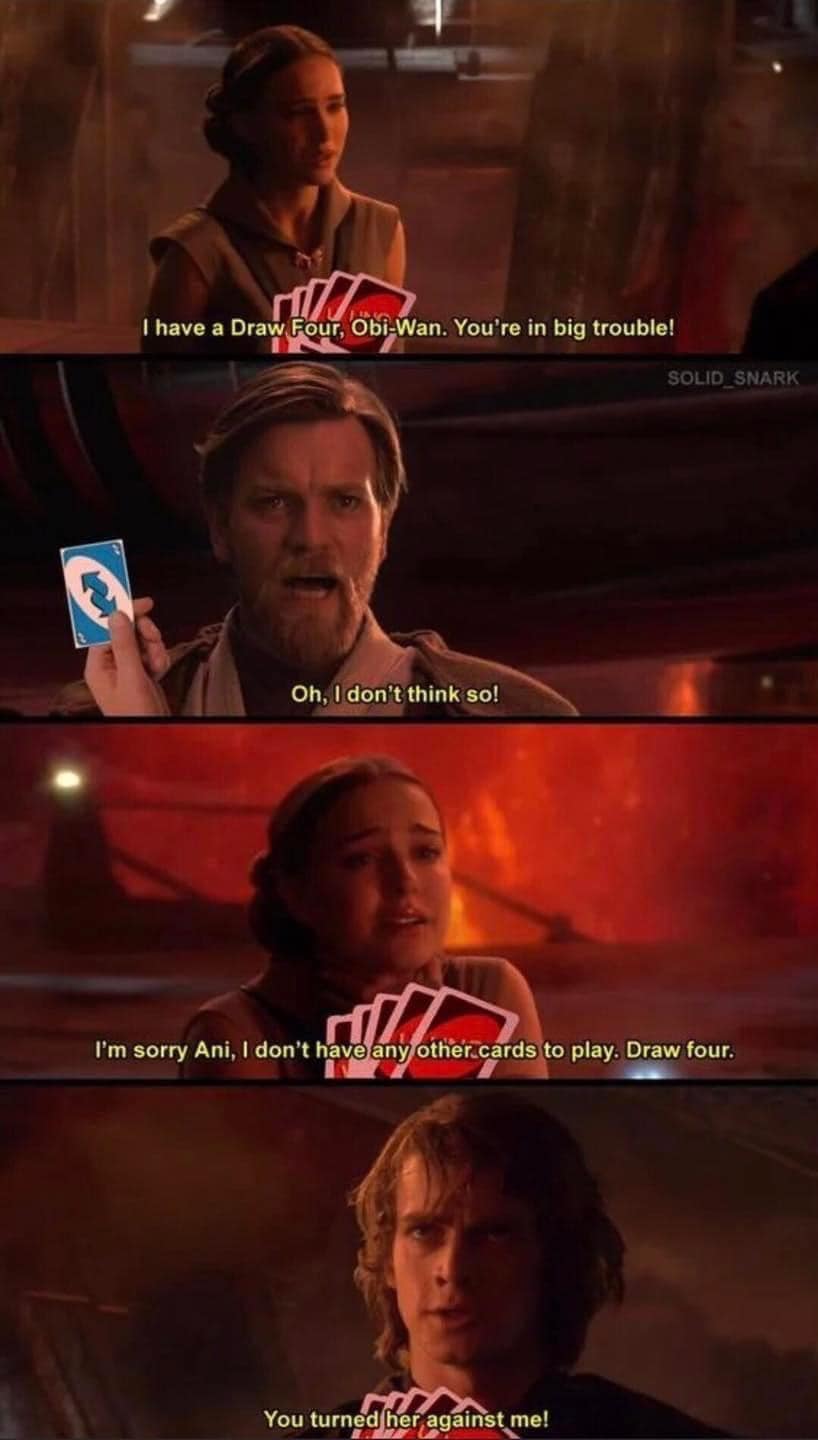
This meme is a humorous parody of a scene from Star Wars (specifically referencing Knights of the Old Republic or The Last Jedi), featuring Obi-Wan Kenobi and Anakin Skywalker.
Since I cannot see the actors' faces or body language, the meaning is told entirely through the text dialogue. A character named "Ani" holds up a "Draw Four" card and claims Obi-Wan is in trouble. Obi-Wan, who is unable to read or hear, misunderstands the situation and says, "Oh, I don't think so!" When she explains she has no other cards to play, Anakin Skywalker immediately gets angry and accuses her of turning her friend against him.
simple-description (llama3.2-vision_11b)
The meme is a scene from the movie Star Wars: Episode III - Revenge of the Sith, where Obi-Wan Kenobi and Anakin Skywalker (Darth Vader) play a game of Dejarik, a holographic game, but instead of Dejarik, they are playing a game of cards. Obi-Wan says "I have made a great mistake" and "I have failed" after Anakin wins the game, implying that he has lost to his son.
detailed-analysis (gemma3-27b-vision)
Okay, let's break down this meme of a Star Wars scene re-imagined as a heated Uno game, applying various theoretical lenses. It's important to note that applying these lenses to a meme is often playful and highlights the potential for even everyday humor to reflect broader societal structures and ideas.
1. Visual Description
The meme consists of four screenshots from what appears to be a dramatic scene, visually mimicking scenes from Star Wars: Revenge of the Sith. However, instead of lightsabers or dramatic pronouncements of allegiance, the characters are holding Uno cards. The color palette is consistent with the movie's aesthetic - heavily reddened and dramatic lighting. The characters are:
- Padme (first panel): Triumphantly holding a "Draw Four" card, looking down on Obi-Wan.
- Obi-Wan (second panel): Holding a blue card, seeming to protest.
- Padme (third panel): Displaying only a ‘draw four’ card and stating she has no other cards.
- Anakin (fourth panel): Looking intensely at Padme with a distressed expression, expressing betrayal.
The text is overlaid onto the images, replacing the expected Star Wars dialogue with Uno-related phrases.
2. Foucauldian Genealogical Discourse Analysis
This meme offers a playful angle to explore power dynamics. Michel Foucault's work emphasizes that power isn't simply top-down repression but rather dispersed through discourses – systems of thought, language, and practices.
- Discourse of Rules: Uno is a game entirely structured by rules. These rules construct the very possibility of conflict and victory. The 'Draw Four' card is power within that system. The meme's humor comes from imposing this seemingly trivial rule-bound system onto a high-stakes, emotionally charged Star Wars scene.
- Genealogy of Conflict: The scene references Anakin and Padme's eventual falling out. This meme, however, re-writes the origins of that conflict. Instead of political manipulation or a clash of ideologies, it's born out of a ruthless Uno strategy. This is a "genealogy" in the sense that it traces the origin of a 'truth' (the conflict) to a different, unexpected source.
- Subjectivation: The characters' reactions demonstrate how they become subjects of the game's power. Anakin's betrayal isn’t about Padme’s political allegiances, it's about her using the ‘Draw Four’ card against him. This constructs Anakin as the victim of a gaming rule.
3. Marxist Conflict Theory
While a bit of a stretch, we can see elements of class/power struggle.
- Power and Control: Padmé, wielding the 'Draw Four' card, controls the game's flow and forces Obi-Wan into a disadvantage. This can be read as a microcosm of broader societal power structures – those with the "cards" (resources, influence) dictate the game.
- Exploitation: The 'Draw Four' itself can be seen as a form of "exploitation" – forcing Obi-Wan to take on a burden that benefits Padmé.
- Ideology: The meme playfully subverts the Star Wars ideology of heroism and destiny, replacing it with the arbitrary rules of a card game.
4. Postmodernism
This meme is very postmodern. Here's how:
- Pastiche/Intertextuality: The meme blends two unrelated texts ( Star Wars and Uno) creating a new, layered meaning. This is a key characteristic of postmodern pastiche.
- Deconstruction: The meme deconstructs the original Star Wars scene by removing its emotional and political weight and replacing it with something trivial. It questions the inherent "seriousness" of the original context.
- Hyperreality: The meme creates a “hyperreality” where the rules of Uno become as (or more) important than the events of Star Wars. This challenges the distinction between “real” and “representation.”
5. Queer Feminist Intersectional Analysis
This is the most challenging lens, but potentially interesting:
- Subversion of Gender Roles: While subtle, the meme places Padmé in a position of power and strategic dominance, flipping traditional Star Wars narratives where Anakin often takes the lead. This challenges the typical heroic/damsel dynamic.
- Power Dynamics: The meme plays with power dynamics as we see Padmé utilizing the ‘Draw Four’ card and manipulating the power in the game.
- Intersectionality: This meme relies on the intersection of two well-known pop culture references to create a humorous situation.
In Conclusion:
This meme, while seemingly lighthearted, demonstrates how even simple forms of humor can reflect and engage with complex theoretical concepts. It's a playful example of how meaning is constructed, how power operates, and how cultural texts can be re-appropriated to create new interpretations. The most powerful aspect of the meme is its ability to take a dramatic, emotionally charged scene and completely undermine it with the absurdity of a card game, highlighting the constructed nature of meaning and the arbitrary rules that govern our lives.
Let me know if you'd like me to expand on any particular aspect of this analysis or apply other theoretical frameworks.
simple-description (llama3.2-vision)
The meme is a screenshot from the movie Star Wars: The Phantom Menace, where Obi-Wan Kenobi and Anakin Skywalker play a game of Dejarik (a holographic game similar to chess). The image shows Obi-Wan's character saying "I have a bad feeling about this" and Anakin responding with a sarcastic "I have a bad feeling about this too".
tesseract-ocr
=. = a ail iy em Se Ta 3 nf ae ia eB PLE WoyLe) Jan. You're in big trouble! —— ree MT Tt -_. f . NCCC 4 ’ * P 4 4 = Pe ~. ) = a an q . Pia = 9 I'm sorry Ani, | ee havejany/other.cards, Ko EVAL Nay four. rf You turn Sar