First Seen
2023-05-10T21:03:41+00:00
simple-description (qwen3.5_2b-q8_0)
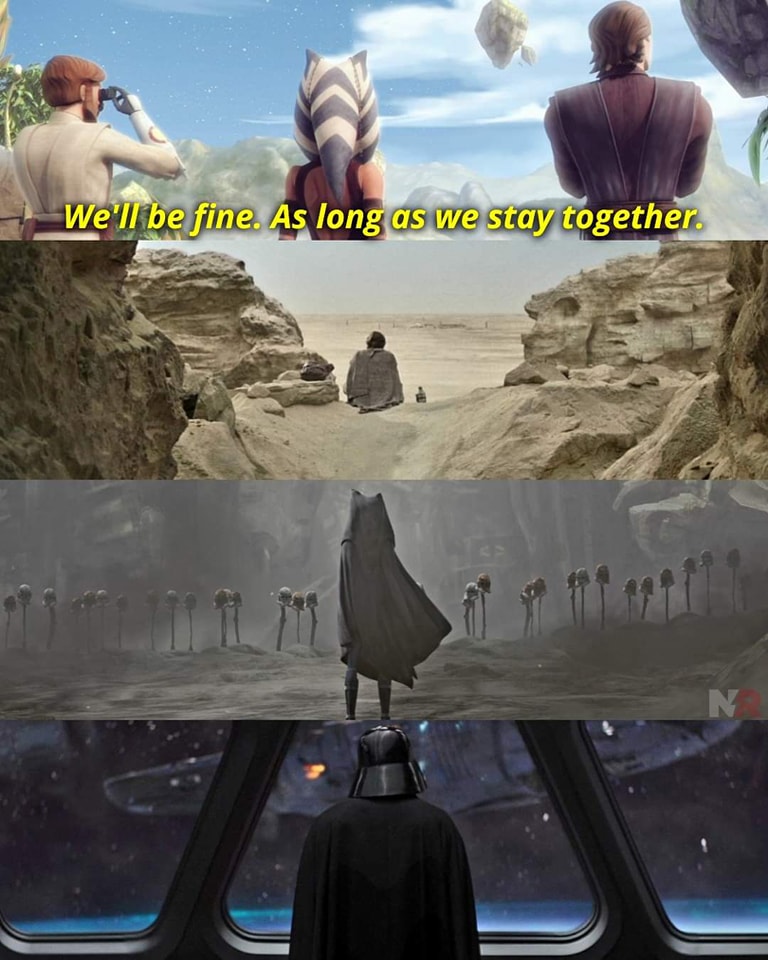
This Star Wars meme sets up a visual joke about the fate of the Jedi Order versus the Emperor. The top image shows Jedi Masters watching over dangers, while the middle image depicts Obi-Wan Kenobi sitting alone in a desert, suggesting that the Order's protection can't save everyone. Finally, the bottom panel shows Darth Vader looking out his ship's window, implying that even after the Jedi are destroyed, the Emperor remains the only threat left to watch out for.
simple-description (llama3.2-vision_11b)
The meme is a screenshot from the movie "Star Wars: Episode VI - Return of the Jedi" (1983) where a character, Yoda, is saying "When 900 years of a life, looking back, I find it is. A long time, it is." The meme is captioned "When you're 900 years old and still can't figure out the internet" and is often used to express frustration or confusion with modern technology.
detailed-analysis (gemma3-27b-vision)
Okay, let's break down this image from Ahsoka with the requested analytical lenses. It's a complex image ripe for these kinds of analyses, so I’ll try to be thorough.
Visual Description
The image is a composite, displaying multiple frames/shots. It features characters from the Star Wars universe, specifically Ahsoka Tano, Sabine Wren, and Anakin Skywalker (as Darth Vader).
- Top Section: A bright, muted desert landscape with Ahsoka and Sabine standing back-to-back, facing outward. They appear to be in a moment of defensive preparation. Text overlayed reads: "We'll be fine. As long as we stay together." The palette is warm and ochre-toned.
- Middle Section: A distant, blurred figure is seated in the desert landscape, appearing contemplative or potentially in mourning. The landscape becomes more barren.
- Bottom Section: A starkly contrasting image presents Darth Vader inside a ship or vessel, his figure imposing and silhouetted. The interior is dark and metallic. The contrast in color and framing highlights his power and menacing presence. The inclusion of a letter “N” on the upper right suggests this is from a network, possibly a streaming service or media platform.
The composite nature is significant – the layering of these images implies connection and discord simultaneously. The composition creates a sense of foreboding and conflict.
Foucauldian Genealogical Discourse Analysis
This image reveals power dynamics and disciplinary mechanisms embedded in the Star Wars universe. Foucault’s genealogy helps us trace the historical conditions that produced these power relations.
- The Discourse of the Jedi & Sith: The image centers around the discourse of the Jedi and Sith, two opposing philosophical and combative orders. This binary shapes the understanding of power, morality, and the “correct” way to use the Force. The image highlights the inherent conflict within this discourse.
- Discipline & Control: Vader, as a figure of the Empire, represents an apparatus of discipline and control. His image is carefully constructed to convey his authority. The rigid lines of the ship, his black uniform, and his posture all contribute to this perception. The Empire aims to discipline and control the galaxy, and Vader is its primary enforcer.
- Ahsoka & Sabine as Deviations: Ahsoka and Sabine, as former Jedi and a Mandalorian warrior respectively, represent a disruption to these established discourses. They operate outside of the traditional structures, forging their own paths. Their connection emphasizes a new form of power, one that rejects the strictures of the Jedi and Sith orders. The statement “As long as we stay together” reinforces the idea of a collective resistance against oppressive forces.
- Genealogy of 'Fine': The concept of being “fine” in the face of impending danger is not neutral. It’s a performative utterance, a way of asserting control and maintaining morale despite the precarious situation. Tracing the genealogy of this phrase reveals how it’s been used historically to suppress fear and encourage conformity, particularly in contexts of conflict.
Critical Theory (Specifically focusing on Frankfurt School & Adorno)
The image can be analyzed through the lens of Critical Theory, particularly the Frankfurt School's focus on the culture industry and the reproduction of ideology.
- The Spectacle of Power: Vader's presentation isn't simply about power; it's about the spectacle of power. His image is carefully constructed to inspire awe and fear, reinforcing the Empire's dominance. This aligns with Debord's concept of the “society of the spectacle,” where images mediate our experience of reality and perpetuate systems of control.
- The Myth of Heroism: The Jedi/Sith narrative often relies on the myth of the individual hero. However, Ahsoka and Sabine’s alliance suggests a shift towards collective resistance. This challenges the traditional notion of heroism and offers a more nuanced understanding of agency and solidarity.
- Reproduction of Trauma: Vader’s presence embodies trauma – both his personal trauma and the trauma he inflicts on others. The image suggests that trauma is not simply an individual experience, but is reproduced and perpetuated through systems of power.
- False Consciousness: The Empire maintains its control through the manipulation of information and the creation of a false consciousness among its subjects. This image subtly hints at the need for critical awareness and resistance.
Marxist Conflict Theory
Through a Marxist lens, the image highlights the struggle between opposing classes and the inherent contradictions within the Star Wars universe.
- The Empire as the Bourgeoisie: The Galactic Empire represents the ruling class, controlling the means of production (ships, weaponry, resources) and exploiting the galaxy for its own benefit. Vader is their enforcer, protecting their interests.
- Ahsoka & Sabine as the Proletariat: While not strictly a working class, Ahsoka and Sabine can be seen as representatives of the oppressed, fighting against the Empire's dominance. Their alliance embodies a collective effort to overthrow the ruling class.
- Class Conflict & Resistance: The image depicts a direct confrontation between the oppressor (Vader/Empire) and the resistance (Ahsoka/Sabine). This represents the inherent conflict between classes in a Marxist framework.
- Ideology & Hegemony: The Empire maintains its power through ideology and hegemony – controlling the narrative and shaping the beliefs of the masses. Ahsoka and Sabine's resistance challenges this dominant ideology.
Postmodernism
A postmodern analysis focuses on the fragmentation, instability, and rejection of grand narratives.
- Deconstruction of the Hero Myth: The image, particularly through the emphasis on Ahsoka and Sabine’s alliance, deconstructs the traditional hero myth. There is no single savior; instead, there is a collaborative effort.
- Rejection of Binary Oppositions: The blurring of lines between Jedi and Sith, and the emphasis on individual agency, challenge the rigid binary oppositions that structure the Star Wars universe.
- Simulacra & Hyperreality: Vader's image can be seen as a simulacrum – a copy without an original. His power and intimidation are constructed through spectacle, creating a hyperreal experience that obscures the underlying reality of the Empire's oppression.
- Loss of Meaning & Narrative Instability: The fragmentation of the image itself reflects a postmodern sensibility, suggesting a loss of coherent narrative and a rejection of grand, overarching explanations.
Queer Feminist Intersectional Analysis
This lens would consider how power dynamics intersect across various identities (gender, sexuality, race/species) and how these intersections are reflected in the image. While the characters presented are primarily gendered masculine or feminine, a queer feminist analysis can still illuminate power dynamics.
- Subversion of Traditional Gender Roles: Ahsoka, as a Jedi who abandoned the Order, and Sabine, as a Mandalorian warrior, both challenge traditional gender roles and expectations. They occupy spaces traditionally dominated by men, demonstrating agency and independence.
- Intersection of Power & Resistance: Their alliance represents a coalition of marginalized voices resisting oppressive forces. It highlights the importance of solidarity and collective action.
- Reclaiming Agency: By forging their own paths, Ahsoka and Sabine reclaim agency over their bodies, identities, and destinies. They reject the constraints imposed by the Jedi Order and the Empire.
- Critique of Imperial Patriarchy: The Empire, as a hierarchical and authoritarian regime, embodies patriarchal structures of power. Ahsoka and Sabine’s resistance can be seen as a challenge to this patriarchal order.
This is a fairly detailed breakdown, but the image is complex enough to invite even more nuanced interpretations. I’ve tried to cover the key points and how they relate to each analytical lens. Let me know if you'd like me to expand on any of these areas or explore different theoretical perspectives!
simple-description (llama3.2-vision)
This meme is a still image from the movie "Star Wars: A New Hope" (1977) where a character named Obi-Wan Kenobi says "When I left you, I was but the youngest of a clan of a thousand in a colony in a desert planet called Tatooine. When I left you, I was but the youngest of a clan of a thousand in a colony in a desert planet called Tatooine. I know this is the last time for me. This is how I look, I'm fine. Have you seen my brother? I know this is the last time for me. This is how I look, I'm fine. Have you seen my brother?"
tesseract-ocr
5 : 4 rat ye / é \ y [iii lasiweistay toget 5 me = ek ; en —— t ~ ea eo pe oo ee, __ ene a - de jhe — wo = Sa ary ei a “Fg PN na w 4 Se erie |S a y y SE nikeaiaill ed & i . fe Cin a ho ? , ; + = = a, |. ag HE, P as ; > . re Ly f ; F i —7 el ——,