First Seen
2023-05-10T21:03:41+00:00
simple-description (qwen3.5_2b-q8_0)
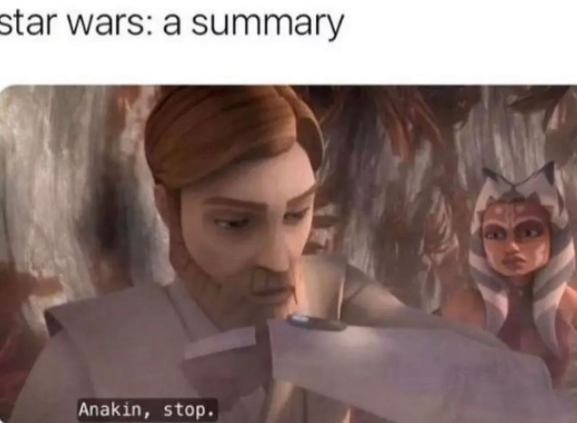
This meme features Jedi Master Obi-Wan Kenobi looking with intense focus at a scroll or map, while his Padawan, Ahsoka Tano, stands behind him looking worried. The dialogue bubble at the bottom left reads "Anakin, stop," referencing Obi-Wan's famous warning to Anakin Skywalker to not get in his head. The text at the very top, "star wars: a summary," suggests a joke implying that Obi-Wan is summarizing the entire Skywalker Saga just by reading this single prophecy.
simple-description (llama3.2-vision_11b)
The meme is a screenshot from the movie "Star Wars: The Clone Wars" (2008) where Anakin Skywalker says "It's a trap!" in a desperate attempt to escape from a situation. The image is captioned "It's a meme" in a humorous way, implying that the phrase has become a cliché and is now used in a ironic or sarcastic manner. The meme is poking fun at the overuse of the phrase and its predictability.
detailed-analysis (gemma3-27b-vision)
Okay, here's an analysis of the image, broken down into relevant theoretical sections. Given the image's content, some sections will be more applicable than others.
Visual Description
The image is a still from the Star Wars: The Clone Wars animated series. It depicts Anakin Skywalker, looking down at something with a distressed or pained expression. He appears to be in a dark, interior space. Behind him, slightly out of focus, is Ahsoka Tano, looking concerned or disapproving. The bottom of the image contains the text "Anakin, stop." The lighting is somewhat dramatic, creating a sense of tension or conflict. The image is clearly referencing a pivotal scene of Anakin's gradual descent into darkness.
Foucauldian Genealogical Discourse Analysis
This image resonates with Foucault's ideas about power and discourse. The command "Anakin, stop" embodies the attempt to regulate Anakin’s behavior and confine him within established norms. The very act of saying “stop” is an exercise of power – an attempt to control his agency.
- Discourse: The entire Star Wars saga represents a discourse on heroism, destiny, and the dangers of unchecked power. This image captures a moment where that discourse is challenged, as Anakin's actions are perceived as crossing a boundary.
- Genealogy: We can trace the genealogy of Anakin’s "dark side" actions back to societal structures that reward aggression and ambition. This scene suggests that the Jedi’s emphasis on suppression of emotion and absolute adherence to a code contributed to the emergence of Anakin's darker impulses. The Jedi, in attempting to control Anakin, ironically contribute to the very thing they fear.
- Power/Knowledge: Ahsoka's statement represents a knowledge of Anakin’s actions and a deployment of power to attempt to halt them. The image shows a power dynamic within their relationship.
Critical Theory
From a Critical Theory perspective, this image represents the tension between individual agency and systemic forces. Anakin's actions aren't simply personal failings; they’re products of the structures of power and control within the Republic and the Jedi Order.
- Ideology: The Jedi Code, while presented as virtuous, functions as an ideology that obscures the true nature of power and justifies the maintenance of the status quo. Anakin's transgression disrupts that ideology.
- Alienation: Anakin's actions, while perhaps destructive, could be interpreted as a form of alienation – a rejection of a system that has failed to address his needs and concerns.
- Hegemony: The Jedi Order maintains its hegemonic control through the creation of norms and the suppression of dissent. Anakin's actions threaten to expose the flaws in that system.
Marxist Conflict Theory
The Star Wars universe lends itself well to a Marxist interpretation. The Republic, ostensibly a democracy, is deeply riddled with corruption and class inequalities.
- Class Struggle: The Clone Wars can be seen as a proxy war driven by the interests of the wealthy and powerful (like Palpatine and the Separatist leaders), exploiting the working class (the clone troopers and the citizens of the Republic) for their own gain.
- False Consciousness: The citizens of the Republic are largely unaware of the true extent of the corruption and manipulation that is taking place. They believe in the ideals of democracy and justice, but these ideals are largely illusory.
- Revolution: Anakin's fall to the dark side can be seen as a symptom of a deeper societal crisis. The existing system is failing, and the old order is crumbling.
Queer Feminist Intersectional Analysis
While not immediately apparent, this image could be interpreted through an intersectional lens, especially given Ahsoka's position.
- Ahsoka's Marginalization: Ahsoka, as a female Jedi and Anakin's padawan, is already marginalized within a predominantly male, hierarchical order. Her voice attempting to "stop" Anakin is a statement about challenging power structures.
- Anakin's Emotional Labor: The Jedi Code emphasizes emotional suppression, which could be seen as a patriarchal expectation that disproportionately harms individuals who struggle with expressing their emotions.
- Intersection of Power: The image shows the interplay of different forms of power - Jedi authority, gender dynamics, and the power of emotional control.
Hopefully, this analysis provides a comprehensive look at the image through various theoretical frameworks. Let me know if you’d like me to expand on any particular aspect or explore a different theory!
simple-description (llama3.2-vision)
This meme is a screenshot from the Star Wars prequels, specifically from the scene where Anakin Skywalker (played by Hayden Christensen) is being trained by Obi-Wan Kenobi. The image shows Anakin's face with a confused expression, and the text overlay reads: "In a galaxy far, far away... I have no idea what's going on."
tesseract-ocr
star wars: a summary i , ) i H ' F y ‘ i” \ + a SF m \ ie “Tb ow Anakin, stop. y)