First Seen
2023-05-10T21:03:41+00:00
simple-description (qwen3.5_2b-q8_0)
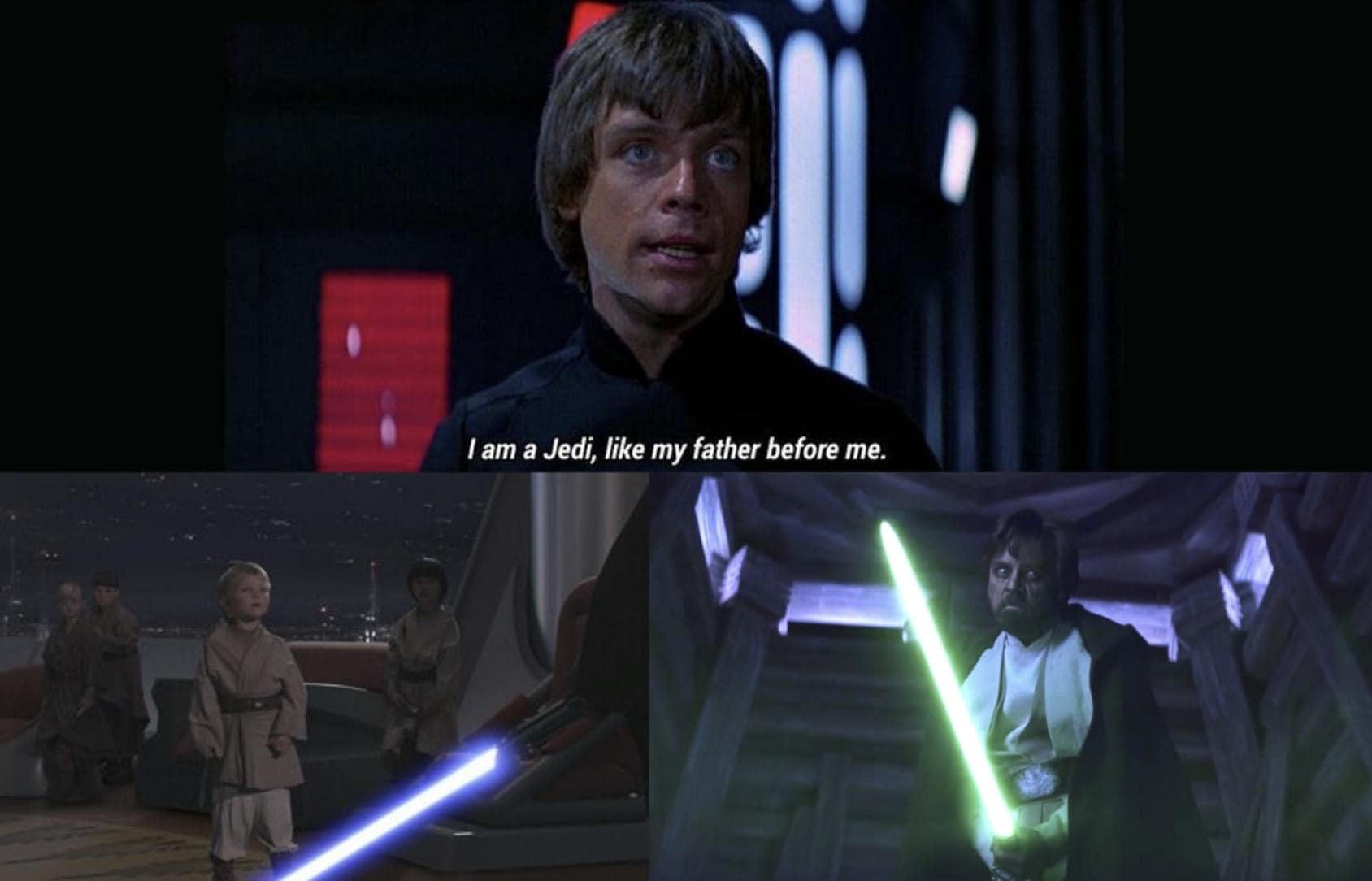
This Star Wars meme plays on the famous line spoken by the young Luke Skywalker in Star Wars: Episode I: "I am a Jedi, like my father before me." It juxtaposes that declaration with the actual, much younger version of that character from Star Wars: The Clone Wars. By placing the two scenes together, the joke suggests that this specific young boy is essentially his own "father" in the Jedi training program.
simple-description (llama3.2-vision_11b)
The meme is a humorous image that juxtaposes the iconic line "Do. Or do not. There is no try." from the Star Wars franchise with a picture of a child trying to fly a toy plane. The text overlay on the image reads "Do. Or do not. Fly. There is no crash." The meme pokes fun at the idea that even with the best intentions, a child's attempt to fly a toy plane will inevitably end in a crash, much like the impossibility of flying with the Force as a Jedi.
detailed-analysis (gemma3-27b-vision)
Okay, here's an analysis of the provided Star Wars images, broken down into sections as requested. I'll indicate if a section doesn't apply.
Visual Description
The images depict Luke Skywalker in moments of transition and symbolic assertion of identity. The primary image focuses on Luke's face in a low-lit environment, likely within the Death Star or a similar structure. His expression is determined, almost strained. The caption reads, "I am a Jedi, like my father before me." His attire is the black outfit he dons briefly, representing a transitionary phase in his becoming.
The other two images offer context. One shows Luke standing with other Jedi initiates as their lightsabers are ignited, illuminating their faces, creating a sense of shared training. The other shows him wielding his green lightsaber in a duel with Darth Vader. The use of lighting and color (the bright blue and green of the lightsabers against the dark backgrounds) draws attention to the power and symbolism of the Jedi weapon and the concept of 'light' vs 'dark'.
Foucauldian Genealogical Discourse Analysis
This scene allows for a Foucauldian analysis focusing on the discourse of "Jedi" and the construction of power/knowledge around it.
- Discourse & Power: The term "Jedi" isn’t just a label; it's a discourse constituted by practices, institutions (the Jedi Order), and ways of thinking. This discourse establishes rules, defines legitimate knowledge (the Force, lightsaber combat), and dictates acceptable behaviors. The Jedi Order, before its near-destruction, held a monopoly on this discourse.
- Genealogy: Luke’s declaration is an attempt to re-establish this discourse. The Jedi Order has been decimated; he's tracing the lineage back to his father (Anakin), trying to recover and reconstitute a fragmented power/knowledge system. It's an act of claiming authority.
- Disciplinary Power: The Jedi Order, historically, employed disciplinary power through training, rituals, and the suppression of emotions (to prevent attachment and the dark side). Luke, in accepting the mantle of Jedi, also accepts, implicitly, the possibility of these disciplinary mechanisms, and potentially the inherent power imbalances within the Jedi Order.
- Shifting Discourse: Luke’s assertion isn’t a simple continuation of the Jedi discourse, but a renegotiation of it. His father’s fall to the dark side necessitates a re-evaluation of the Jedi ideals and practices. Luke attempts to forge a new version of the Jedi, one that might avoid the failures of the old.
Critical Theory
Critical Theory, particularly through the lens of the Frankfurt School, can examine this moment through the concept of hegemony and the potential for ideological reproduction.
- Ideology & Hegemony: The Jedi Order, historically, represented a dominant ideology in the Star Wars universe. This ideology, centered on the Force and the principles of peace and justice, legitimized their power and social order. Luke, by declaring himself a Jedi, risks simply reproducing this ideology without critically examining its inherent power dynamics.
- Enlightenment Rationality & its Discontents: The Jedi Order, can be seen as representing a form of Enlightenment rationality – a belief in objective truth (the Force), reason, and a universal moral code. However, the fall of Anakin Skywalker and the flaws within the Order demonstrate the limitations and potential dangers of this approach.
- Instrumental Reason: The Jedi Order's emphasis on control and adherence to rules, while intended to maintain peace, can be seen as an example of instrumental reason – the application of reason to achieve specific goals, without considering ethical implications. This can lead to the suppression of individuality and critical thinking, ultimately contributing to the Order's downfall.
Marxist Conflict Theory
While not a perfect fit, a Marxist lens can illuminate the power struggles at play.
- Class Struggle: The Jedi, as a ruling elite with access to a unique source of power (the Force), can be seen as representing a ruling class. The Sith, as a rebellious force seeking to overthrow the Jedi, represent a counter-class. The conflict between them is a struggle for control over resources and power.
- Base and Superstructure: The “base” of Star Wars society (the economic and material conditions) is somewhat abstracted, but we can identify elements like resource control (planets, ships), technological dominance (the Death Star), and military power. The Jedi Order and the Sith represent different “superstructural” elements – the ideologies, institutions, and cultural norms that justify and maintain the existing power structures.
- Alienation: The rigid rules and emotional suppression within the Jedi Order could be seen as contributing to alienation – a sense of disconnection from oneself and others. This alienation could have contributed to Anakin Skywalker’s vulnerability to the dark side and his eventual rebellion.
Postmodernism
A postmodern reading challenges the grand narratives and essentialist claims associated with the Jedi.
- Deconstruction of Meaning: Postmodernism would deconstruct the notion of a fixed “Jedi” identity. Luke’s assertion isn’t a simple claim of belonging to a pre-existing category, but an act of constructing a Jedi identity in the face of its near-extinction. The very meaning of "Jedi" is fluid and open to interpretation.
- Simulacra and Simulation: The Jedi Order, as a historically powerful institution, has become a simulacrum – a copy without an original. Luke is attempting to revive a representation of the Jedi, not necessarily the “authentic” Jedi of the past.
- Rejection of Metanarratives: The Jedi Order previously represented a grand narrative of justice, peace, and the triumph of good over evil. Postmodernism would challenge this narrative as being overly simplistic and potentially oppressive.
Queer Feminist Intersectional Analysis
This lens is the most challenging to apply directly, as the Star Wars universe doesn’t consistently prioritize gender or sexuality in the way modern queer/feminist theory demands. However, some points can be made:
- Limited Representation: The traditional Star Wars universe lacks diverse gender and sexual representation. The focus on binary gender roles and heterosexual relationships reinforces patriarchal norms.
- The Force & Power Dynamics: The Force, as a source of power, could be analyzed through a feminist lens. The ways in which power is accessed, controlled, and wielded by Jedi and Sith, might perpetuate gendered power imbalances.
- Intersectionality & Rebellion: The characters who challenge the established order (like Rey in the sequel trilogy) could be read as embodying intersectional rebellion – challenging multiple forms of oppression simultaneously. However, this requires extrapolation beyond the original films.
I've tried to provide a comprehensive analysis based on the images and the specified theoretical frameworks. Let me know if you'd like me to elaborate on any particular point!
simple-description (llama3.2-vision)
This meme is an image of a child in a Star Wars costume, looking up at Darth Vader with a concerned expression. The text overlay reads: "I am a Jedi, like my father before me." The image is a humorous take on the iconic line from the Star Wars movie, but with a child in a Vader costume, implying that the child is a mini-Vader, rather than a Jedi.
tesseract-ocr
lA a me | | | EEC AC Ue a ee | / 4 ‘li ‘7