First Seen
2023-05-10T21:03:41+00:00
simple-description (qwen3.5_2b-q8_0)
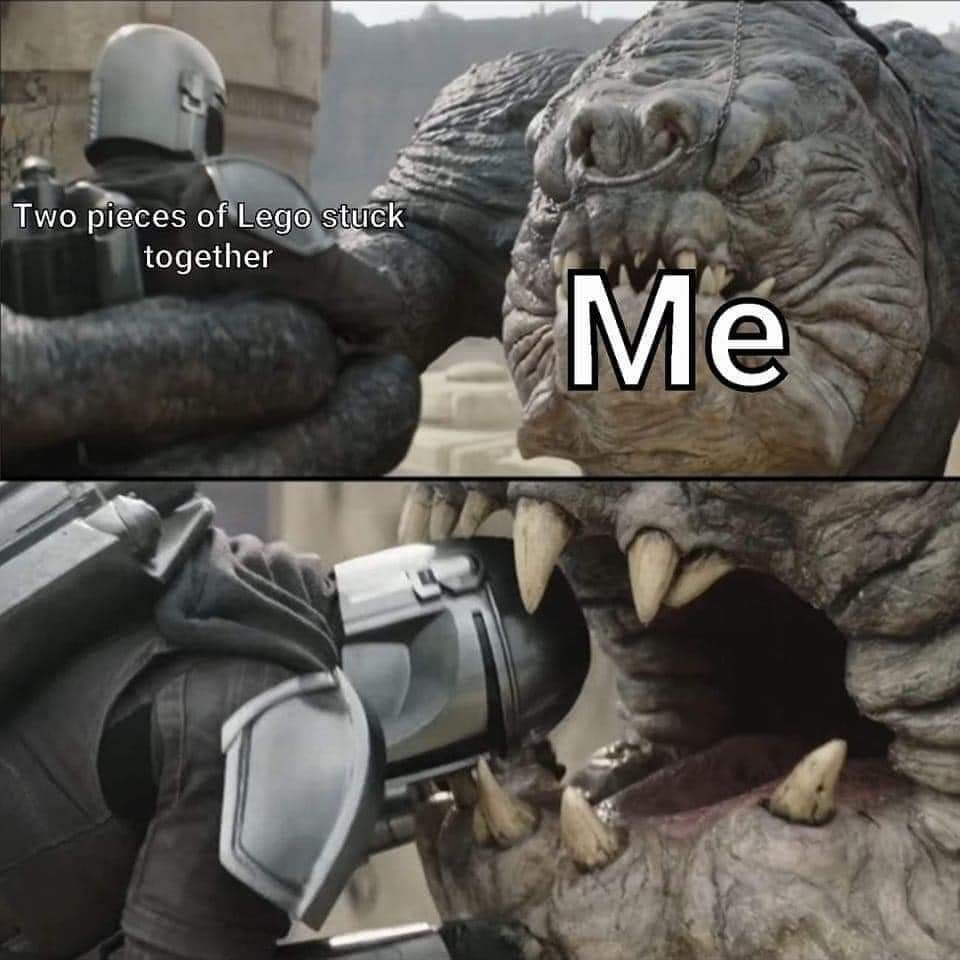
This Star Wars meme features Jango Fett, a clone trooper from The Mandalorian. The text "Two pieces of Lego stuck together" is a visual pun on the two main parts of Jango's iconic helmet, which visually resemble LEGO bricks, that are stuck in his mouth next to a giant creature. The bottom panel features the text "Me" to humorously identify the character.
simple-description (llama3.2-vision_11b)
In the Star Wars category, this meme is a play on a scene from the movie "The Mandalorian" where the character Din Djarin (also known as "The Mandalorian") is trying to protect a young creature known as "The Child" (also known as "Baby Yoda"). The meme features a still image from the show with the caption "I found you" and a picture of the creature's face with a caption "I've been looking all over for you". The meme is poking fun at the idea that the character is trying to protect the creature, but the creature is actually the one who found the character.
detailed-analysis (gemma3-27b-vision)
Okay, let's break down this meme using the requested theoretical frameworks. It's a rich image for analysis, surprisingly!
Visual Description
The meme uses a "Drakeposting" format. This format features two panels, one positioned "disapprovingly" above the other.
- Top Panel: Features a Mandalorian in full Beskar armor (from The Mandalorian TV series) looking somewhat to the side with a disapproving, stoic expression. Text overlay reads: "Two pieces of Lego stuck together."
- Bottom Panel: Features a close-up of a Tusken Raider (also from The Mandalorian, representing the native people of Tatooine) with a look of intense discomfort and distress. The Mandalorian is visibly attempting to remove something from the Tusken Raider’s mouth (which is the source of the Tusken Raider’s distress). The text overlay reads: “Me.”
The juxtaposition is the core of the joke. The comparison implies the user finds the simple, mildly frustrating experience of two Lego pieces stuck together akin to the invasive, physically distressing experience the Tusken Raider is undergoing.
Foucauldian Genealogical Discourse Analysis
This meme touches on the production of subjectivity and the power dynamics embedded within seemingly simple interactions.
- Discourse of Childhood & Play: The Lego reference evokes a specific discourse around childhood, play, and the expectation of building and creating. This discourse positions Lego as inherently positive and enjoyable. However, the meme undermines this by connecting it to the Tusken Raider’s obvious suffering.
- Discourse of Colonialism & "Savages": The Tusken Raider, within the Star Wars universe, is often depicted as a "savage" or "barbaric" people, often in conflict with the "civilized" settlers. The meme subtly replays the power dynamic of the colonial encounter. The Mandalorian (representing the "civilized" colonizer) is acting on the Tusken Raider (the colonized), even if the initial intention is to "fix" a problem. The Tusken Raider’s discomfort is dismissed, overshadowed by the trivial frustration of the Lego situation.
- Power/Knowledge: The meme demonstrates how power operates through the construction of knowledge. The user (and presumably, the broader audience) finds the Lego situation relatable and slightly annoying, framing it as the primary point of reference. This framing disregards the Tusken Raider’s obvious pain and distress, creating a hierarchy of suffering based on cultural position and experience. The Mandalorian’s act of intervention (trying to fix the Tusken Raider’s mouth) becomes a symbol of external control and the imposition of one group’s values onto another.
Critical Theory (Frankfurt School)
The meme can be analyzed through the lens of Critical Theory, which examines how culture perpetuates systems of domination.
- Commodification of Experience: The meme trivializes a potentially serious issue (the Tusken Raider's discomfort and potential injury) by equating it with a minor consumer frustration (stuck Lego bricks). This illustrates how capitalist society can reduce complex experiences to commodities and prioritize superficial inconveniences over genuine suffering.
- Culture Industry & Distraction: The use of a pop culture reference (Star Wars) reinforces the idea that the "culture industry" produces mass-produced content that distracts from social and political realities. By focusing on a trivial comparison, the meme avoids engaging with the historical and political contexts of the Tusken Raider’s character and the broader themes of colonialism in Star Wars.
- Loss of Empathy: The juxtaposition of the two images suggests a diminished capacity for empathy. The user’s ability to relate to the Lego frustration more than the Tusken Raider’s obvious distress points to a desensitization to suffering and a prioritization of individual comfort over collective well-being.
Marxist Conflict Theory
From a Marxist perspective, this meme speaks to class/power dynamics and the construction of narrative to maintain the status quo.
- Oppressor/Oppressed: The Mandalorian represents a technological and culturally dominant group, while the Tusken Raider embodies a marginalized, "othered" people. The act of intervention, however well-intentioned, reinforces the power imbalance. The Tusken Raider’s discomfort is dismissed in favor of the Mandalorian’s trivial frustration.
- Ideology & False Consciousness: The meme subtly reinforces a narrative where the comfort of the privileged (the Mandalorian/user) outweighs the suffering of the marginalized (the Tusken Raider). This creates a “false consciousness” where the user (and potentially the audience) accepts a hierarchical system where their minor inconveniences are considered more important than the genuine problems faced by others.
- Control of Narrative: The meme’s framing – prioritizing the Lego comparison – controls the narrative. It shifts focus away from the Tusken Raider's situation and frames the user's experience as the primary point of reference.
Postmodernism
This meme embodies several aspects of postmodern thought:
- Intertextuality: It relies heavily on intertextuality – the relationship between different texts (the Star Wars universe, the Drakeposting format, the shared cultural knowledge of Lego bricks). Meaning isn't inherent in the image itself, but created through the interplay of these different references.
- Deconstruction of Meaning: The meme deconstructs the conventional associations of both images. Lego is usually seen as fun, and the Tusken Raider is often portrayed as hostile, but the meme juxtaposes them to create an unexpected and ironic meaning.
- Subjectivity & Relative Truth: There is no "objective" truth in the meme. The humor relies on the user’s subjective experience and the absurdity of comparing two vastly different situations.
- Irony & Parody: The meme’s humor derives from irony and parody. It playfully subverts expectations and challenges conventional ways of thinking about both Lego bricks and the Tusken Raider’s character.
I hope this detailed analysis is helpful! It demonstrates that even seemingly simple memes can be rich sites for critical inquiry. Let me know if you would like me to elaborate on any of these points.
simple-description (llama3.2-vision)
The meme is a play on the popular "I see you" meme format, where a character from a movie or TV show is shown looking directly at the viewer, but in this case, it's a character from the Star Wars franchise, specifically a Wookiee, looking at a person who has just been caught with their pants down (or in this case, with a pair of pants on, but with a hole or tear in them, implying they are "undressed" in some way).
The text on the image reads "I see you" and "Two pieces of Lego stuck together".
tesseract-ocr
ra ew ea pe Ns re eet A iy a ' “ieee of uaa Siu a ay Ge So wen tec ttl vy Tee : ss : ¥ / sh a bt, a . er, ee a . rT Mt,