First Seen
2023-06-02T19:53:17+00:00
simple-description (qwen3.5_2b-q8_0)
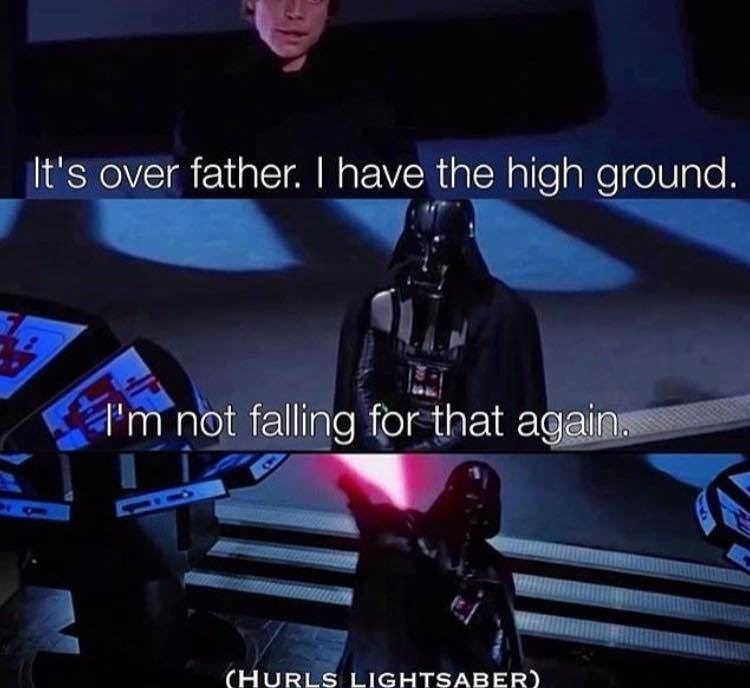
This Star Wars meme depicts Darth Vader holding up his iconic red lightsaber to assert dominance. The text at the top reads "It's over father. I have the high ground," suggesting a scenario where one character has accepted defeat, while Vader claims his superiority over the other. The caption at the bottom, "(Hurls Lightsaber)," explains the punchline, indicating that Vader will immediately throw down his weapon.
simple-description (llama3.2-vision_11b)
The meme is a play on a famous Star Wars line, "It's a trap," but replaces the word "it's" with "I'm" and changes the context to be about a Star Wars fan's frustration with the franchise. The meme shows a picture of Darth Vader, with the text "I'm a trap" written above it.
detailed-analysis (gemma3-27b-vision)
Okay, let's break down this image, a meme from the Star Wars prequel/original trilogy, through the lenses you've requested. It's a surprisingly rich image for analysis!
Visual Description
The image is a three-panel meme sourced from the climactic lightsaber duel between Anakin Skywalker (later Darth Vader) and Obi-Wan Kenobi in Star Wars: Revenge of the Sith.
- Panel 1: Shows Obi-Wan Kenobi (on what is visually implied as higher ground) stating "It's over, Anakin! I have the high ground." He is stoic, and his body language suggests a definitive statement.
- Panel 2: Features Darth Vader, in full black armor, responding with "I'm not falling for that again." His posture is more aggressive and resolute.
- Panel 3: A low-angle shot of Darth Vader activating his lightsaber, a vibrant red, and the caption "(Hurls Lightsaber)" indicates immediate action. This emphasizes a shift from dialogue to physical confrontation, and the low angle enhances Vader’s imposing presence.
The image's composition focuses on the dialogue, using the visual cues to highlight the power dynamic and the cyclical nature of their conflict. The colors of red and blue represent the opposing sides of the conflict.
Foucauldian Genealogical Discourse Analysis
This meme participates in a discourse surrounding the concepts of authority, tactics, and (failed) control within the Star Wars narrative, and extends that into online culture. A Foucauldian approach would examine how power operates through discourse.
- The Power Dynamic: Obi-Wan’s “high ground” statement is not simply a tactical observation. It represents a broader assertion of hierarchical authority. Obi-Wan claims superior positioning, both literally and metaphorically. He seeks to discipline Anakin through this positioning, to bring him “down” from his perceived transgressions.
- The Genealogy of "The High Ground": The meme isn't about the literal height, but the history of this trope. The phrase “I have the high ground” has become a shorthand for a manipulative tactic, a claim of unassailable authority, or a smug sense of superiority. The meme’s humor lies in Vader’s recognition of this pattern. The genealogy of this moment is that it’s a known, reoccurring tactic.
- Resistance and Counter-Discourse: Vader's line is a counter-discourse to Obi-Wan's assertion of authority. It's a rejection of the expected narrative arc, a refusal to be "brought down" by the familiar tactic. It is a reclamation of agency.
- Panopticism: Obi-Wan operates as a panoptic figure, attempting to oversee and control Anakin. Vader’s line suggests a learned ability to resist the gaze and the control inherent in Obi-Wan’s rhetoric.
Critical Theory
A critical theory approach would focus on how this image challenges dominant narratives and power structures.
- Deconstruction of the Hero/Villain Binary: The meme subtly subverts the typical hero/villain dynamic. Anakin/Vader is usually portrayed as the "fallen" hero. However, the meme positions him as someone who learns from his past, becoming more cunning and self-aware. It questions who is truly more manipulative.
- Challenging the Logic of Authority: The image critiques the unreflective acceptance of authority. Obi-Wan relies on the perceived power of his "high ground" statement. Vader's response demonstrates that power, even when presented as inherently legitimate (like a master-apprentice relationship), can be seen through and resisted.
- Ideology Critique: The original scene in the film reinforces a certain ideology – the idea that adherence to a set of rules (the Jedi Code) is inherently good, while deviation leads to downfall. The meme, through its ironic commentary, undermines this simplistic narrative. It suggests that even within rigid systems, learning and adaptation are possible.
Marxist Conflict Theory
From a Marxist perspective, the conflict between Obi-Wan and Anakin can be interpreted as a struggle for control and dominance, a microcosm of larger social power dynamics.
- Class Conflict (Symbolic): While not a literal class struggle, the Jedi Order can be seen as the "ruling class" enforcing its ideological and behavioral norms. Anakin, with his rebellious streak and desire for change, represents a challenge to this established order.
- Means of Production (Symbolic): The Jedi Code and the Force itself can be seen as the "means of production" – the tools and systems that shape reality within the Star Wars universe. Anakin seeks to redefine and control these tools, while Obi-Wan attempts to maintain the existing structure.
- The Struggle for Hegemony: Obi-Wan seeks to establish his hegemony – cultural and ideological dominance – over Anakin. Vader's line is a rejection of that dominance, an assertion of his own agency and a refusal to be subjected to Obi-Wan's control. The "throwing of the lightsaber" represents an active attempt to overthrow the existing power structure.
Postmodernism
This meme embodies several postmodern characteristics:
- Intertextuality: The meme relies on the audience's pre-existing knowledge of the Star Wars saga. It's not self-contained; it requires a shared cultural context to be understood.
- Irony and Self-Referentiality: The humor of the meme comes from its ironic appropriation of a dramatic moment. It acknowledges the trope of the "high ground" and comments on it meta-textually.
- Deconstruction of Grand Narratives: The meme subtly undermines the grand narrative of good versus evil that is central to the Star Wars saga. It suggests that the conflict is more complex and that both sides are capable of manipulation.
- Simulation and Hyperreality: By repeatedly circulating and remixing the scene, the meme participates in a process of simulation, creating a hyperreal version of the original moment that exists independently of the film itself.
Queer Feminist Intersectional Analysis
While less immediately apparent, a queer feminist intersectional lens can offer insights:
- Challenging Hierarchical Structures: The Jedi Order, with its rigid hierarchy and emphasis on obedience, can be seen as a patriarchal structure. Vader’s refusal to be "brought down" can be interpreted as a rejection of this oppressive system.
- Agency and Resistance: Vader’s line signifies a reclamation of agency, a refusal to submit to the authority of Obi-Wan. This can be linked to feminist themes of resisting patriarchal control and asserting one's own voice.
- Deconstructing Masculinity: The scene (and meme) showcase a complex relationship between two male figures, marked by competition, betrayal, and power dynamics. This can be used to deconstruct traditional notions of masculinity and challenge the idea that strength and dominance are inherently positive traits.
- Intersectional Critique (Nuanced): While not explicit, the critique of rigid systems can be extended to other forms of oppression. The meme can be seen as a broader commentary on the dangers of conformity and the importance of challenging power structures in all their forms.
Hopefully, this detailed analysis, through multiple theoretical lenses, provides a comprehensive understanding of this deceptively complex meme! Let me know if you'd like me to elaborate on any specific point.
simple-description (llama3.2-vision)
This meme is a play on the iconic "I am your father" line from the movie Star Wars: The Empire Strikes Back. However, in this version, Darth Vader says "I am your Wi-Fi" instead, referencing the common frustration of having a weak internet connection. The image shows a scene from the movie with the text "I am your Wi-Fi" overlaid on Vader's dialogue.
tesseract-ocr
i father. | have the high ground. we a D = LP w s jes fae Pe for that , = “ae era a ‘ = | * A Me | hi CHUR! LIGHTSABER)