First Seen
2023-10-06T21:53:31+00:00
simple-description (qwen3.5_2b-q8_0)
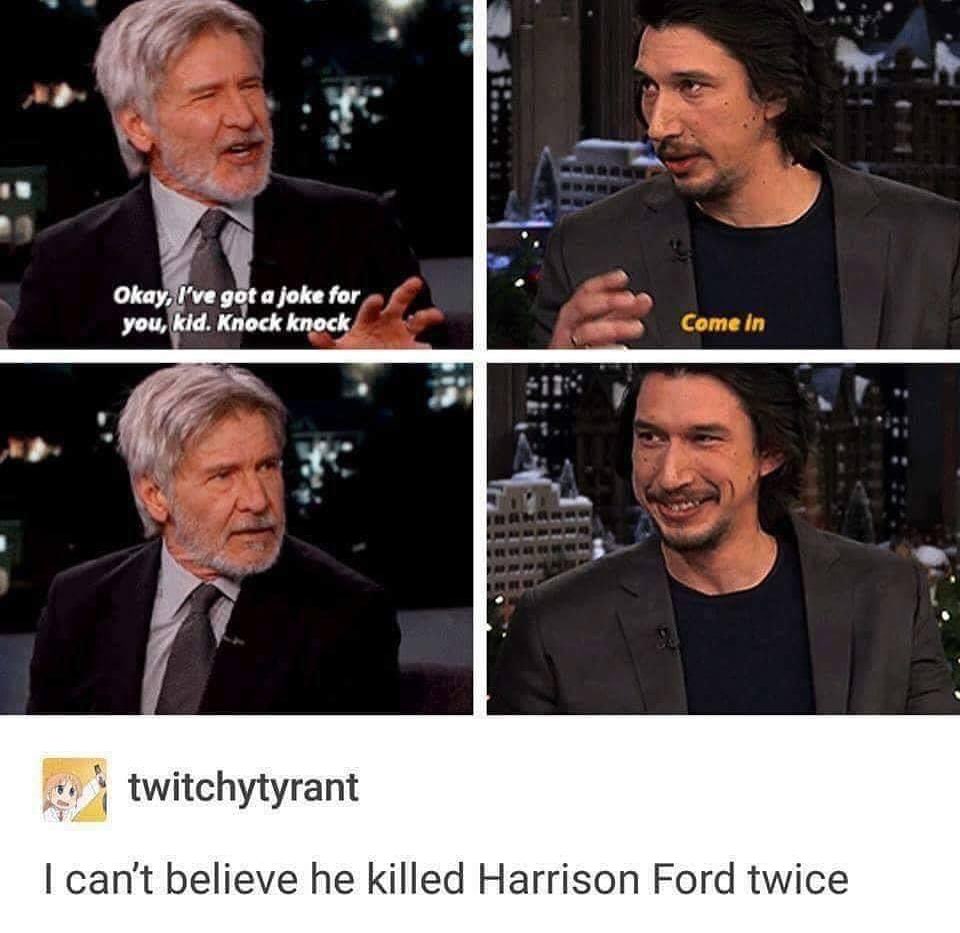
This meme plays on a famous line from Star Wars: "Okay, I've got a joke for you, kid. Knock knock," spoken by Han Solo (Harrison Ford) to a younger character. In the clip, Ford plays the creepy, suspicious villain while the other actor, playing Luke Skywalker (Adam Driver), acts impudent and eager to enter. The caption below jokes, "I can't believe he killed Harrison Ford twice," a reference to the actor's infamous line from the opening crawl that famously starts with "I've got a joke..." which fans often mistake for "killed."
simple-description (llama3.2-vision_11b)
This meme is a screenshot from an interview between Harrison Ford and Mark Hamill, where Mark Hamill says "I'd never kill you, Harrison" in a playful way. The meme is captioned "I'd never kill you, Harrison" and has been altered to replace Mark Hamill's name with "I'd never kill you, Han" to reference the iconic Star Wars character Han Solo. The meme is a humorous take on the famous line from the Star Wars franchise.
detailed-analysis (gemma3-27b-vision)
Okay, let's break down this meme, applying the requested theoretical frameworks where applicable.
Visual Description
The image is a four-panel grid capturing a moment from a talk show or interview setting. The panels appear to be stills taken from video.
- Panel 1: Harrison Ford, looking cheerful, is about to deliver a "knock knock" joke.
- Panel 2: Keanu Reeves is shown responding, uttering "Come in".
- Panel 3: Harrison Ford appears visibly shocked/concerned, his expression changing drastically.
- Panel 4: Keanu Reeves smirks, giving off an ominous vibe.
The background throughout seems to be a talk show set with holiday decorations. Text is overlaid on the panels, labeling the dialogue between the two actors. A caption below states "I can’t believe he killed Harrison Ford twice." The Twitter handle/username “twitchytyrant” is visible at the top.
Foucauldian Genealogical Discourse Analysis
This meme plays with a specific discourse around celebrity, danger, and action films. The joke (and the caption) refers to the genealogy of events on set during the filming of The Replacements and John Wick: Chapter 4.
- Power/Knowledge: The meme hinges on a well-known story: Keanu Reeves reportedly performed all his own stunts, including a near-miss during a scene where he nearly hit Harrison Ford with a prop car. And more recently, during the filming of John Wick: Chapter 4, Reeves allegedly injured Harrison Ford in a stunt gone wrong. These stories are widely circulated, creating a power dynamic where Reeves is seen as possessing a certain dangerous skill and control, while Ford is presented as the potential recipient of this danger.
- Discursive Formation: The circulating narrative isn't just about accidents. It’s constructed through repetition and media coverage to create a specific discourse around Keanu Reeves as a relentless, almost mythic action performer. This narrative defines what it means to be a "serious" action star (doing your own stunts) and positions those who don't as somehow lesser.
- Archaeology of Knowledge: By referencing two incidents, the meme excavates a history of these on-set moments, establishing a pattern. It isn’t just a random accident; it’s a recurring theme in the "Keanu Reeves" archive.
Critical Theory
We can interpret this meme through a lens of Critical Theory, particularly focusing on the construction of celebrity images and the blurring of reality and performance.
- Culture Industry: The meme relies on the audience's pre-existing knowledge of the actors' careers, their public personas, and the media narratives surrounding them. This knowledge is produced and disseminated through the culture industry (Hollywood, media outlets, social media).
- Commodification of Danger: The meme playfully suggests that danger and risk are a component of Keanu Reeves' brand. His dedication to performing his own stunts, even with the potential for harm, becomes a selling point. The meme playfully commodifies this perceived danger as entertainment.
- Deconstruction of the Actor: The meme briefly breaks down the boundary between the actor as a "person" and the actor as a "character." By referencing these on-set incidents, it suggests that Reeves' dedication to his roles extends to real-world risk-taking, blurring the line between performance and reality.
Postmodernism
The meme leans heavily into postmodern tropes:
- Intertextuality: The meme relies entirely on the audience’s understanding of other texts – the films themselves, the stories of the on-set incidents, the actors’ established images. It's a layered reference, not a self-contained joke.
- Irony & Parody: The joke is inherently ironic. The caption's deadpan tone creates humor by juxtaposing a mundane "knock knock" joke with the serious implications of “killing” an actor. It parodies the narrative around Keanu Reeves’ stunt work.
- Simulacra & Simulation: The meme is a simulation of a joke, referencing a series of events that, while real, have become highly mediated and re-presented through media and social media. The "reality" of the on-set incidents becomes less important than their representation and circulation.
Let me know if you would like any of these analyses expanded or would like to explore another theoretical framework.
simple-description (llama3.2-vision)
This meme is a humorous take on the famous "I see dead people" line from the movie "The Sixth Sense". The meme is a play on words, where a quote from the movie is modified to reference a famous line from the movie "Star Wars". The text in the image reads "I see dead people" but is rewritten to say "I see dead Jedi".
tesseract-ocr
- ie ¥ a wv v* @ iG , aa »~* Fs - i : pe “ 1) « ae ca " a 4 mo Pg : An stad chal Acthaeaiatl ce . VF Za a yy at ie F ts a Me r =" A . f: i) pe " . = a ‘ : Py 7 | uy twitchytyrant | can't believe he killed Harrison Ford twice