First Seen
2023-05-10T21:03:41+00:00
simple-description (qwen3.5_2b-q8_0)
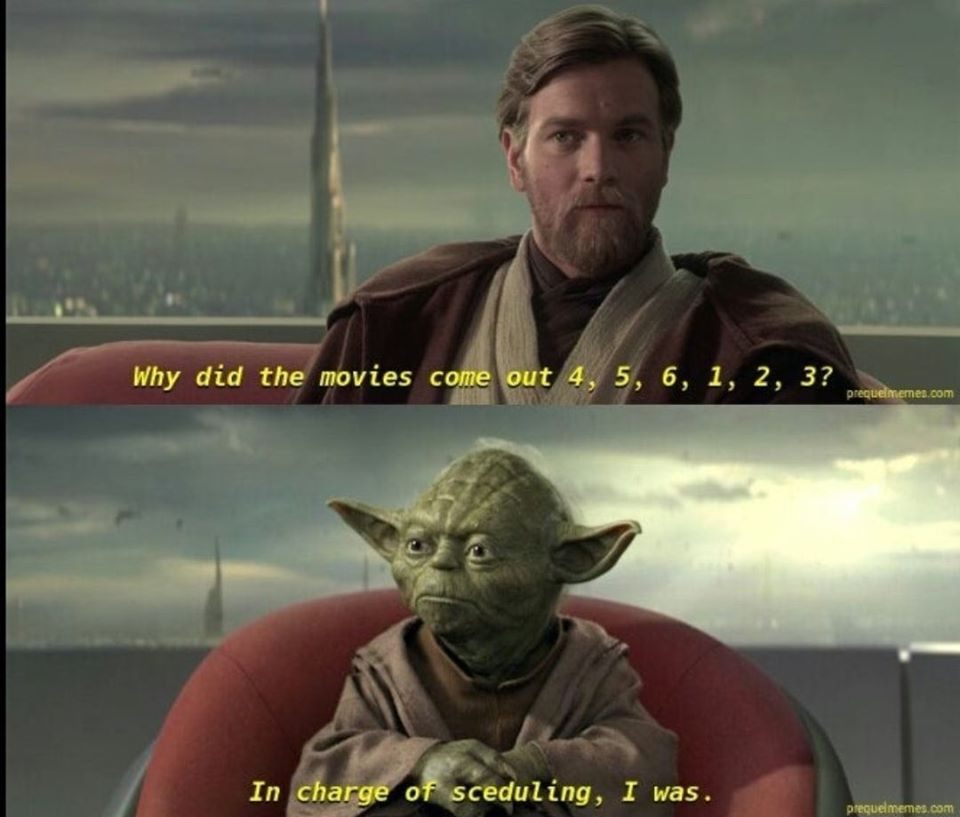
This Star Wars meme plays on a popular internet meme about how films like The Phantom Menace, Attack of the Clones, and Revenge of the Sith were released out of chronological order (often starting in the 4th or 5th). It humorously implies that the character Yoda was the mastermind responsible for the release schedule. The text in the image asks, "Why did the movies come out 4, 5, 6, 1, 2, 3?" and then Yoda replies, "In charge of schedulling, I was."
simple-description (llama3.2-vision_11b)
The meme is a play on the Star Wars franchise, specifically a scene from "The Empire Strikes Back" where Yoda says "Do. Or do not. There is no try." However, in this meme, Yoda's quote is replaced with "Do. Or do not. Read the manual. It's not that hard." The image likely features a screenshot of Yoda from the movie, with the quote overlaid in a humorous and sarcastic tone.
detailed-analysis (gemma3-27b-vision)
Okay, let's break down this Star Wars prequel meme through several theoretical lenses.
Visual Description
The meme is a two-panel image using stills from Star Wars: Episode III – Revenge of the Sith.
- Top Panel: Obi-Wan Kenobi, looking exasperated and questioning. He’s framed with a slightly desaturated color scheme, suggesting a serious tone. The text overlaid reads: "Why did the movies come out 4, 5, 6, 1, 2, 3?"
- Bottom Panel: Yoda, seated in what appears to be a senate chair, with a distinctly disgruntled expression. He is smaller in the frame and the image is a close-up of his face. The text reads: "In charge of scheduling, I was."
- Overall: The meme relies on the contrast between Obi-Wan’s frustration and Yoda’s reluctant acknowledgement of responsibility. It references the unusual release order of the Star Wars prequel films – Episodes I, II, and III were released after Episodes IV, V, and VI. The joke hinges on the subversion of the logical flow of storytelling. The "incorrect" release order is presented as a deliberate choice, and Yoda, as a powerful and respected figure, is jokingly implicated as the orchestrator.
Foucauldian Genealogical Discourse Analysis
This meme, though seemingly simple, can be read through a Foucauldian lens as a commentary on power and the construction of narrative.
- Discourse: The meme participates in the "Star Wars fandom" discourse - the collective conversations, critiques, and celebrations surrounding the franchise. This discourse is heavily invested in the correct order of storytelling, implying a belief that narratives should follow a logical progression. The release order of the prequels is an anomaly within this discourse.
- Power/Knowledge: The meme suggests that power structures (here, represented by Lucasfilm, the creators of the saga) have the agency to construct meaning and manipulate narratives, even if it defies audience expectations. Yoda, as a figure of authority, owns the deviation from the expected narrative flow.
- Genealogy: A genealogical approach would ask how the expectation of linear storytelling emerged in cinema. The meme hints at a disruption of this expected order, challenging the assumption that narratives must be presented chronologically. It traces a break in convention.
- Disciplinary Power: By "owning" the unusual release order, Yoda disrupts the disciplinary power of conventional narrative structure. The audience feels a discomfort, a questioning, because of the divergence from the norm.
Critical Theory
The meme can be interpreted through a broad Critical Theory lens as a critique of auteurism and the power dynamics inherent in franchise management.
- Auteurism: Traditionally, auteur theory focuses on the director as the “author” of a film. Here, the joke implies that the creative decisions weren’t necessarily about artistic vision but about calculated strategic choices, potentially driven by marketing, finance, or other external factors. The release order is presented not as an organic result of filmmaking, but as a deliberate act, and Yoda is the "author."
- Ideology: The meme plays on the audience’s expectation of logical storytelling. By subverting this expectation, it subtly critiques the ways in which dominant narratives are constructed and consumed. The franchise holds power over the audiences expectations.
- Commodification of Culture: Star Wars is a vast commercial enterprise. The meme, in a meta way, acknowledges this by commenting on a specific (and slightly controversial) business decision regarding the film releases.
Marxist Conflict Theory
While subtle, a Marxist reading can be applied to the meme.
- Power Structures: The release order of the films can be seen as a decision made by those in control of the production (capitalists/owners) to maximize profit. Releasing the prequels later allowed for building hype and leveraging the existing fanbase of the original trilogy.
- Alienation: The unusual release order could be seen as a form of alienation – separating the audience from a cohesive narrative experience and potentially prioritizing financial gain over artistic integrity.
- Hegemony: The franchise maintains its hegemonic status by controlling the narrative flow and exploiting pre-existing audience investments. Yoda, as a representative of this power structure, "owns" the decision, subtly reinforcing the capitalist control over the franchise.
Postmodernism
The meme exhibits several hallmarks of postmodernity.
- Meta-narrative Disruption: It deliberately breaks the established order of storytelling, questioning the idea of a "grand narrative" with a clear beginning, middle, and end.
- Irony and Playfulness: The joke is rooted in a playful irony, subverting expectations and inviting the audience to question the very nature of storytelling.
- Pastiche/Intertextuality: The meme relies heavily on the audience’s pre-existing knowledge of Star Wars and the franchise's internal timeline. It draws on this existing cultural context to create humor.
- Deconstruction: The meme deconstructs the idea of a linear, logical narrative.
I hope this detailed breakdown is helpful! Let me know if you'd like me to elaborate on any particular aspect or explore other theoretical frameworks.
simple-description (llama3.2-vision)
This meme is a play on the famous line "I am your father" from the Star Wars franchise. The meme shows a photo of Obi-Wan Kenobi from the Star Wars prequels, with a caption "Why did the movie 2-3" and a response from Obi-Wan "I am your father". The joke is that the question "Why did the movie 2-3" is a play on the infamous "I am your father" line, but in this case, it's asking why the movie was released in 2-3 theaters, implying that it was a low-budget or poorly received film.
tesseract-ocr
J ( ”“ . * { aE y ! Sad i FA Why did the movies ee ot 7. dA e, m2, 37 A RA —— ml oa GIDC... coe a , ee