First Seen
2023-11-30T22:46:13+00:00
simple-description (qwen3.5_2b-q8_0)
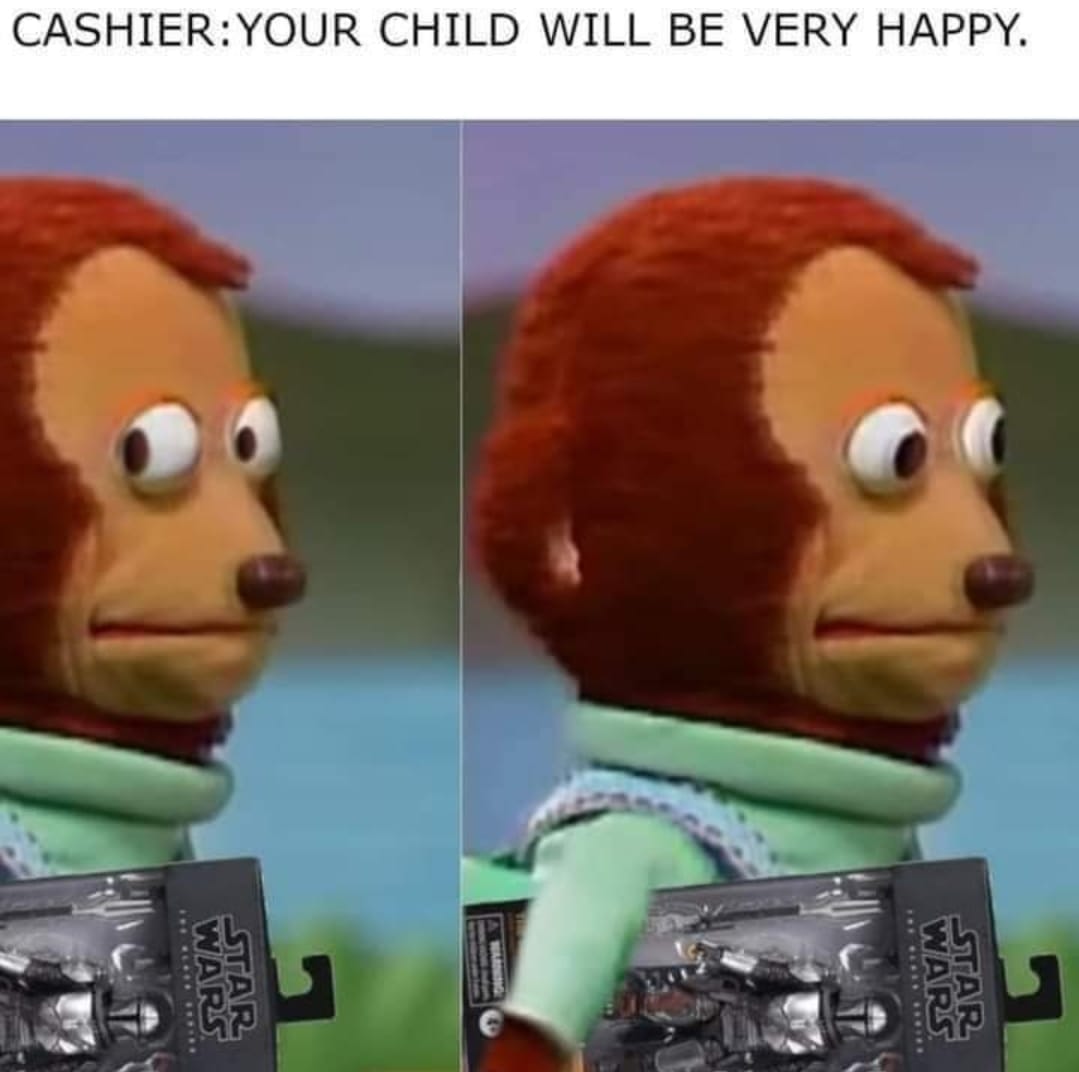
This Star Wars-themed meme features a figure holding a boxed toy (the text on the box reads "STAR WARS"). The image plays on a classic scam joke involving a shopkeeper. The cashier says, "YOUR CHILD WILL BE VERY HAPPY," implying they are offering to sell the child to the person holding the item. The person holding the item (a dad) then chooses the child because the child said in the "Clone Wars" movie, "Your child will be very happy," effectively buying the child as a scam to get the toy.
simple-description (llama3.2-vision_11b)
The meme is a humorous image of a character from the Star Wars franchise, specifically a Stormtrooper, looking at a child's toy, a Star Wars action figure, with a shocked and confused expression. The text at the top of the image reads "C-3PO: I've found your... lost... thing." This meme is a play on the character's awkward and humorous personality, and the idea that even a highly skilled protocol droid like C-3PO can make a mistake and lose something as simple as a child's toy.
detailed-analysis (gemma3-27b-vision)
Okay, let's break down this meme through several lenses as requested. It's a rich, if slightly absurd, image for analysis!
Visual Description
The image features a side-by-side comparison of a digitally-manipulated image of Curious George, the beloved monkey character, with an expression of profound discomfort. The meme is captioned with the phrase "CASHIER: YOUR CHILD WILL BE HAPPY." The monkey's facial expression is crucial - lips pursed, eyes wide and fixed with a slightly panicked/skeptical stare. In both frames, a Star Wars action figure in its packaging is visible in the lower part of the image. The image's composition creates an immediate sense of incongruity; the gap between the presumed happiness conveyed by the cashier and the monkey’s clearly unhappy demeanor is the core of the humor.
Foucauldian Genealogical Discourse Analysis
This meme can be read through a Foucauldian lens as a demonstration of power dynamics embedded within consumer culture and parental expectations. Consider the discourse surrounding "good parenting." There's a historical construction of what constitutes 'treating' or 'spoiling' a child. The cashier's statement ("Your child will be happy") isn't simply a neutral observation, it's an invocation of this discourse—a normative expectation that purchasing this item will generate happiness, and therefore, signify good parenting.
The monkey's expression serves as a disruption to this normalized discourse. It implies an awareness of the power imbalance – the cashier is enacting a subtle form of disciplinary power, framing the purchase as a necessary step in fulfilling the "happy child" ideal. The monkey's skepticism represents a challenge to this assumed relationship between material possessions and happiness, and the underlying assumptions about what it means to be a 'good' parent. It disrupts the smooth operation of this power/knowledge regime.
The genealogy would trace how this idea of 'treating' children with material goods as a display of affection has evolved, and the historical context that has made it so ingrained in our culture.
Critical Theory
Through a Critical Theory lens, this meme reveals the ways in which consumerism shapes our perception of value and happiness. The purchase of a toy is presented as a solution to an emotional need (childhood joy). This connects to the Frankfurt School's critique of the culture industry, where standardized goods and experiences are mass-produced to create a homogenous, passive consumer base. The toy itself isn’t intrinsically valuable; its value is constructed through marketing and cultural narratives.
The monkey’s skeptical expression highlights the alienation inherent in this system. It suggests an awareness that material possessions do not inherently bring lasting fulfillment. The meme subtly critiques the idea that happiness can be bought. It challenges the underlying assumptions of capitalist ideology that equate consumption with well-being.
Marxist Conflict Theory
This meme can be interpreted as a subtle commentary on the alienation of labor and the commodification of childhood. The toy represents a commodity produced through the exploitation of labor, and the act of purchasing it perpetuates this system. The cashier’s statement serves to reinforce the belief that happiness is linked to acquisition, thus driving the cycle of production and consumption.
The monkey’s discomfort can be read as a symbolic representation of the exploited worker – the unseen labor that went into creating the toy is ignored in the pursuit of consumer gratification. The meme implicitly asks whether the momentary happiness of a child is worth the social and economic costs of production. There is an underlying class struggle present – the cashier is an agent of the capitalist system, while the monkey seems to be challenging its fundamental principles.
Postmodernism
From a postmodern perspective, the meme highlights the instability of meaning and the breakdown of grand narratives. The image juxtaposes a seemingly innocent scenario (buying a toy) with a deeply skeptical expression, creating a sense of ambiguity and irony. The meme questions the idea that there is a singular, objective meaning to happiness or parenthood.
The image plays with pastiche (combining the classic Curious George character with a contemporary consumer item) and challenges the notion of authenticity. The monkey’s expression is deliberately exaggerated and humorous, disrupting any attempt to take the situation too seriously. The meme ultimately suggests that meaning is fluid and contingent, constructed through individual interpretation and cultural context.
Queer Feminist Intersectional Analysis
While this image isn't explicitly feminist or queer, a nuanced intersectional reading could be applied. The image critiques the pressure on parents (specifically often mothers, due to societal expectations) to provide material goods to prove their love and fulfill perceived societal norms of “good parenting”. The monkey’s expression could be read as a rebellion against those societal expectations. The idea of “treating” children is linked to societal conditioning and gendered roles.
A queer feminist reading would also consider how societal pressures to conform to norms can be alienating – just as the monkey seems alienated from the cashier’s statement. The meme can be seen as a critique of normative assumptions about childhood, happiness, and family dynamics.
I hope this breakdown is helpful and covers the requested analytical lenses! Let me know if you’d like me to elaborate on any specific section.
simple-description (llama3.2-vision)
This meme is a humorous take on the common experience of a child being overjoyed when a parent or caregiver says "I love you" to them. The image features a character from the popular children's TV show "Sesame Street" with a shocked and delighted expression, captioned with the phrase "I love you" and the child's response "I LOVE YOUUUUUUUUUUUUUUUUUUUUUUUUUUUUUUUUUUUUUUUUUUUUUUUUUUUUUUUUUUUUUUU
tesseract-ocr
CASHIER: YOUR CHILD WILL BE VERY HAPPY. “= * =| oD, “= - = i - oo a SS ho eo F <i at 8 m4 => le : i =