First Seen
2024-03-17T10:08:05.799870+00:00
simple-description (qwen3.5_2b-q8_0)
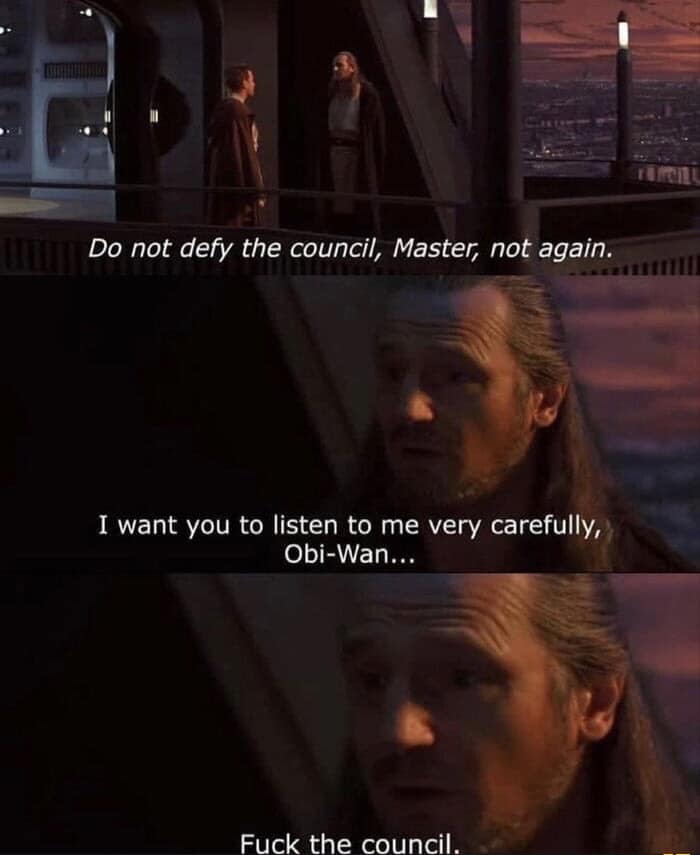
This meme uses a clip from the Star Wars franchise to satirize the absurd power dynamic between Jedi Master Yoda and his apprentice, Obi-Wan Kenobi. The text overlays the scene, first having Obi-Wan warning Yoda not to defy the Council again, followed by Yoda asserting that he wants to listen to Obi-Wan carefully. The punchline comes from Yoda's final line, "Fuck the council," where he abruptly breaks character to express genuine anger and frustration with the Jedi High Council.
simple-description (llama3.2-vision_11b)
The meme is a screenshot from the Star Wars movie "The Phantom Menace" where a character says "When I left you in Ryloth, I knew it was to keep you safe. I was to protect you. Then I discovered you were being watched. It was you. I never told you what I became. I am the one they call when they need a job done. I’m a scavenger. I have no fear. I am meant to live. I am meant to survive. That is why I am here. I am here to protect you."
The meme is a humorous take on the character's speech, replacing the serious tone with a more sarcastic and humorous one, saying "Do not. I mean, do not. Build it. I don't care about it. I don't care about it. It's a terrible idea. It's a terrible idea. I don't care about it. I don't care about it. I don't care about it. I don't care about it. I don't care about it. I don't care about it. I don't care about it. I don't care about it. I don't care about it. I don't care about it. I don't care about it. I don't care about it. I don't care about it. I don't care about it. I don't care about it. I don't care about it. I don't care about it. I don't care about it. I don't care about it. I don't care about it. I don't care about it. I don't care about it. I don't care about it. I don't care about it. I don't care about it. I don't care about it. I don't care about it. I don't care about it. I don't care about it. I don't care about it. I don't care about it. I don't care about it. I don't care about it. I don't care about it. I don't care about it. I don't care about it. I don't care about it. I don't care about it. I don't care about it. I don't care about it. I don't care about it. I don't care about it. I don't care about it. I don't care about it. I don't care about it. I don't care about it. I don't care about it. I don't care about it. I don't care about it. I don't care about it. I don't care about it. I don't care about it. I don't care about it. I don't care about it. I don't care about it. I don't care about it. I don't care about it. I don't care about it. I don't care about it. I don't care about it. I don't care about it. I don't care about it. I don't care about it. I don't care about it. I don't care about it. I don't care about it. I don't care about it. I don't care about it. I don't care about it. I don't care about it. I don't care about it. I don't care about it. I don't care about it. I don't care about it. I don't care about it. I don't care about it. I don't care about it. I don't care about it. I don't care about it. I don't care about it. I don't care about it. I don't care about it. I don't care about it. I don't care about it. I don't care about it. I don't care about it. I don't care about it. I don't care about it. I don't care about it. I don't care about it. I don't care about it. I don't care about it. I don't care about it. I don't care about it. I don't care about it. I don't care about it. I don’t.
detailed-analysis (gemma3-27b-vision)
Okay, let's break down this meme based on the requested theoretical frameworks. It's a very loaded image, given the context it draws from and its meme-ified alteration.
Visual Description
The image is a still from Star Wars: Episode III – Revenge of the Sith. It features Anakin Skywalker, dramatically lit, with a look of intense emotion and a dark shadow partially obscuring his face. He is addressing Obi-Wan Kenobi, visible in the distant background as a small figure. The scene is set in a dimly lit, somewhat cavernous space. The image is altered with superimposed text. The original dialogue "Do not defy the council, Master, not again..." is followed by "I want you to listen to me very carefully, Obi-Wan..." and is then dramatically subverted by "Fuck the council." The juxtaposition of the formal, Jedi-centric language with the modern, irreverent expletive is the core of the meme's impact.
Foucauldian Genealogical Discourse Analysis
This meme is rich for a Foucauldian analysis. The Jedi Council functions as a central discourse that regulates knowledge, power, and behavior within the Star Wars universe. This discourse constructs "truth" about the Force, appropriate Jedi conduct, and the proper order of the galaxy.
- Genealogy: The meme "genealogically" destabilizes this discourse. By introducing the profane language, it traces the historical construction of the Jedi Council’s authority. It suggests the rules aren't natural or divinely ordained, but made, and therefore are subject to challenge. It exposes the "will to power" embedded within the Council's pronouncements.
- Power/Knowledge: The Jedi Council's power isn't simply coercive; it's productive. It generates the "truth" about the Force and imposes a system of knowledge. The meme disrupts this by framing the Council as something to be openly disrespected. It highlights that even "truth" is a tool of control.
- Discipline: The Jedi Order functions as a disciplinary regime. The phrase "Do not defy the Council" is a direct exercise of that discipline. The meme's counter-statement is a rejection of that discipline, a refusal to be normalized by its rules.
Critical Theory
This meme can be examined through the lens of critical theory, specifically looking at how it challenges established authority and societal norms.
- Hegemony: The Jedi Council represents a hegemonic power structure. Hegemony, in this context, isn’t just about force, but about achieving consent. The Jedi, through their perceived wisdom and power, gain the acceptance of many as rightful rulers. The meme's vulgar response is a direct challenge to this hegemonic control. It exposes the flaws and hypocrisy within the Jedi Order.
- Ideology: The Jedi Council's teachings constitute an ideology, a set of beliefs that legitimizes their power. The meme dismantles this ideology by reducing it to a system to be dismissed and cursed. It suggests the Jedi’s "high-minded" principles are concealing selfish motivations or are simply arbitrary.
- Emancipatory Potential: Though expressed crudely, the meme has an emancipatory potential. By rejecting the Council’s authority, it suggests the possibility of a different order, one free from rigid control.
Marxist Conflict Theory
From a Marxist perspective, the meme can be viewed as representing a class conflict within the Star Wars universe.
- Ruling Class: The Jedi Council can be seen as the ruling class, possessing the power and authority to dictate the rules of society. They control the use of the Force and maintain a position of privilege.
- Oppressed Class: While not immediately apparent, Anakin's frustration can be interpreted as a resentment towards this established hierarchy. He feels restricted by the Council's rules and limitations. The meme acts as an expression of this pent-up resentment.
- Revolutionary Impulse: The profane declaration ("Fuck the Council") can be seen as a radical rejection of the existing power structure, suggesting a desire for change and revolution. It represents a call to overthrow the established order.
- Material Conditions: While not explicit in the meme itself, a Marxist reading might explore the material conditions that led to Anakin's anger – perhaps a lack of opportunity, a sense of being used, or a desire for greater control.
Postmodernism
The meme is deeply aligned with postmodern sensibilities.
- Deconstruction: It actively deconstructs the Jedi Order's authority. Postmodernism is often concerned with taking apart seemingly stable concepts and revealing their underlying assumptions and contradictions. The meme strips away the Jedi's solemnity, revealing the arbitrariness of their rules.
- Irony and Pastiche: The juxtaposition of formal Jedi dialogue with profane language is deeply ironic. It is a clear example of pastiche – a playful imitation and blending of styles.
- Rejection of Grand Narratives: The Star Wars saga can be seen as a grand narrative about good versus evil. The meme challenges this narrative by suggesting that even the “good guys” have flaws and that their authority is not absolute. It suggests a more fragmented and nuanced reality.
- Simulation and Hyperreality: The meme highlights the mediated nature of the Star Wars universe. It's a fictional construct, and this meme reminds us that even in fiction, power structures can be challenged and subverted.
Queer Feminist Intersectional Analysis
While potentially less immediately apparent, an intersectional reading can be applied, though it requires some stretching of the context.
- Challenging Hierarchies: The meme, at its core, is about challenging authority. Queer and feminist theory often focus on dismantling hierarchical power structures that oppress marginalized groups. The rejection of the Council can be viewed as a metaphorical rejection of all forms of oppressive control.
- Subversion of Norms: Profane language is often considered transgressive and goes against social norms. It's a form of rebellion against the established order, which is a core tenet of queer and feminist thought.
- Power Dynamics: The Jedi Council's power structure, while seemingly benevolent, is inherently patriarchal and operates on rigid codes of conduct. A queer-feminist reading could analyze how these codes silence and marginalize individuals who don't conform to expectations.
- The “Dark Side” as Othering: The Jedi often present anything outside their control as the “Dark Side” – a form of othering. The meme could be read as a rejection of this binary thinking and a celebration of ambiguity.
Important Note: These theoretical frameworks are complex and nuanced. This analysis is an interpretation based on the given image and its meme context. Different individuals might offer alternative readings based on their own theoretical orientations and understandings.
simple-description (llama3.2-vision)
This meme is a play on a famous line from the Star Wars movie "Star Wars: Episode II - Attack of the Clones". The original line, spoken by the character Mace Windu, is "When I left you in Ryloth, you were but the youngest of clones. Now, years have passed since then and you are one of the most powerful Jedi Knights of the Order. But never tell me the odds." The meme takes this line and replaces "never tell me the odds" with "never tell me the joke" and "I left you" with "I left my" to create a humorous and ironic statement.
tesseract-ocr
yh i ae =—| \ a_i Do not defy the council, Master, ae Ore Te 7 = : 3 ae 3) I want you to rk seed fat mV-18d cele “gi Bh Ce i = ~ an = ry , - 3 = Fuck the council. iy