First Seen
2024-05-19T00:13:06.705144+00:00
simple-description (qwen3.5_2b-q8_0)
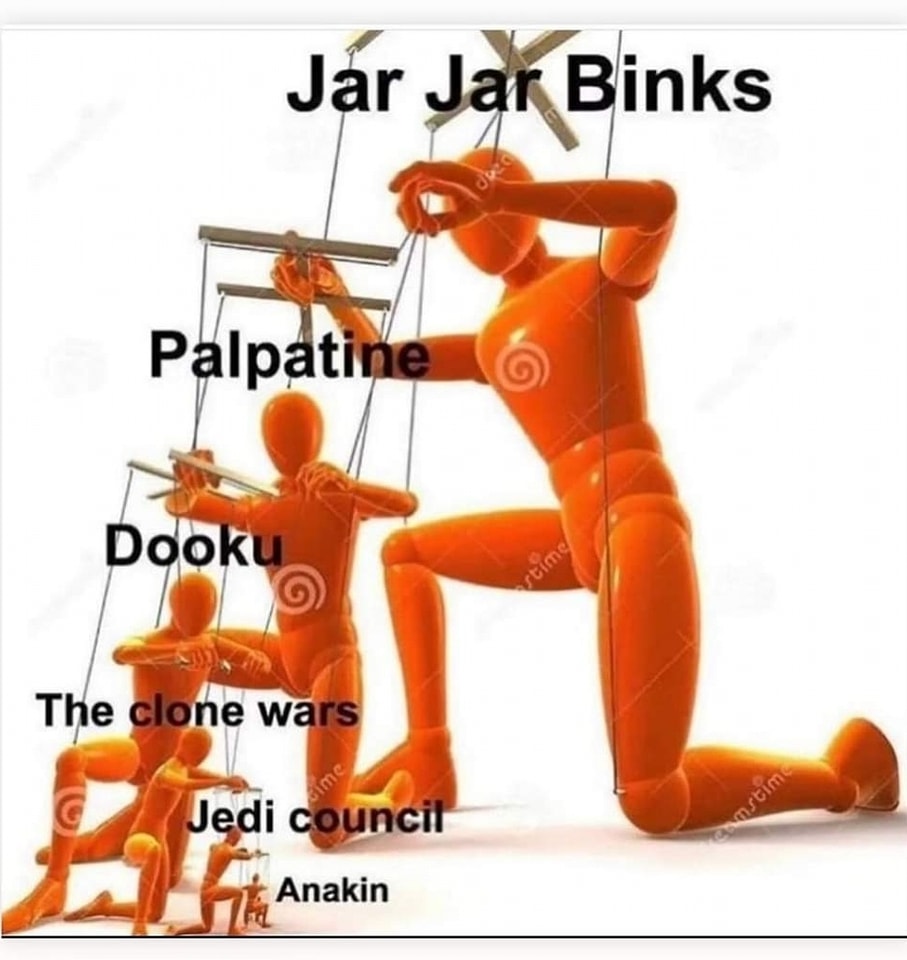
This Star Wars meme visualizes a hierarchy of puppet masters using the classic "Jar Jar Binks" reference. The text labels the largest figure as "Jar Jar Binks," who appears to be pulling the strings of the larger figures behind him. Below him, the chain is labeled "Palpatine," "Dooku," "The clone wars," "The Jedi council," and "Anakin," creating a visual story of one figure controlling the actions of the others.
simple-description (llama3.2-vision_11b)
The meme is a play on the Star Wars franchise, specifically referencing the character of Jar Jar Binks, who is often considered one of the most annoying characters in the series. The image likely shows a person or character with multiple puppet strings controlling them, with each string labeled with a different Star Wars character or concept (e.g. "Jar Jar Binks", "Palpatine", "Darth Vader", etc.). The text "I'm controlled by the puppet masters" or something similar might appear above or below the image, referencing the idea that these characters are somehow controlling or manipulating the protagonist of the Star Wars series.
detailed-analysis (gemma3-27b-vision)
Okay, let's break down this meme using the requested theoretical lenses. It's a pretty layered image, so each section will address how the chosen theory illuminates its meaning.
Visual Description
The image depicts a digitally manipulated representation of Jar Jar Binks as a large, puppet-like figure, constructed from what appears to be orange plastic mannequin parts. This is set against a light blue background with watermarks from the stock photo website "dreamstime". Strings extend from above, manipulated by smaller figures labeled as: Palpatine, Dooku, “The Clone Wars”, “The Jedi Council”, and Anakin. The positioning suggests that each labeled figure is controlling Jar Jar Binks's movements, presenting him as a puppet in their schemes. The meme is framed as a direct indictment of Jar Jar as a plot device.
Foucauldian Genealogical Discourse Analysis
This image is highly amenable to a Foucauldian reading. Michel Foucault’s genealogical approach focuses on the historical construction of power relations and how “truth” is produced through discourse.
- Power/Knowledge: The meme depicts Jar Jar Binks as a site upon which power is enacted, not as an agent of power itself. Palpatine, Dooku, the Jedi Council, the Clone Wars, and Anakin all "pull the strings," signifying that their discourses (their strategies, manipulations, rules, and narratives) construct Jar Jar’s function within the Star Wars narrative.
- Discourse and Subjectivity: Jar Jar’s apparent clumsiness and perceived uselessness aren’t inherent traits but are produced by the dominant discourses within the Star Wars universe. The image suggests his very existence is a deliberate construction to further the agendas of the controlling figures. It suggests his representation reinforces particular power dynamics.
- Archaeology of Knowledge: A genealogical analysis would examine how the perception of Jar Jar Binks as a comedic relief, a clumsy Gungan, has become a normalized part of Star Wars "knowledge," obscuring the potential for a more complex reading of his role. The meme is an attempt to disrupt that normalized reading.
- The Meme as Counter-Discourse: The meme itself is a counter-discourse—a challenge to the accepted understanding of Jar Jar Binks and the Star Wars saga. It proposes a new "truth" about his function as a manipulated pawn.
Critical Theory
Applying Critical Theory (rooted in the Frankfurt School, figures like Adorno and Horkheimer) focuses on the structures of power and domination.
- Culture Industry: The Star Wars franchise, as a major component of the culture industry, produces narratives that can reinforce existing ideologies. This meme critiques the underlying structures within that narrative, exposing how a character like Jar Jar Binks can be used to advance a larger, potentially problematic agenda.
- Ideology: The meme suggests that the “comedic relief” and perceived ineptitude of Jar Jar Binks serve an ideological function, potentially distracting from deeper political machinations within the Star Wars universe. His function as a figure of ridicule might normalize a kind of powerlessness.
- Domination: The controlling figures (Palpatine, Dooku, etc.) represent the dominant forces within the Star Wars narrative. They exploit Jar Jar Binks for their own ends, demonstrating a clear power imbalance.
- Alienation: Jar Jar Binks, as a puppet, can be seen as a symbol of alienation—separated from agency and controlled by external forces.
Marxist Conflict Theory
A Marxist lens focuses on class struggle and the exploitation of one group by another. While Star Wars isn't a straightforward allegory for class struggle, the meme can be interpreted through this lens:
- Exploitation: Jar Jar Binks, as the manipulated figure, represents a class of “useful fools” or exploited subjects. He is a pawn in the power struggles of the Jedi, Sith, and political elites.
- False Consciousness: If we see the Star Wars audience as the "proletariat" in this context, their enjoyment of Jar Jar Binks as a comedic character could be seen as a form of “false consciousness”—a distraction from the underlying power dynamics. They are entertained while deeper, more exploitative processes unfold.
- Power Dynamics: The image explicitly depicts the unequal distribution of power within the Star Wars universe. Those with power (Palpatine, Dooku) control those without (Jar Jar Binks).
- Means of Production: In a broader interpretation, the "means of production" could be the narrative itself. The controlling figures control the narrative, and Jar Jar Binks is a product of that control.
Postmodernism
Postmodern thought challenges grand narratives and emphasizes the constructed nature of reality and knowledge.
- Deconstruction: The meme deconstructs the traditional understanding of Jar Jar Binks as a simple comic character. It reveals the hidden power structures that influence his portrayal and function.
- Simulacra & Simulation: Jar Jar Binks, in this meme, is arguably a simulacrum—a copy without an original. His function within the narrative is artificial, constructed by external forces. The “reality” of his character is a simulation.
- Meta-narrative Critique: The meme critiques the larger Star Wars saga as a "meta-narrative" – a sweeping story that claims to offer a unified meaning. It argues that this narrative is itself constructed and potentially problematic.
- Rejection of Objective Truth: Postmodernism would suggest that there is no single "correct" interpretation of Jar Jar Binks. The meme is just one possible reading, challenging the notion of objective truth.
Queer Feminist Intersectional Analysis
While this meme doesn’t explicitly address issues of gender or sexuality, it’s possible to apply an intersectional lens:
- Power Dynamics and Marginalization: Jar Jar Binks, as a Gungan, could be seen as representing a marginalized group within the Star Wars universe. The meme highlights how this marginalized figure is exploited and manipulated by dominant forces. (This is a bit of a stretch, as the portrayal of Gungans in the film is itself problematic.)
- Control & Agency: The meme depicts a complete lack of agency for Jar Jar Binks. This can be linked to feminist critiques of patriarchal power structures that deny agency to marginalized groups.
- Intersection of Oppression: The meme might be interpreted as highlighting the intersection of marginalization (being a Gungan) with exploitation (being used as a pawn).
- Challenging Dominant Narratives: The meme challenges the dominant narrative of Jar Jar Binks as a simple comic character, potentially reclaiming his agency by exposing the power structures that control him.
I hope this detailed analysis is what you were looking for! Let me know if you’d like me to expand on any specific point or theoretical lens.
simple-description (llama3.2-vision)
This meme is a play on the phrase "I'd rather die than" and features a split-screen image with the Star Wars character Darth Vader on one side and the character Anakin Skywalker on the other. The text "I'd rather die than" is written above the split-screen, and the phrase "be a Jedi" is written below, referencing the iconic "I'd rather die than be a Jedi" line from the Star Wars prequels. The meme is a humorous take on the character's infamous line, poking fun at the idea that being a Jedi is somehow worse than death.
tesseract-ocr
J r Ja Binks ra oe Palpatines T © re ia j =. Bie ~_—