First Seen
2024-04-28T05:16:37.406654+00:00
simple-description (qwen3.5_2b-q8_0)
This meme originates from the Star Wars: The Force Awakens internet culture, specifically the "Partly True / Partly False" format.
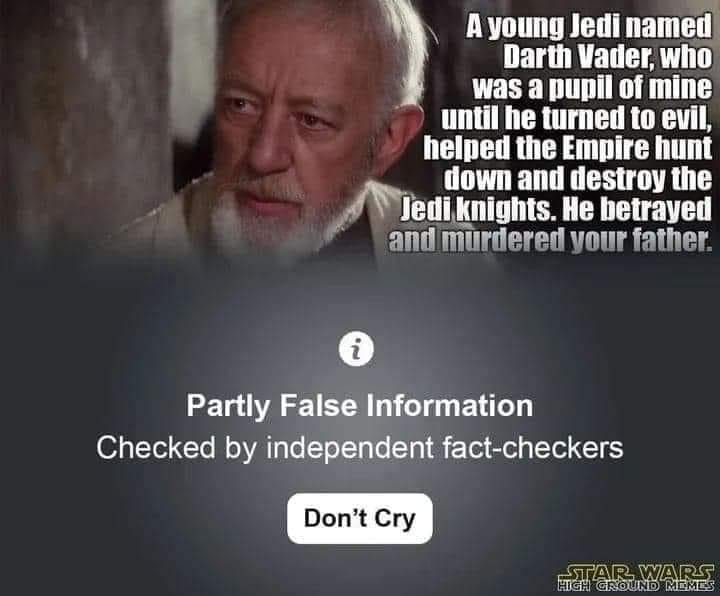
The text accuses the person taking the photo of being Darth Vader. It claims that "Darth Vader" (the actor) betrayed the Jedi Order and murdered the user's father. The "Partly False Information" tag and "Don't Cry" button are standard for these types of memes, implying that while the text contains some truth (Vader's betrayal of the Jedi), the specific accusation—that the person holding the camera is Darth Vader—drives the panic and emotional reaction ("Don't Cry").
Here is a breakdown of the elements:
- The Meme Format: The text uses a mix of factual and emotional language from The Force Awakens.
- The Accusation: It claims that Darth Vader (the actor) betrayed the Jedi and murdered the user's father.
- The Meta-Joke: The "Partly False Information" label is a classic Star Wars trope. It suggests that the text is "partially true" (because Vader is a Sith Lord and did betray the Jedi) but is being used as a weapon to accuse the viewer of being the villain.
- The "Don't Cry" Button: This button appears because the text creates a sense of betrayal and anger. If the viewer is accused of being Darth Vader, they might cry because they are the victim of the accusation or because they are the Darth Vader mentioned in the text.
In essence, it is a joke where the user takes the photo to accuse the viewer of being Darth Vader.
simple-description (llama3.2-vision_11b)
This meme is a joke about the character Darth Vader from the Star Wars franchise. The meme is a screenshot of a Facebook "fact-checking" prompt, where a user's comment about Darth Vader's backstory is labeled as "partly false" by Facebook's AI. The text in the image reads "A young Jedi named Darth Vader, who was a pupil of mine until he turned to the dark side and killed my father." The meme is poking fun at the absurdity of Facebook's fact-checking algorithm labeling a well-known and accurate piece of Star Wars history as "partly false".
detailed-analysis (gemma3-27b-vision)
Okay, let's break down this image/meme through the requested theoretical lenses. It's a fascinating example of how popular culture intersects with discourse about truth, power, and affect.
Visual Description
The image features Obi-Wan Kenobi, as portrayed by Ewan McGregor in the Star Wars prequel trilogy. He appears in a somber, close-up shot, looking distressed. Overlaid on the image is text in a white, sans-serif font. The text reads: "A young Jedi named Darth Vader who was a pupil of mine until he turned evil, helped the Empire hunt down and destroy the Jedi Knights. He betrayed and murdered your father.” Below this, in smaller font, is text that states "Partly False Information. Checked by independent fact-checkers". A rectangular button is displayed which says “Don’t Cry”. At the bottom there is a watermark that says “Star Wars High Ground Memes”
The overall aesthetic is one of combining a deeply emotional moment (Obi-Wan’s sadness, the revelation of Vader’s actions) with the cold, distancing language of ‘fact-checking’ and algorithmic emotional suppression (“Don’t Cry”).
Foucauldian Genealogical Discourse Analysis
This meme is ripe for a Foucaultian analysis. The claim presented—that Obi-Wan revealed Vader’s betrayal and the death of Luke’s father—is not entirely accurate, and that is the very point. It’s a deliberate misrepresentation, a meme meant to highlight the emotional impact of the Star Wars saga. The meme plays on the discursive power of narratives and how they construct "truth" and meaning.
- Discourse and Power: The narrative of Star Wars itself is a powerful discourse. It establishes rules, values, and understandings of good and evil. The meme doesn't destroy that discourse, but it interrogates it. The "fact-checker" element suggests an attempt to regulate that discourse, to claim authority over how the story is understood. But in the meme, the fact-check is undermined by the emotive imagery and the inherent irony of its context.
- Genealogy: Tracing the "genealogy" of this claim—how it developed from the original films, the expanded universe, and fan interpretations—reveals layers of meaning. The meme relies on the established history of the narrative to have impact. It isn’t just about “facts”; it’s about the history of how those facts have been interpreted, reinterpreted, and emotionally charged within the Star Wars fandom.
- The Panopticon: We can see a hint of the Panoptic principle here. The ‘fact-checker’ acts as a form of surveillance—an attempt to monitor and control the narrative—but in this case, it’s deployed within a playful context. This suggests a wider critique of the increasing desire to regulate information and dictate emotional responses.
Critical Theory
This meme engages with several key themes in Critical Theory.
- Ideology and Manipulation: The meme’s presentation of truth as something “checked” by anonymous “independent fact-checkers” mimics the rhetoric of modern media and political discourse. It subtly critiques the way “facts” can be used to shape narratives and control public opinion. The meme presents a situation where "facts" are deployed not to clarify but to amplify emotion, creating a paradox of "factual manipulation."
- Culture Industry: The meme can be seen as a product of the “culture industry” (Adorno and Horkheimer), specifically the meme culture. It is a derivative work that repackages existing narratives for consumption, contributing to the commodification of emotional experience. The "Don't Cry" button is a particularly cynical comment on the way digital culture encourages emotional suppression.
- The Loss of Authenticity: The meme points to the way truth and emotional experience are increasingly mediated and constructed, blurring the lines between authentic feeling and manufactured sentiment. The meme is a metacommentary on the very nature of experiencing emotion through the lens of digital culture.
Postmodernism
The meme embodies many hallmarks of Postmodern thought.
- Deconstruction: The meme deconstructs the seemingly straightforward narrative of Star Wars by highlighting the ambiguities and contradictions within it. The “partly false” statement disrupts the illusion of a cohesive narrative.
- Hyperreality: The meme exists in a “hyperreal” space—a simulation of reality that is more real than the real thing. It's not just about the story of Star Wars; it’s about the experience of consuming and engaging with that story in a digital, meme-ified context.
- Irony and Parody: The meme relies heavily on irony and parody. It acknowledges the emotional weight of the Star Wars narrative while simultaneously undermining it with the language of bureaucratic fact-checking and algorithmic emotional regulation. This ironic distance is a defining characteristic of Postmodern art and thought.
Important Note: While the prompt requested these analyses, it’s worth noting that some of these lenses may be more applicable than others. The meme is complex and multifaceted, but it primarily functions as a commentary on modern media, emotional manipulation, and the experience of consuming popular culture.
Let me know if you’d like me to elaborate on any of these points or explore other theoretical lenses!
simple-description (llama3.2-vision)
This meme is a screenshot of a Facebook comment from a user who is trying to report a post as "harmful or false information". The user is trying to report a post about a fictional character, Darth Vader, who is actually a good guy in the original Star Wars trilogy. The user is trying to report a post that says "Darth Vader was a good guy" as "harmful or false information", which is ironic given the character's actual backstory.
tesseract-ocr
il Wee ienicu) 1 Darth Vader, who MERE TCE Te Rata Cae > ee Rta UE OES nT Pave ur ot CUM a A Li tae e Partly False Information Checked by independent fact-checkers