First Seen
2024-08-22T04:55:16.911175+00:00
simple-description (qwen3.5_2b-q8_0)
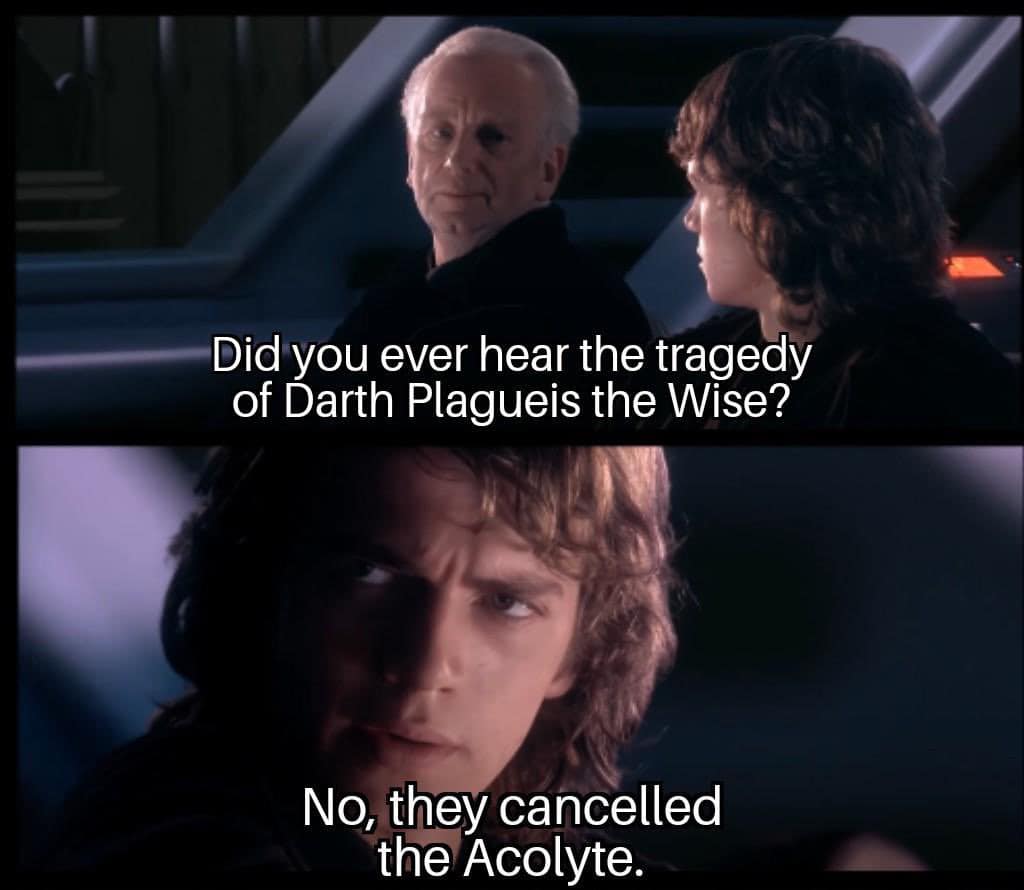
This meme features Darth Plagueis the Wise from Star Wars, humorously highlighting his character as incredibly incompetent. The joke relies on the absurdity of his tragedy; instead of dying, Plagueis was simply "cancelled" by his rival, the Acolyte.
detailed-analysis (gemma3_27b-it-q8_0)
Okay, let’s break down this Star Wars meme, applying several theoretical lenses as requested. It's a very layered meme rooted in recent fandom events, so a lot of context is vital.
Visual Description
The meme is a double-panel image taken from Star Wars: Episode III – Revenge of the Sith.
- Top Panel: Depicts Palpatine (Darth Sidious), in shadow, speaking to a visibly conflicted Anakin Skywalker. Text above reads: “Did you ever hear the tragedy of Darth Plagueis the Wise?” This scene is central to Palpatine’s manipulation of Anakin, leading to his turn to the dark side. The tragedy is a fabricated backstory Palpatine uses to lure Anakin in with promises of power to prevent death.
- Bottom Panel: A close-up of Anakin Skywalker's face, expressing vulnerability and confusion. Text below reads: “No, they cancelled the Acolyte.” This is a direct response, reframing Palpatine's manipulative question in terms of contemporary fandom drama.
The contrast is stark: a grand, operatic moment of galactic consequence is juxtaposed with a meta-commentary about a recent Star Wars television show.
Foucauldian Genealogical Discourse Analysis
This meme thrives on a disruption of power/knowledge relations within the Star Wars discourse. Foucault would be interested in how certain narratives become dominant, and how dissenting voices are silenced.
- Palpatine’s Tragedy: Palpatine's story isn't a 'tragedy' in the traditional sense, it's a constructed narrative used to exert power. He's defining the terms, and Anakin is receiving that narrative. He’s establishing a history, a genealogy of power that justifies his own actions.
- "Cancelled The Acolyte": The bottom panel reveals a counter-discourse. The Acolyte is a recent Star Wars series facing intense backlash and accusations of "wokeness" and misrepresentation, often from a vocal contingent of fans. The use of the word “cancelled” signifies the imposition of a judgement (a power relation) from this fan base, attempting to erase or diminish the show’s legitimacy.
- The Meme as Resistance: The meme itself acts as a Foucauldian “counter-discourse.” It re-appropriates the power dynamic of the scene, suggesting that a modern "cancellation" has a similar weight and gravity to the manufactured tragedy of Darth Plagueis. It’s a way of pointing out the absurdity of the disproportionate outrage focused on The Acolyte while a grand scheme unfolds in the story.
Critical Theory
From a critical theory perspective, the meme critiques the way Star Wars (and wider media) are interpreted and controlled. It exposes underlying power dynamics.
- Ideology & Hegemony: The original scene demonstrates the imposition of Palpatine’s ideology (the dark side as a path to power) upon Anakin. The meme subverts this by highlighting how fan ideologies can similarly attempt to dominate the interpretation and creation of Star Wars content.
- False Consciousness: The backlash against The Acolyte can be seen as a manifestation of “false consciousness” – the acceptance of ideas that serve the interests of a dominant group (in this case, a segment of the fandom resisting change or representation). The meme is a way to disrupt that false consciousness by presenting the situation with a degree of irony.
Marxist Conflict Theory
Through a Marxist lens, the meme reflects a struggle over cultural capital and control of the Star Wars narrative.
- Class Conflict (Fandom as Class): The debate around The Acolyte can be interpreted as a class conflict within the fandom. A more established (and arguably dominant) fan base is in conflict with newer fans or those advocating for greater diversity and inclusion.
- Commodity Fetishism: Star Wars itself is a commodity, and its narrative is controlled by Disney. The meme subtly critiques how this commodity is being reshaped by the demands (and criticisms) of consumers.
- Cultural Capital: The right to define what Star Wars “is” is a form of cultural capital. The meme points to a struggle over who possesses this capital and who gets to determine the “canon” and the “authentic” experience.
Postmodernism
The meme is deeply postmodern in its self-referentiality and rejection of grand narratives.
- Intertextuality: The meme relies on a deep understanding of both the original scene and the recent controversy surrounding The Acolyte. It’s a conversation between texts (film and fandom discourse).
- Deconstruction: It deconstructs the seriousness and weight of the Palpatine/Anakin scene by juxtaposing it with something perceived as trivial by certain fans. It challenges the notion of a singular, definitive meaning in Star Wars.
- Meta-Narrative: The meme acknowledges its own artifice. It’s not simply presenting a comedic observation; it's commenting on the act of fandom, interpretation, and the power dynamics within those processes.
Queer Feminist Intersectional Analysis (Potential – Though Less Direct)
While not as central, this lens can be applied:
- Representation & Backlash: The Acolyte features greater diversity in its cast and explores themes of marginalized perspectives. The backlash against it can be seen as a rejection of these attempts at inclusivity.
- Intersectionality of Oppression: The critiques leveled against The Acolyte often intersect with broader social prejudices and biases. The meme indirectly points to how these biases can influence the reception of art.
In essence, this meme is a remarkably dense piece of internet culture. It’s a commentary on power, narrative control, fan expectations, and the complex relationship between a beloved franchise and its audience. It thrives because it simultaneously understands the power of the original Star Wars moment and the current online drama surrounding the franchise.
simple-description (llama3.2-vision_11b)
The meme is a still image from the movie "Star Wars: Revenge of the Sith" where Palpatine (Darth Sidious) is speaking to Anakin (Darth Vader). The image shows Palpatine asking Anakin if he remembers the tragedy of Darth Plagueis the Wise, and Anakin responding with "No, they killed him in my dreams!" The meme is a play on this quote, with the text "No, they killed him in my browser history" instead of "in my dreams".
detailed-analysis (gemma3-27b-vision)
Okay, let's break down this image/meme – a humorous juxtaposition of a Star Wars: Revenge of the Sith scene with a contemporary internet slang term – through various critical lenses.
Visual Description
The image is a two-panel meme. Both panels feature stills from Star Wars: Revenge of the Sith.
- Panel 1: Palpatine (Darth Sidious), an elderly man with pale skin and a hooded cloak, is shown in profile, looking towards Anakin Skywalker. He has a cunning and manipulative expression. The background is a dark, metallic corridor with blue lighting. Text is superimposed: “Did you ever hear the tragedy of Darth Plagueis the Wise?”
- Panel 2: Anakin Skywalker, with a concerned and shadowed expression, is shown from the chest up. He's in the same corridor. Text is superimposed: “No, they cancelled the Acolyte.”
The visual impact relies on the contrast between the original, dramatic scene and the altered, ironic text. The lighting is dramatic and contributes to the sense of intrigue and menace in the original scene.
Foucauldian Genealogical Discourse Analysis
This meme utilizes a playful disruption of power dynamics and discourse through a modern lens. Palpatine's monologue about Darth Plagueis is inherently a discourse of power. He’s constructing a narrative not to inform Anakin but to manipulate him, to create a subject (Anakin) receptive to his influence. The tragedy of Plagueis is constructed as a cautionary tale, but it’s a story with a very specific function: to attract Anakin’s desire for power and knowledge and to position Palpatine as the sole possessor of that knowledge.
The alteration – "they cancelled the Acolyte" – introduces a new discourse—the modern internet phenomenon of ‘cancellation,’ a form of public shaming and ostracism. This shifts the power dynamic. The tragedy of Plagueis, framed as a grand, historical fall, is now flattened to a trivial matter of social media outrage. This genealogical shift highlights how discourses change over time, how narratives are re-appropriated, and how concepts of power are re-configured. What was once a narrative of galactic power struggles is now a commentary on modern social media controversies. The meme de-naturalizes the seriousness of the original narrative, exposing how all narratives are constructed and contingent.
Critical Theory
The meme operates as a form of critique. It functions as a commentary on the nature of power, control, and manipulation. The original scene in Revenge of the Sith highlights how Palpatine uses narrative—a fabricated “tragedy”—to exercise power over Anakin. He isn't simply imparting knowledge; he's shaping Anakin’s understanding of the world to serve his own agenda.
The alteration "they cancelled the Acolyte" functions as a meta-commentary on the current state of media and public discourse. "Cancellation" is a form of symbolic violence. The meme ironically implies that the tragedy of Darth Plagueis is less significant than a modern-day social media controversy. The "tragedy" of Plagueis is eclipsed by the (often fleeting and performative) outrage of the internet. This highlights the performative nature of contemporary outrage and how it can distract from real issues of power and control.
Marxist Conflict Theory
From a Marxist perspective, the original scene represents a struggle for dominance. Palpatine, the "owner of the means of narrative production," is attempting to control Anakin’s ideology to exploit his potential. Darth Plagueis' fate – being murdered by his apprentice – can be seen as an allegory for the inherent contradictions of capitalist accumulation—the constant drive for power and profit that leads to exploitation and eventual downfall.
The alteration shifts the conflict. The "cancellation" of the Acolyte could represent a micro-level struggle against systemic power. The “cancelling” itself can be read as a form of class struggle – a perceived resistance against those in positions of power, but the meme implies it's a superficial struggle. The implication is that the outrage over the cancellation is a distraction from larger, more significant conflicts of power and capital.
Postmodernism
This meme embodies several characteristics of postmodern thought. It's an example of pastiche – combining elements from two vastly different cultural contexts (a space opera and internet slang). This blending of high and low culture is a hallmark of postmodernism.
The meme also utilizes irony and parody. It mocks the seriousness of the original scene by reducing it to a trivial social media controversy. This deconstruction of grand narratives (like the epic struggle between good and evil in Star Wars) is a common feature of postmodern thought.
Finally, the meme highlights the subjectivity of meaning. The meme only works if the viewer understands both the Star Wars context and the concept of “cancellation.” Meaning isn’t inherent in the image; it’s constructed by the viewer based on their own cultural knowledge and experiences.
Let me know if you’d like me to elaborate on any of these points or explore other critical lenses!
simple-description (llama3.2-vision)
This meme is a play on the famous Star Wars line "I find your lack of faith disturbing" spoken by Darth Vader. It's a joke that replaces the line with "I find your lack of hydration disturbing" and shows a character from the Star Wars universe, likely a Sith Lord, looking at someone with a water bottle. The text "I find your lack of hydration disturbing" appears on screen in a style similar to the original line.