First Seen
2024-10-30T05:12:04.003525+00:00
simple-description (qwen3.5_2b-q8_0)
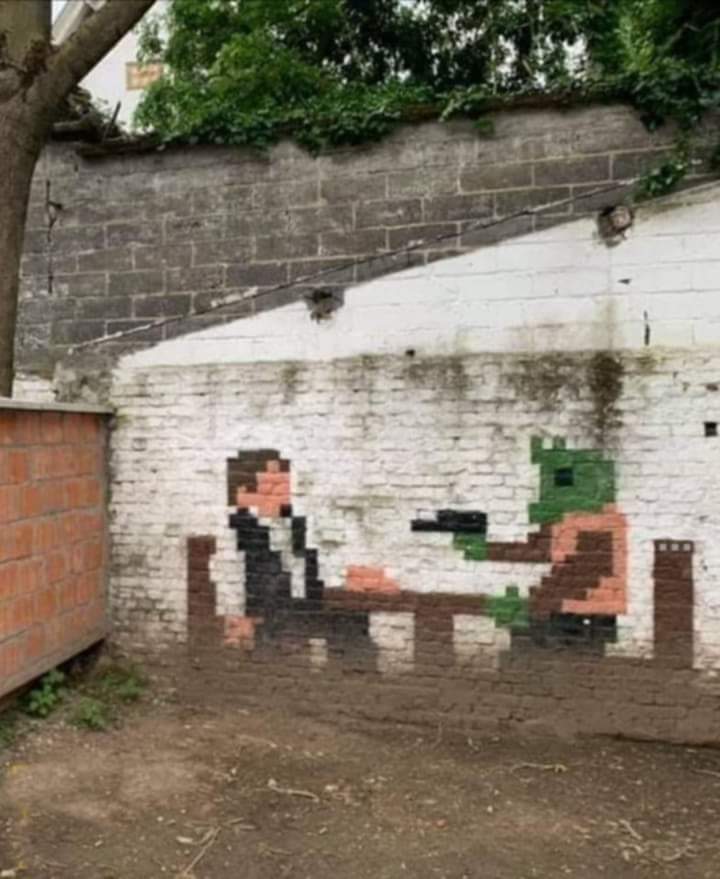
This pixel art mural recreates a scene from the 8-bit era of Star Wars, featuring a standoff between a character in a suit and a green pixel monster, evoking the violence of classic video game battles. The text "Hilton" is visible on a building in the upper left, providing a clue to the street art's location. It serves as a nostalgic tribute to the retro gaming aesthetic that defined the Star Wars franchise for decades.
detailed-analysis (gemma3_27b-it-q8_0)
Okay, let's analyze this meme—a pixelated mural depicting a scene strongly resembling the Mos Eisley Cantina from Star Wars: A New Hope—through the lenses you've requested. Given the image's nature, some theoretical frameworks will be more applicable than others.
Visual Description
The image showcases a street mural, likely painted on a whitewashed brick wall. The mural depicts a very low-resolution (pixelated, 8-bit style) scene of a cantina interior. We can discern two figures: one is dressed in clothing closely associated with Han Solo (dark vest, light shirt), seated at a small, pixelated table. Facing him is a character that strongly resembles a Rodian (the species of Greedo). The Rodian is pointing a blaster at the Solo figure. The overall aesthetic leans into a retro-video game visual, almost reminiscent of early console graphics. The surroundings are minimalist, utilizing the brick texture to suggest walls and structure, and some minimal rendering of a bar area. The image is shot from a slightly low angle, showing some of the surrounding urban environment (bushes, a brick structure, ground).
Foucauldian Genealogical Discourse Analysis
This meme engages with the discourse surrounding the "Who Shot First?" debate in Star Wars. Originally, in the 1977 theatrical release, Han Solo shot Greedo without provocation. Later special editions, heavily revised by George Lucas, altered the scene to make Greedo shoot first, thereby painting Han as more of a reluctant hero acting in self-defense.
Foucault’s genealogy examines how power operates through discourse. The scene and its subsequent alterations were not merely aesthetic choices but enactments of power. Lucas's revision was a re-writing of history, an assertion of control over the narrative, and a desire to shape the perception of Han Solo's character. The pixelation of the mural in this meme suggests a deliberate "deconstruction" of that power. By reducing the scene to its most basic visual elements, it emphasizes the constructedness of the narrative itself. The “truth” of who shot first becomes fragmented, pixelated, and open to interpretation. The meme acknowledges that the event is not a fixed reality but a product of discourse and power relations.
Critical Theory
From a critical theory perspective (drawing on scholars like the Frankfurt School, especially Adorno and Horkheimer), this meme functions as a subtle critique of the culture industry. Lucasfilm's revisions represent the commodification of art and the simplification of complex moral questions. The original scene offered ambiguity and challenged traditional heroic tropes. The revised scene, designed to be more palatable to a wider audience, represents a retreat into simplified narratives and consumer-friendly characterization.
The pixelated aesthetic further reinforces this critique. It transforms the iconic scene into a form of low art, deliberately distancing itself from the polished, high-budget production values of the Star Wars franchise. It's a meta-commentary on the process of turning art into commodity, and the loss of nuance inherent in that process.
Marxist Conflict Theory
While not a primary focus, we can apply a Marxist lens. Consider Lucasfilm as representing the "means of production" of the Star Wars narrative. The original scene can be seen as a challenge to dominant ideologies (the unquestioning acceptance of hero narratives). The revisions represent the imposition of ideology by those in control of the means of production, ensuring the narrative aligns with commercially viable themes and reinforces conventional heroic tropes.
The meme, then, acts as a form of cultural resistance. It is a grassroots, fan-created re-appropriation of the image, challenging the official narrative. The pixelated style can be read as a deliberate rejection of the slick, highly produced aesthetic that signifies the corporate control of the Star Wars universe.
Postmodernism
The meme is highly postmodern. It’s a pastiche — taking an iconic image and re-presenting it in a deconstructed, stylized way. The pixelation is a key element of this, highlighting the artifice and constructed nature of the original scene.
Several postmodern tenets are present:
- Intertextuality: The meme relies on pre-existing knowledge of the Star Wars scene and the "Who Shot First?" controversy.
- Meta-narrative Deconstruction: It doesn’t simply show the scene, it comments on the scene and its contested history.
- Irony and Playfulness: There's an ironic humor in reducing such a culturally significant moment to a retro-gaming aesthetic.
- Blurring of High and Low Culture: The meme takes a piece of high-budget filmmaking and transforms it into a form of low-brow street art.
Queer Feminist Intersectional Analysis
This is the least directly applicable theoretical framework. While one could stretch an argument to discuss how the revision of the scene reinforces heteronormative expectations of heroism (i.e., the "good guy" doesn't shoot first), it's a tenuous connection. There isn’t a clear intersectional element in the original scene's gender dynamics or the way it portrays marginalized identities. The meme itself does not overtly engage with these issues. However, one could argue that the act of fan reclamation of the original narrative (which the meme represents) is itself an act of resistance against dominant power structures.
In conclusion, the meme is a surprisingly rich artifact that functions as a subtle but powerful commentary on the control of narrative, the commodification of art, and the enduring power of fandom. Its pixelated aesthetic acts as a deliberate strategy for deconstruction and resistance, highlighting the constructed nature of reality and the enduring debate surrounding one of Star Wars' most controversial moments.
simple-description (llama3.2-vision_11b)
This meme is a reference to the iconic scene from the Star Wars franchise where Han Solo and Chewbacca are escaping from the Death Star. The image is a pixel art recreation of this scene, with Han Solo and Chewbacca sitting at a table, but with a twist: Han is drinking a cup of coffee, and Chewbacca is holding a cup of coffee, but it's actually a cup of espresso with a face on it, making it look like it's saying "I'm not a coffee, I'm a coffee with feelings".
detailed-analysis (gemma3-27b-vision)
Here's an analysis of the image, broken down into relevant sections. It's important to note that some of these lenses may be more applicable than others, and interpretation is subjective.
Visual Description
The image depicts a street art mural painted on a brick wall. The mural is a pixellated representation of two figures seated at a table. One figure, on the left, is dressed in a dark suit and appears to be facing the viewer. The other figure, on the right, is partially obscured, but seems to be similarly dressed and engaged in some kind of interaction with the first figure. A table separates them, with objects resembling smoking paraphernalia laid out upon it.
The wall itself is a mixture of white-washed brick and exposed weathered brick. The setting appears to be an alleyway or courtyard, with rough dirt ground and some greenery visible above. The mural's pixelated style gives it a deliberately lo-fi aesthetic, reminiscent of early digital art or 8-bit video games. This contrasts with the otherwise realistic depiction of the subjects.
Foucauldian Genealogical Discourse Analysis
The mural speaks to a discourse of illicit social activity. The presence of smoking paraphernalia strongly suggests a transgression, a practice that's been historically subjected to regulation and surveillance. Foucault would see this as an example of power operating through "disciplinary technologies."
- Power/Knowledge: The mural doesn't directly show the imposition of power, but implies the social structures that define “normal” behavior and “deviance.” The act of depicting this illicit activity itself becomes an exercise of power, a claiming of space for what might otherwise be hidden.
- Genealogy: The act of smoking, and the associated subcultures, have a complex history of regulation, medicalization, and moral condemnation. A genealogical approach would trace how these discourses emerged, solidified, and changed over time. The pixelated style might be interpreted as a disruption of established historical narratives.
- Panopticism: The mural implies the "gaze." Someone is watching or has watched, or the figures anticipate being watched. The alleyway setting, with its potential for hidden observation, reinforces this notion.
Critical Theory
The mural lends itself to a Critical Theory interpretation in its depiction of a marginalized space.
- Alienation: The alleyway setting and the clandestine nature of the depicted activity suggest a sense of social alienation. The figures are separated from mainstream society, inhabiting a liminal space.
- Commodity Fetishism: While not explicit, the paraphernalia on the table hints at the consumption of goods – materials for smoking, potentially drugs, or other substances. This aligns with a critical theory understanding of consumer culture and its role in shaping identity.
- Critique of Rationality: The image challenges the assumptions of a perfectly rational and orderly society. The alleyway is an "irregular" space that is necessary for illicit activity, but is often ignored in the construction of city landscapes.
Marxist Conflict Theory
Conflict theory, rooted in Marxist thought, can be applied by looking at power imbalances and the struggle for resources. The mural depicts an act that, depending on the substance being consumed, may be tied to economic undercurrents.
- Class conflict: The activity depicted may be associated with a marginalized social group, perhaps experiencing economic disadvantage. The alleyway setting, outside of the mainstream, can be interpreted as a physical manifestation of social exclusion.
- Ideology: The image might challenge dominant ideologies about health, morality, and appropriate social behavior. It presents a counter-narrative, a glimpse into a world operating outside of the accepted norms.
- Control of resources: Depending on the material consumed in the depiction, it could also be interpreted as a visual statement about the illicit distribution of resources.
Postmodernism
The image resonates with several postmodern themes:
- Intertextuality: The pixelated style references the aesthetic of early digital art and video games, creating a layer of intertextual meaning. It plays with our cultural understanding of these forms.
- Simulacra and Simulation: The mural itself is a representation of an event, a simulation of reality. The pixelated style adds to this sense of artificiality.
- Fragmentation: The pixelation and the hidden nature of the setting visually fragment the scene, mirroring the postmodern sense of a fractured and unstable reality.
- Rejection of Grand Narratives: The alleyway setting and the implied subculture reject the idea of a singular, unified truth. It’s a localized, alternative space.
Queer Feminist Intersectional Analysis
While not immediately apparent, a Queer Feminist Intersectional reading can be applied:
- Hidden Spaces: Alleyways and marginalized spaces have historically served as safe havens for LGBTQ+ communities and other groups pushed to the periphery of society.
- Challenge to Normative Behavior: The illicit activity depicted challenges societal norms around legality, morality, and public conduct, potentially aligning with queer and feminist critiques of repressive norms.
- Intersectional marginalization: The space may have a history of being used by multiple oppressed groups. The analysis could examine how factors like class, race, and gender intersect within this hidden landscape.
Disclaimer: These interpretations are not exhaustive and are subject to individual perspective. The power of art lies in its ability to be read in multiple ways.
simple-description (llama3.2-vision)
The meme is a photo of a Star Wars character, Darth Vader, sitting at a table with a Stormtrooper, but instead of a traditional table setting, they are having a meal of spaghetti and meatballs. The caption "I find your lack of spaghetti disturbing" is a play on Vader's famous line "I find your lack of faith disturbing" from the original Star Wars film. The meme is a humorous twist on the classic Star Wars character, poking fun at his reputation as a villain.