First Seen
2025-05-23T22:33:18.965098+00:00
simple-description (qwen3.5_2b-q8_0)
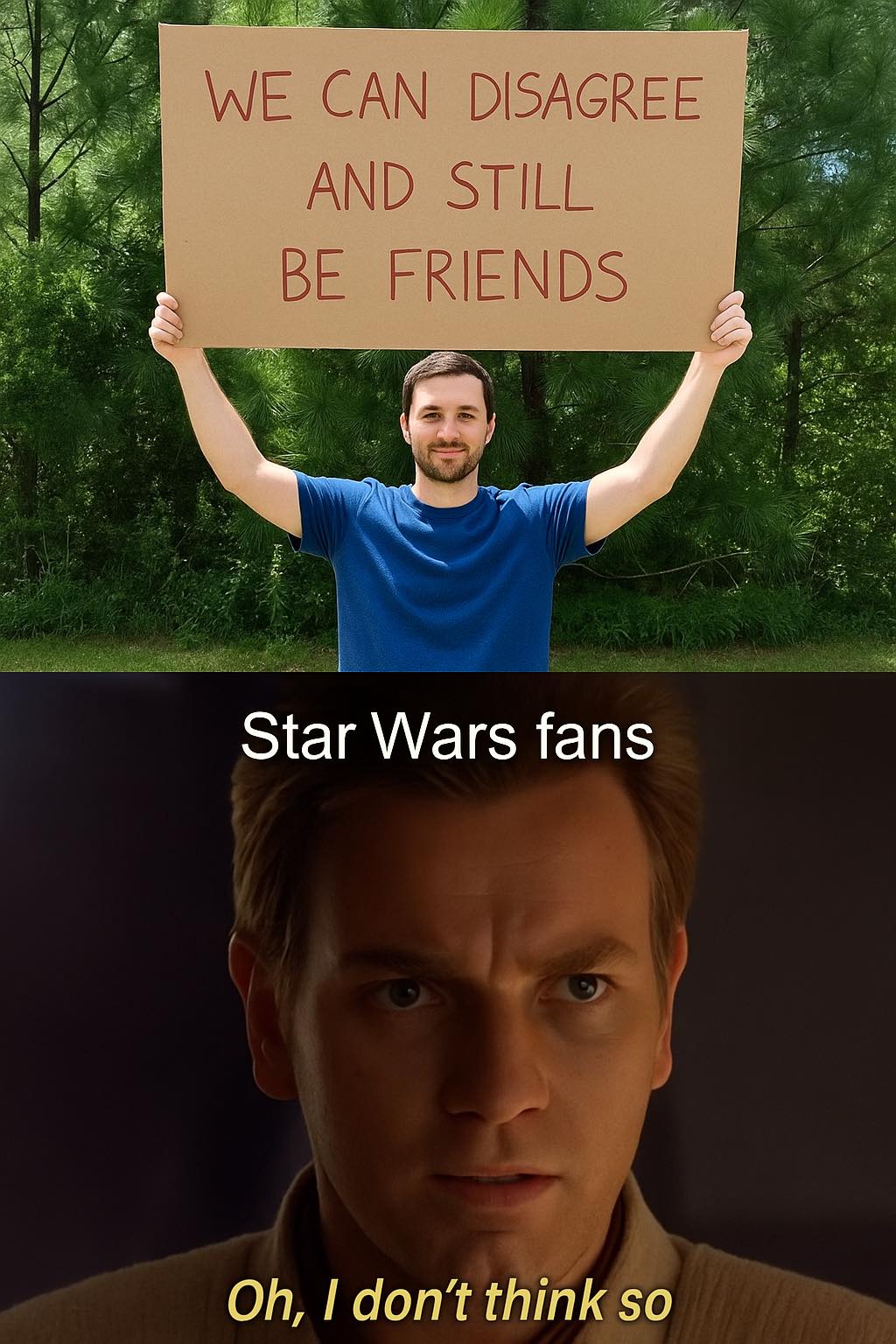
This meme pairs a generic, wholesome photo of a man holding a sign about friendship with the dramatic, unrecognizable face of Walter Cronk from the Star Wars franchise. The text overlay identifies the top image as "Star Wars fans," but then abruptly switches to the line "Oh, I don't think so," a nonsensical parody of the famous Obi-Wan Kenobi dialogue. The humor comes from the sudden juxtaposition of a sincere message of friendship with the gritty, nonsensical dialogue of the Star Wars movies.
detailed-analysis (gemma3_27b-it-q8_0)
Okay, let's break down this Star Wars meme through a few relevant theoretical lenses. This is a particularly potent meme because the Star Wars fandom is notorious for its, shall we say, passionate disagreements.
Visual Description
The meme is a two-panel format. The top panel depicts a person in a casual blue t-shirt holding a handwritten sign that reads “WE CAN DISAGREE AND STILL BE FRIENDS.” They appear to be outdoors, in a somewhat idyllic setting. The image suggests a hopeful, optimistic desire for civility.
The bottom panel features a still of Grand Moff Tarkin (played by Peter Cushing) from Star Wars: A New Hope. Tarkin is a cold, calculating Imperial officer, and his expression is one of disdainful disbelief. He is captioned with "Oh, I don't think so."
The contrast is key. The hopeful message is immediately undercut by the villainous figure implying such civility is impossible, particularly within the realm of Star Wars fandom.
Foucauldian Genealogical Discourse Analysis
This meme speaks volumes about the discourse surrounding Star Wars. Michel Foucault’s work would suggest that power operates not through repression, but through the production of knowledge and the shaping of subjectivity. The Star Wars fandom, while appearing like a collective of fans, is actually a site where various power dynamics play out.
The "canon" itself (what is officially considered part of the Star Wars story) is a prime example. Disney's acquisition of Lucasfilm and subsequent "de-canonization" of the Expanded Universe (now "Legends") generated immense conflict. This wasn’t simply about stories being removed; it was about the power to define what "Star Wars" is.
The meme highlights the impossibility of "agreeing to disagree" because the stakes aren’t just opinions about a story. They are tied to subjective identification and investment in a specific version of Star Wars, shaped by years of engagement and a desire to have that version validated. Tarkin, embodying Imperial authority, represents the feeling that some interpretations are simply wrong, and that there’s an inherent hierarchy of "correctness". The discourse around Star Wars quickly turns into a battle for the "true" meaning and value of the franchise.
Critical Theory
From a Critical Theory perspective, the meme reveals how a seemingly harmless entertainment franchise can become a battleground for deeper ideological tensions. The intensity of arguments often extends beyond the films themselves, touching on broader cultural issues like nostalgia, authorship, representation, and the impact of corporate ownership.
The "sequel trilogy" (Episodes VII-IX) is a perfect example. Criticism of these films often isn't just about plot points. It can tap into anxieties about the disruption of established narratives, perceived political agendas, and changing cultural values. Fans who feel the sequels betrayed the “spirit” of Star Wars aren’t necessarily just complaining about character arcs; they’re reacting to a perceived loss of control and a shift in the cultural meaning of the franchise.
Tarkin, representing the established order and authority, signifies the resistance to change and the desire to maintain the "original" vision. The meme, therefore, exposes the critical tensions within the fandom – the struggle between tradition and innovation, fan agency and corporate control.
Marxist Conflict Theory
While a direct Marxist reading might seem strained, the conflict around Star Wars can be framed through the lens of class and cultural capital. Early fans of the original trilogy – those who experienced it during its initial release – hold a certain "cultural capital." They have a perceived authority based on their seniority and original experience.
Later fans, particularly those who embrace the newer content, are often viewed as less "authentic" or as lacking the necessary understanding of what "true" Star Wars is. This creates a class dynamic, with the "original" fans acting as a sort of cultural elite. The sequels, in this view, become a site of conflict between these groups, representing a challenge to the established cultural order.
Tarkin, as an officer of the Empire, embodies a hierarchical structure and the dominance of one group over another. His response embodies the unwillingness of the "cultural elite" to share or compromise on their definition of Star Wars.
Postmodernism
The meme itself embraces a postmodern sensibility. It's a metacommentary on the fandom, a self-aware acknowledgement of its internal contradictions. Postmodernism challenges grand narratives and emphasizes the subjectivity of truth. In the Star Wars context, this means there's no single "correct" interpretation of the films. However, the fandom often acts as if there is.
The meme uses irony – the contrast between the optimistic message and Tarkin’s dismissive tone – to highlight this tension. It acknowledges that while postmodern thought suggests multiple valid perspectives, the reality within the Star Wars fandom often feels very different. There's a constant attempt to impose a singular narrative, to declare certain interpretations "canon" and others "heretical.” The meme doesn't solve the problem of conflicting interpretations; it points to it with a cynical amusement.
In conclusion:
This meme is funny because it resonates with the lived experience of being a Star Wars fan. It’s a knowing nod to the intense debates, the passionate defenses, and the often-uncivil discourse that characterize the fandom. It exposes the underlying power dynamics, ideological tensions, and the impossibility of truly "agreeing to disagree" when the stakes, for many fans, feel so incredibly high. Tarkin's response is not merely a joke; it's a reflection of the often-toxic reality of Star Wars fandom.
simple-description (llama3.2-vision_11b)
The meme is a play on the iconic "I find your lack of faith disturbing" line from the Star Wars franchise, but this time it's a humorous take on the "I don't like you" sentiment. The image shows a person holding a sign that says "I don't like you" and the response from a Star Wars character, Obi-Wan Kenobi, saying "I find your lack of faith disturbing" but this time it's a humorous take on the sentiment.
detailed-analysis (gemma3-27b-vision)
Okay, here's a breakdown of the image using the requested theoretical lenses. Note that some lenses won't be as strongly applicable, and I'll explain why.
Visual Description
The image is a meme/double panel format.
- Top Panel: A man stands outdoors, seemingly in a suburban backyard or park. He's holding a handwritten cardboard sign that reads "We can disagree and still be friends." He’s smiling and appears to be promoting a message of tolerance and amicable discussion.
- Bottom Panel: A portrait of actor Ewan McGregor in character as Obi-Wan Kenobi from the Star Wars prequels/series. He's looking directly at the viewer with a very skeptical, almost disapproving expression. Text below the image reads, “Oh, I don’t think so.”
- Overall: The juxtaposition is ironic. The meme relies on the understanding that Star Wars fandom is notoriously divisive and that disagreements within that fandom often escalate into significant conflict, making the claim of amicable disagreement demonstrably untrue within that context.
Foucauldian Genealogical Discourse Analysis
This image is rich for a Foucauldian analysis.
- Discourse of Fandom: The meme directly engages with a specific discourse – the discourse surrounding fandom, particularly Star Wars fandom. This discourse is governed by rules, expectations, and power dynamics. The idea of "being a true fan" creates a system of inclusion/exclusion.
- Power/Knowledge: The meme exposes the power/knowledge relationship at play within fandom. Who gets to define what constitutes acceptable Star Wars discussion? Who is deemed a “gatekeeper”? The bottom panel (Obi-Wan) is subtly asserting a power dynamic – a “correct” interpretation of Star Wars or a certain standard of “acceptable” fan behavior. His disapproval implies a "correct" way of being a fan, and a judgment on those who diverge.
- Genealogical Trace: The genealogy of this conflict within Star Wars fandom is long. Tracing it would reveal historical shifts in expectations about canon, artistic ownership, and community standards. The prequels, sequel trilogy, and now the Disney+ series have all created moments of fracture and conflict. This meme isn't simply a comment on present disagreement, it implies a historical root of this conflict.
- Normalization: The normalization of conflict within Star Wars fandom is also a point of consideration. The meme suggests that disagreement is so rampant and intense that amicable discussion is a naïve fantasy.
Critical Theory
This image can be viewed through the lens of Critical Theory, specifically looking at how culture reproduces ideology.
- Ideology of Tolerance vs. Reality of Conflict: The top panel presents a liberal ideology of tolerance and peaceful disagreement. However, the bottom panel subverts this by highlighting the reality of intense, often hostile, conflict within the Star Wars fandom. This demonstrates a gap between ideal values and actual behavior.
- Commodity Fetishism & Fandom: Star Wars is a hugely commodified franchise. Fandom is often tied to consumption of merchandise, content, and experiences. This commodification can contribute to the intensity of debate, as fans become invested in “protecting” their perceived ownership of the franchise.
- The Culture Industry: The meme itself is a product of the "culture industry." It's a piece of content created for consumption and shared through digital networks. This reflects a larger trend of cultural production that often relies on irony and cynicism.
Marxist Conflict Theory
While not a primary reading, we can see elements of conflict theory here.
- Competing Interpretations as "Class Struggle": We can stretch the metaphor to see competing interpretations of Star Wars as representing different "classes" of fans. Those who adhere to a certain canon or artistic vision might see themselves as defending “authentic” Star Wars, while others might be viewed as “revisionists” or “outsiders.” This isn't a literal class struggle, but the dynamic of defending a "cultural territory" shares similarities.
- Ownership and Control: The conflict over the direction of the Star Wars franchise (and who "owns" the narrative) can be seen as a struggle over cultural production. Disney, as the current owner of the franchise, exerts a significant influence over its development, which creates tension with fans who feel their expectations aren't being met.
Postmodernism
This meme is highly postmodern.
- Irony and Self-Reflexivity: The meme relies on irony – the contrast between the stated ideal and the known reality of Star Wars fandom. It's self-reflexive because it acknowledges the absurdity of expecting amicable disagreement in such a divisive space.
- Deconstruction of Meaning: The meme deconstructs the idea of a harmonious community. It suggests that notions of shared values and collaborative discussion are often illusions, particularly in spaces where passionate, subjective interpretations abound.
- The Death of Grand Narratives: The image implicitly critiques the idea that shared enjoyment of Star Wars can create a unifying grand narrative. It suggests that fandom is fragmented and driven by competing interests and interpretations.
- Pastiche/Intertextuality: The meme is a pastiche, combining images from different sources (the handwritten sign and the Star Wars screencap). This intertextuality is a hallmark of postmodern art and humor.
Queer Feminist Intersectional Analysis
This is the least directly applicable lens. However, we can make some connections.
- Gatekeeping and Exclusionary Fandom: Often, strong expressions of fandom, particularly around beloved franchises, can be highly gatekeeping. This can disproportionately affect marginalized fans (women, POC, LGBTQ+ fans) who may not fit the dominant image of the "true" fan, or whose interpretations are dismissed or invalidated. The Obi-Wan image could be read as representing this exclusionary dynamic.
- The Construction of "Authenticity": The concept of "authenticity" within fandom is often socially constructed and can reinforce dominant norms. What constitutes a "true" Star Wars fan is often defined by those in positions of power within the community, which can marginalize alternative perspectives.
- Online Harassment: While not directly depicted, the meme implicitly acknowledges that disagreements within Star Wars fandom can escalate into online harassment. This harassment often targets marginalized fans who challenge dominant interpretations.
I hope this detailed analysis is helpful! Let me know if you’d like me to elaborate on any of these points or apply other theoretical frameworks.
simple-description (llama3.2-vision)
This meme is a play on the iconic "I know" meme from the TV show South Park. The meme features a split-screen image with a photo of a person holding a sign that says "We can disagree and still be friends" on the left, and a photo of a person with a similar expression holding a sign that says "I know" on the right.