First Seen
2025-07-07T16:47:48.131996+00:00
simple-description (qwen3.5_2b-q8_0)
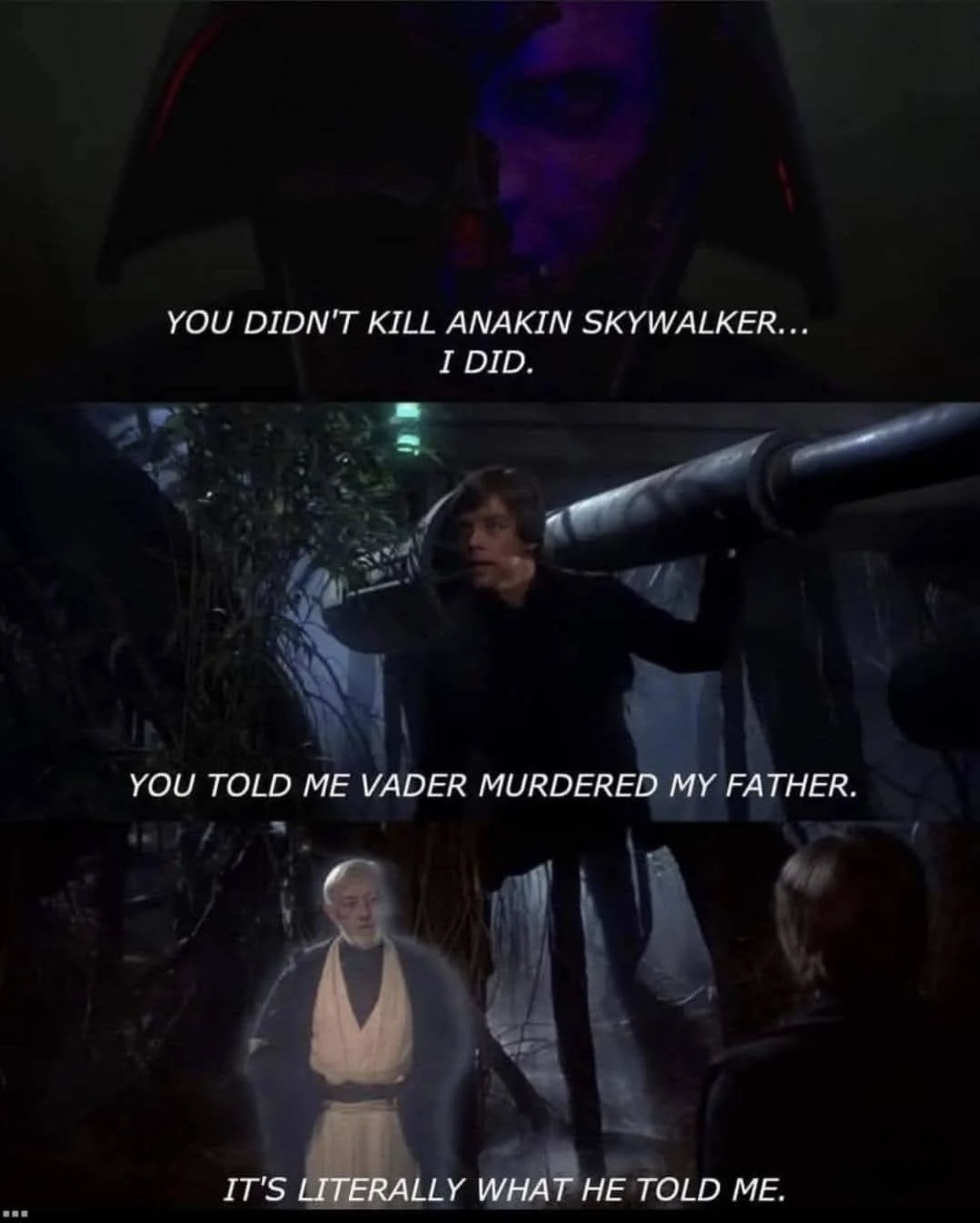
This meme illustrates a tragic twist in Star Wars lore where Darth Sidious falsely claims Anakin Skywalker died to force the young Jedi to betray their brother. It blames Luke for spreading that lie, which causes the son to become furious over the misunderstanding. The final line explains that Han Solo became angry specifically because the reason he believed—Vader had murdered their father—was exactly what Han told his father (Luke).
detailed-analysis (gemma3_27b-it-q8_0)
Okay, let's break down this Star Wars meme using the requested theoretical lenses.
Visual Description
The meme is constructed from three panels of screenshots from Star Wars: Return of the Jedi.
- Top Panel: Features a dark, close-up shot of Emperor Palpatine, his face heavily shadowed, and dialogue text: "YOU DIDN'T KILL ANAKIN SKYWALKER... I DID." The font is white, typical of meme text.
- Middle Panel: Shows Luke Skywalker, clad in black, holding his lightsaber, and Obi-Wan Kenobi (as a Force ghost) observing him. Dialogue Text: "YOU TOLD ME VADER MURDERED MY FATHER."
- Bottom Panel: Focuses on Princess Leia, looking distraught. Dialogue text: "IT'S LITERALLY WHAT HE TOLD ME."
The image arrangement sets up a reveal, highlighting the irony and contradiction in the narrative. The dark portrayal of the Emperor contrasts with the relatively brighter scene of Luke and Obi-Wan, and Leia’s despairing expression anchors the emotional impact.
Foucauldian Genealogical Discourse Analysis
This meme touches on the discourse of truth within the Star Wars universe, as constructed and controlled by power structures.
- Genealogy: The "truth" about Anakin Skywalker's fate isn't a natural fact but a historically constructed narrative. Obi-Wan’s account (Vader killed Anakin) was the dominant discourse for years. It established a clear villain (Vader) and defined Luke's motivations (revenge). Palpatine’s revelation is a disruption of this genealogy, revealing the narrative was a deliberate manipulation to serve his own goals.
- Power/Knowledge: Palpatine wields power through knowledge. By revealing he, not Vader, "killed" Anakin, he reasserts his dominance over the narrative and Luke’s understanding of his past. The revelation isn’t about objective truth, but about Palpatine's control over Luke’s perceptions.
- Discipline: The original discourse disciplined Luke into a particular path – one of hatred and potential alignment with the dark side. The meme highlights how easily this discipline can be altered by a different "truth," revealing the fragility of the narrative control.
The meme’s humor stems from the deconstruction of this carefully constructed truth. It exposes the way power operates by shaping our understanding of events.
Critical Theory
From a Critical Theory perspective, the meme exposes the ideological function of narratives in shaping our perceptions of good and evil.
- Hegemony: The initial narrative of Vader as the killer of Anakin represented the hegemonic view within the Star Wars universe. It was the accepted ‘truth’ that justified resistance to the Empire. Palpatine's claim challenges this hegemony, forcing a re-evaluation of the characters and their motivations.
- False Consciousness: Luke and Leia initially operate under a "false consciousness" shaped by the dominant narrative. They believe they understand the past, but this understanding is a carefully constructed illusion designed to manipulate them. The meme shows the moment of awakening from this false consciousness.
- Ideology: The meme critiques the ideology embedded within the original narrative. By revealing the manipulation, it suggests that power structures often distort the truth to maintain control and perpetuate conflict.
Marxist Conflict Theory
While Star Wars isn’t explicitly Marxist, this meme can be interpreted through the lens of class struggle and false consciousness.
- Ruling Class Manipulation: Palpatine, as the head of the Empire (the ruling class), actively manipulates the narrative to maintain his power. He controls the information Luke and Leia receive, ensuring their loyalty (or at least, their opposition) aligns with his goals.
- Class Consciousness: Luke and Leia's realization represents a nascent class consciousness. They begin to understand that their perceptions have been shaped by the ruling class to serve its interests. The meme is funny because it highlights the absurdity of having believed the initial "truth" for so long.
- False Needs: The initial narrative fed into Luke’s desire for revenge, a manufactured “need” that served Palpatine's purpose.
Postmodernism
The meme very easily slots into a Postmodern analysis.
- Deconstruction: The meme deconstructs the grand narrative of good vs. evil. It reveals that "truth" is not absolute but relative and subject to interpretation. There is no singular, objective reality, but rather competing narratives.
- Simulacra and Simulation: The “truth” about Anakin's fate is revealed as a simulacrum – a copy without an original. The narrative of Vader’s murder wasn’t based on a factual event, but a constructed reality designed to control perception.
- Meta-Narrative: Star Wars is, itself, a meta-narrative about good versus evil. This meme draws attention to the constructed nature of that narrative. It reminds us that even the most epic stories are not necessarily based on objective truth, and can be manipulated for various ends.
In essence, the meme's humor arises from its satirical deconstruction of a foundational narrative in the Star Wars universe, highlighting how easily "truth" can be manipulated by those in power. It’s a playful critique of the grand narratives we often accept without question.
simple-description (llama3.2-vision_11b)
This meme is a play on a famous Star Wars quote, where a character says "I did" in response to a question about killing someone. The meme takes this quote and adds a humorous twist, implying that the character is trying to downplay their involvement in a specific event. The text "I did" is used in a way that is ironic and humorous, as it is often used in a way that is opposite of the original quote's context.
detailed-analysis (gemma3-27b-vision)
Okay, here's a breakdown of the image, with sections dedicated to relevant theoretical frameworks. I'll indicate where a section is not applicable.
Image Description
The image is a still from the film Return of the Jedi. It depicts a dramatically lit confrontation in the Emperor's throne room.
- Characters: The central figures are Luke Skywalker, clad in black, and Emperor Palpatine/Darth Sidious, draped in shadowy robes. Yoda, in Jedi robes, is positioned in the foreground, looking up at Luke.
- Setting: The throne room is dark and imposing, with a gothic architectural style. Minimal environmental details are visible other than the throne and some implied architecture.
- Composition & Lighting: The image heavily relies on chiaroscuro (strong contrast between light and dark). Luke is partially silhouetted, making him appear strong and determined. The Emperor is bathed in a sickly glow, highlighting his malice. Yoda appears smaller and more vulnerable.
- Text Overlay: Three lines of dialogue are superimposed on the image:
- “YOU DIDN'T KILL ANAKIN SKYWALKER… I DID.” (Attributed to Luke)
- “YOU TOLD ME VADER MURDERED MY FATHER.” (Attributed to the Emperor)
- “IT'S LITERALLY WHAT HE TOLD ME.” (Attributed to Luke)
Foucauldian Genealogical Discourse Analysis
This image and its dialogue are a prime example for a Foucauldian analysis. The scene is a discourse – a system of thought, ideas, and language that constructs reality. Here’s how we can break it down:
- Power/Knowledge: The scene revolves around the construction of truth. The Emperor and Luke are engaged in a battle over knowledge. The Emperor attempts to define reality by claiming Luke killed Anakin, positioning him as a murderer. Luke's counter-argument challenges this, claiming the Emperor was the one who told him Vader killed his father, turning the narrative around. Power isn't merely repressive (forceful), but productive. The Emperor's attempt to define Luke’s identity and history creates a specific version of reality.
- Genealogy: A genealogical approach would trace the history of this specific "truth." How did the Emperor initially plant the seed of Vader being a murderer? What earlier discourses (e.g., the Jedi Code, the Republic's propaganda, the Separatists’ claims) laid the groundwork for this particular construction of reality? The scene is a culmination of a long-running manipulation.
- Disciplinary Power: The Emperor's manipulation is a form of disciplinary power. He attempts to control Luke by controlling his understanding of the past and defining his identity. By making Luke believe he killed Anakin, he attempts to mold him into a compliant Sith Lord.
Critical Theory
The scene illustrates several key themes in Critical Theory:
- Ideology: The Emperor’s manipulation is a form of ideological control. He seeks to instill a worldview that justifies his power and undermines the Jedi Order. The "truth" about Anakin's death is a tool for maintaining control.
- Hegemony: The Emperor's power doesn't solely rely on brute force, but also on hegemony. He aims for Luke to consent to his worldview, to believe it willingly. Luke initially almost falls into that trap.
- False Consciousness: Luke, in a way, experiences a moment of "false consciousness" as he struggles to reconcile the conflicting narratives. He temporarily believes what the Emperor tells him.
- Alienation: The entire saga can be seen as a narrative of alienation. Characters are separated from their true selves, their histories, and their potential. The manipulation of truth is a key component of this alienation.
Marxist Conflict Theory
While Star Wars isn't a directly Marxist text, conflict theory can be applied:
- Class Struggle: The conflict between the Jedi and the Sith can be interpreted as a struggle between competing ideologies and power structures. The Jedi, initially representing a somewhat benevolent (though flawed) ruling class, are overthrown by the Sith, who represent a tyrannical order.
- Control of Narrative: The Emperor’s manipulation of truth is a means of maintaining power and suppressing dissent. Controlling the narrative is essential for controlling the masses (in this case, Luke).
- Ideological Apparatuses: The Empire's propaganda, education system, and use of fear can be seen as "ideological apparatuses" used to reinforce its dominance.
Postmodernism
Postmodern ideas are present in the scene:
- Deconstruction of Truth: The entire scene revolves around the instability of "truth." The Emperor and Luke offer competing narratives, and it’s unclear which one is "real" initially. There’s a questioning of objective reality.
- Simulacra & Simulation: The constructed "truth" about Anakin's death can be seen as a simulacrum – a copy without an original. The Emperor’s version of events isn’t necessarily based on fact, but rather on a fabricated reality.
- Meta-Narratives: The scene challenges the traditional "hero's journey" meta-narrative. Luke is not simply a hero who triumphs over evil; he's caught in a web of manipulation and deception.
Queer Feminist Intersectional Analysis
This section is difficult to apply directly. Star Wars has historically faced criticism for its limited representation of diverse genders and sexualities. However, we can find some interpretive angles:
- Power Dynamics & Manipulation: The scene highlights how power imbalances are exploited through manipulation and control of information. This resonates with feminist concerns about patriarchal systems that rely on controlling women’s narratives and bodies.
- Deconstruction of "Fatherhood": The revelation about Darth Vader being Luke's father disrupts traditional notions of family and paternity. The "father" figure is revealed to be a monstrous villain, challenging conventional ideals of masculinity and paternal authority.
- Silencing & Voice: The Emperor attempts to silence Luke's agency by controlling his understanding of his own history. This can be linked to feminist concerns about the silencing of marginalized voices.
- Intersectionality (Stretch): We could extend this by considering how different forms of power (e.g., paternal authority, Imperial control) intersect to create a system of oppression.
Let me know if you'd like me to elaborate on any of these points or explore other theoretical frameworks!
simple-description (llama3.2-vision)
This meme is a humorous take on a famous scene from the movie "Star Wars: The Return of the