First Seen
2023-05-10T21:03:41+00:00
simple-description (qwen3.5_2b-q8_0)
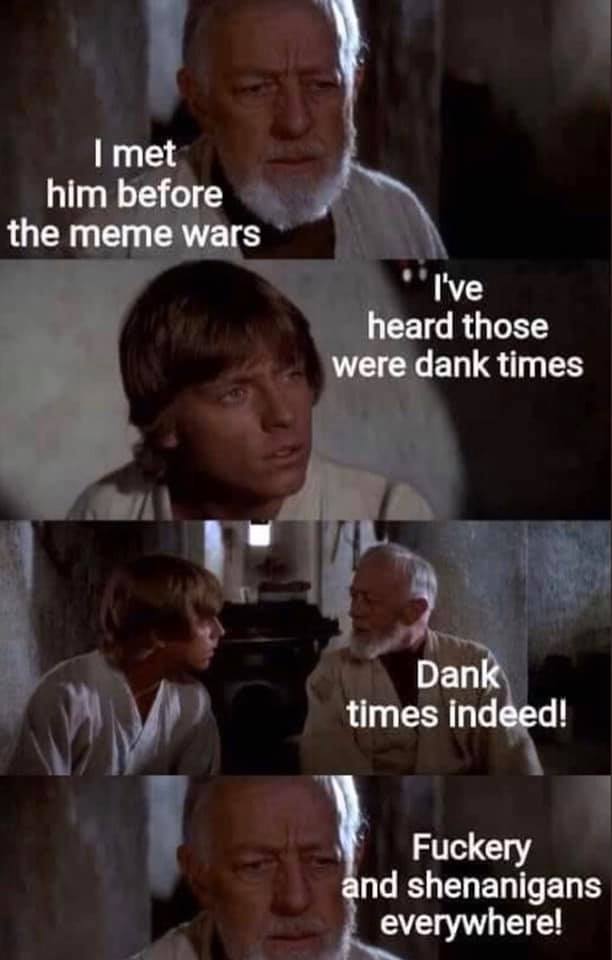
This Star Wars meme features a humorous exchange between the Jedi Master Obi-Wan Kenobi and the young Luke Skywalker. In the first panel, Obi-Wan jokes that he has encountered this specific type of joke before the current "meme wars," while Luke playfully claims it is called "dank times." The final panel has Obi-Wan mockingly declare that the situation is filled with "fuckery and shenanigans," highlighting his intense, dark persona compared to the silly memes.
simple-description (llama3.2-vision_11b)
The meme is a screenshot from the Star Wars movie "A New Hope" where Obi-Wan Kenobi (Ewan McGregor) is teaching Luke Skywalker about the Force. The meme is captioned with a quote from the movie: "When you meet someone for the first time and you've heard of them." The image shows Obi-Wan and Luke standing in a desert landscape, with a subtle background of stars and planets.
detailed-analysis (gemma3-27b-vision)
Okay, let's break down this meme (a series of panels from Star Wars: Episode III – Revenge of the Sith) through a few theoretical lenses, as requested. I'll focus on the most relevant ones, and if a section feels forced, I'll acknowledge that.
Visual Description
The meme utilizes four panels from a scene between Obi-Wan Kenobi and a young Anakin Skywalker in Star Wars: Episode III. The panels progressively show Obi-Wan recounting a story about Darth Vader (Anakin) to a worried and increasingly distressed Luke Skywalker. The original dialogue is replaced with internet slang and commentary, turning the scene into a meta-commentary on the evolution and decay of internet culture. The panels move from Obi-Wan’s initial statement to Luke’s incredulous response to Obi-Wan’s confirmation, and finally to an exasperated proclamation. The color palette is muted, as is typical for this era of Star Wars. The overall visual aesthetic is intentionally low-resolution, contributing to the meme’s ironic and self-aware tone.
Foucauldian Genealogical Discourse Analysis
This meme is incredibly fertile ground for a Foucauldian analysis. It's not simply about the story being told, but about the history of discourse surrounding that story, and how it's been reproduced and transformed. The meme traces the genealogy of "Dankness" (a term central to internet culture) from its origins (arguably originating on Tumblr and 4chan) and its evolution into a decaying, overused and ironically self-aware phenomenon.
- Power/Knowledge: The original Star Wars scene carries a weight of narrative power and authority. Obi-Wan is a figure of knowledge, conveying a truth about Anakin's past. The meme subverts this by injecting the slang "dankness," which is a term associated with irony, internet subcultures, and often, the rejection of mainstream values. This is a power play in itself. The meme-maker is attempting to wrest control of the narrative.
- Discursive Formation: The panels demonstrate a discursive formation around “dankness." The language represents an episteme or a particular way of thinking and talking about the internet itself – a self-aware acknowledgement of the constant re-cycling and eventual decay of online trends.
- Archaeology of Knowledge: The meme can be read as an "archaeology" of the internet's humor. It exposes the layers of irony and meme culture that have built up over time, revealing the "rules" (often unspoken) of internet communication. The final panel, with its exaggerated language, marks the point where that archaeology uncovers a "ruin" - the sense that the humor has lost its edge and become exhausting.
Postmodernism
This meme is a textbook example of postmodern playfulness and irony. Several core postmodern themes are at work:
- Pastiche & Intertextuality: The meme borrows from a major cultural text (Star Wars) and completely re-contextualizes it with internet slang. This creates a jarring juxtaposition, highlighting the constructed nature of meaning.
- Hyperreality: The original Star Wars scene aimed for a sense of dramatic realism (within a sci-fi context). The meme, however, replaces that with an overtly artificial and ironic layer. This pushes the image into a state of hyperreality – a simulation that feels more “real” than the original because of its self-awareness.
- Deconstruction of Grand Narratives: Star Wars is a grand narrative – a story of good vs. evil, destiny, and heroism. By stripping the scene of its emotional weight and injecting internet slang, the meme actively deconstructs that narrative, reducing it to a comment on internet trends.
- Loss of Authenticity: The final panel (“Fuckery and shenanigans everywhere!”) emphasizes the loss of authentic meaning, suggesting that everything is simply a performance or a joke.
Critical Theory
Applying Critical Theory (especially Frankfurt School), we can see the meme as a commentary on the commodification of culture and the alienation of modern experience.
- Culture Industry: The meme can be seen as a meta-commentary on the “culture industry.” The original Star Wars is a product of that industry, and the meme itself is a product of the internet – a further level of commodification and reproduction.
- Loss of Aura: Walter Benjamin's concept of the "aura" (the unique presence of an original work of art) is relevant. By endlessly remixing and re-contextualizing Star Wars (and all cultural artifacts), the meme contributes to the erosion of that aura. Everything becomes endlessly reproducible and loses its sense of sacredness or originality.
- Alienation: The final panel, with its exaggerated language, can be read as a symptom of alienation. The speaker is overwhelmed by the absurdity and meaninglessness of the situation.
Let me know if you'd like me to elaborate on any of these points or explore other theoretical frameworks!
simple-description (llama3.2-vision)
The meme is a screenshot from the movie Star Wars: A New Hope, featuring a scene between Obi-Wan Kenobi and Luke Skywalker. The image shows Obi-Wan's face with a caption "I found you" and a response from Luke saying "I've heard of the Jedi. I want to learn." The meme is being used to poke fun at the idea of a "new" Jedi being discovered, with the caption "I've heard of the Jedi" implying that the person is being sarcastic about their lack of knowledge about the Jedi.
tesseract-ocr
. Miata | imbefore » ™ the meme " a ‘ 7) a leard those eh ails bf ‘ uy 4 : | ha ; ~. Dank, WN ag see ats (sel | atte a eS aT la te 1iy r Cea