First Seen
2023-05-10T21:03:41+00:00
simple-description (qwen3.5_2b-q8_0)
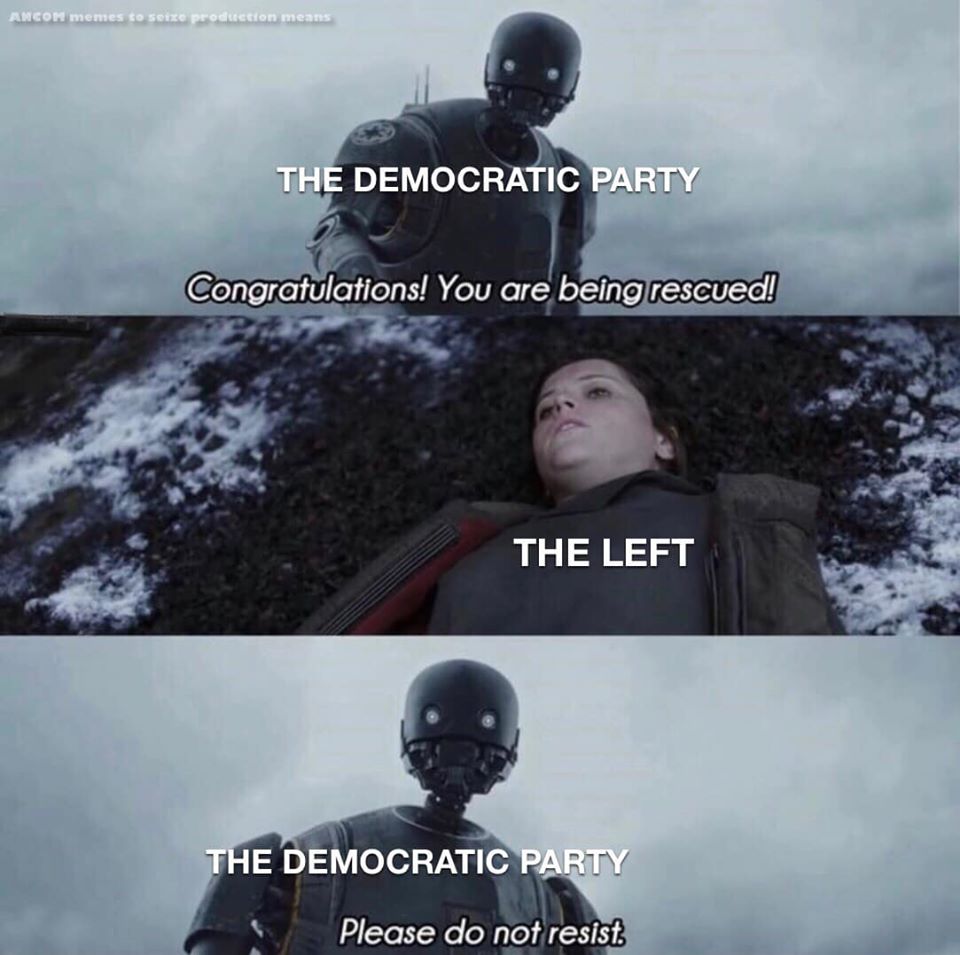
This Star Wars meme is a political satire that mimics a famous scene from the movie The Last Jedi, where C-3PO declares to a fallen hero, "Congratulations! You are being rescued!"
The joke flips the context to suggest that a governing party, "The Democratic Party," has taken over during a rebellion or revolution, "The Left," and is trying to crush the uprising to save the citizens. The final text, "Please do not resist," adds to the absurdity by implying that the government will suppress any opposition for its own safety.
simple-description (llama3.2-vision_11b)
In the Star Wars universe, the character C-3PO is often portrayed as a fussy and anxious protocol droid. This meme plays on that character's personality by imagining a scenario where C-3PO is a politician and his anxious nature is used to comment on the political divide between the Democratic and Republican parties. The image depicts C-3PO looking worried and saying "I don't like it, I don't like it, not one bit!"
detailed-analysis (gemma3-27b-vision)
Okay, here's an analysis of the meme, broken down into the sections you requested, focusing on applicable theoretical frameworks.
Visual Description
The meme is a three-panel image taken from a scene in the film The Matrix. It depicts a character (Trinity) being "rescued" from the Matrix by a robotic Sentinel (representing the system of control).
- Panel 1: A Sentinel approaches a floating, unconscious Trinity. Text reads "THE DEMOCRATIC PARTY - Congratulations! You are being rescued!"
- Panel 2: Trinity is being carried by the Sentinel, implying a rescue is in progress. Text reads "THE LEFT"
- Panel 3: The Sentinel continues to carry Trinity, now close-up. Text reads "THE DEMOCRATIC PARTY - Please do not resist."
The imagery is striking. The Sentinel, despite being a force of control, is presenting itself as benevolent, performing a "rescue". This immediately creates a sense of unease and paradox. The person being rescued appears passive, vulnerable, and perhaps unaware of the true implications of being 'saved'.
Foucauldian Genealogical Discourse Analysis
This meme lends itself strongly to a Foucauldian reading.
- Power/Knowledge: The meme illustrates how power operates not through brute force alone, but through discourse. The Democratic Party presents itself as a benevolent "rescuer," positioning itself as the rightful authority to define and address the problems facing "the Left" (those advocating for progressive change). This framing constructs a discourse where the Democratic Party is the solution, and any resistance to its guidance is framed as irrational or self-destructive.
- Discipline & Normalization: The directive "Please do not resist" is crucial. It suggests that the Democratic Party seeks not just to change things, but to discipline the Left, to steer it into acceptable boundaries. The offer of "rescue" implies that the Left is in need of saving – framing it as incapable of self-determination. The "rescue" isn't about liberation, but normalization into the established system.
- Genealogy: One could trace a genealogy of this 'rescue' narrative within the history of the Democratic Party. This might examine how the Party has historically co-opted, absorbed, or sidelined radical movements, often presenting itself as the pragmatic "lesser evil" that can eventually deliver on progressive goals.
Critical Theory
The meme operates as a critique of the way mainstream political parties can neutralize radical movements.
- Hegemony: Drawing on Gramsci, the meme suggests that the Democratic Party seeks to establish hegemony over the Left. Hegemony isn't simply domination; it's a process where the dominant ideology (in this case, the Democratic Party platform) becomes seen as natural, common sense, and even desirable by those it seeks to control. The "rescue" narrative is a tool for achieving this.
- Instrumental Reason: The meme could be interpreted through Adorno and Horkheimer’s lens of instrumental reason, arguing that the Democratic Party seeks to instrumentalize the Left’s desires for justice and equality, reducing them to tools for achieving its own (potentially different) goals.
- Ideology: The image can also be seen as a critique of ideology. The Democratic Party's presentation of itself as a benevolent rescuer masks the underlying power dynamics and potentially reinforces the status quo.
Marxist Conflict Theory
The meme illustrates a tension between the interests of different classes or factions within the progressive movement.
- False Consciousness: It can be argued that the Left, in accepting the Democratic Party’s “rescue,” is suffering from a form of false consciousness – believing that the Party has its best interests at heart, when in reality it serves the interests of a different class (perhaps the liberal establishment, donors, or the capitalist system itself).
- Co-optation: The Democratic Party is shown co-opting the energy and demands of the Left, channeling them into avenues that are ultimately compatible with the existing capitalist structure.
- Class Struggle: It subtly suggests a class struggle within the Left – a tension between those who are willing to compromise and work within the system, and those who advocate for more radical change.
Postmodernism
While perhaps less overtly than other frameworks, postmodern themes are present.
- Meta-Narratives: The meme deconstructs the meta-narrative of the Democratic Party as the benevolent savior of the Left. It exposes the constructedness of this narrative and challenges its authority.
- Simulacra and Simulation: The “rescue” itself is a simulation, a constructed reality that masks the underlying power dynamics. The image suggests that reality is increasingly mediated by representations and simulations, making it difficult to discern authentic action from manufactured consent.
Note: The meme’s effectiveness comes from its ambiguity. The viewer is invited to interpret the roles and motivations of the different players, leading to a rich and complex analysis.
Let me know if you would like me to expand on any of these analyses, or if you'd like me to explore other theoretical perspectives!
simple-description (llama3.2-vision)
This meme is a humorous commentary on the perceived differences between the Democratic and Republican parties in the United States. The image shows a character from the movie "Star Wars: Rogue One" (K-2SO, a reprogrammed Imperial droid) with a caption that reads: "In a galaxy far, far away..." followed by two options: "The Democratic Party: We have a plan" and "The Republican Party: We have a plan... and it's going to blow up in your face".
tesseract-ocr
nya Motel TN i lod 2.559: 7*é Eongratulations! You are beingjrescued!) - Jn , , i Ae ‘ > a Re ; edt > ~ ie ‘ ‘ a sree a, J @ 7 HE DEMOCRATIC PARI Bal M Please do mee