First Seen
2023-05-10T21:03:41+00:00
simple-description (qwen3.5_2b-q8_0)
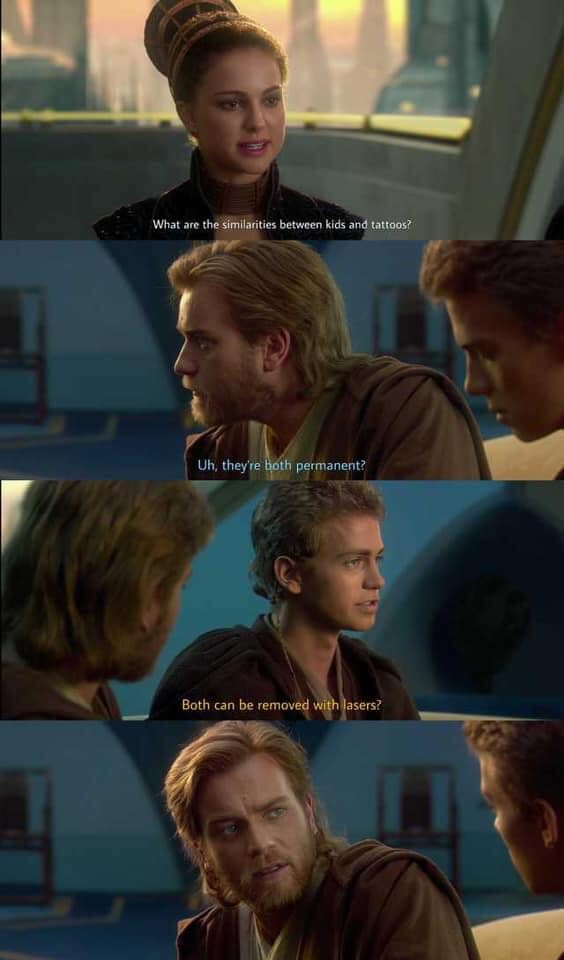
This meme depicts a humorous and absurd moment from Star Wars: Episode I – The Phantom Menace involving characters Padmé Amidala, Anakin Skywalker, and Obi-Wan Kenobi discussing tattoos. Padmé asks Anakin, "What are the similarities between kids and tattoos?" Anakin responds with a serious scientific tone, "Uh, they're both permanent?" and Padmé playfully challenges him, "Both can be removed with lasers?" The joke is inverting the question with Anakin (and Obi-Wan) responding about the permanence and laser removal of tattoos.
simple-description (llama3.2-vision_11b)
The meme is a screenshot from the movie Star Wars: Episode II - Attack of the Clones, where Obi-Wan Kenobi asks a young Anakin Skywalker about his relationship with Padmé Amidala. Anakin responds by saying "I don't like sand. It's of the devil." The meme is a humorous take on this quote, with the text "I don't like sand. It's of the devil" replaced with "I don't like tattoos. They're of the devil."
detailed-analysis (gemma3-27b-vision)
Okay, here's a breakdown of the image and its potential for analysis through the lenses you requested, with headings as appropriate. I'll only include sections if a relevant argument can be made.
Visual Description
The image is a screencap from Star Wars: Episode III – Revenge of the Sith. It’s a multi-panel meme format.
- Panel 1: Padmé Amidala, looking concerned and questioning, is positioned at the top. Text above her reads, “What are the similarities between kids and tattoos?”
- Panel 2: Anakin Skywalker, looking thoughtful and struggling, follows, with the text "Uh, they’re both permanent?"
- Panel 3: Anakin repeats the last line of the previous panel with a more intense, perhaps desperate expression “Both can be removed with lasers?”
- The setting is a dimly lit interior of a spacecraft, likely a Naboo Royal Starship. The color palette is dominated by blues and grays. The composition emphasizes the contrast between Padmé's poised questioning and Anakin's increasingly strained responses.
Foucauldian Genealogical Discourse Analysis
This meme offers a fertile ground for a Foucauldian reading. The question "What are the similarities between kids and tattoos?" itself isn’t about finding a logical similarity, but rather exposes a discursive formation.
- Power/Knowledge: The question highlights how concepts of permanence, body ownership, and control are interwoven. Both "having children" and "getting tattoos" are often presented as impactful, potentially lifelong decisions, but the meme subverts that seriousness. The implication is that both are now treated as commodities – something to be chosen, altered, or even removed with technology ("lasers").
- Genealogy: Tracing the historical genealogy of discourses around reproduction and body modification would reveal how both have been historically regulated by social norms, religious beliefs, and increasingly, medical/technological interventions. What was once considered a natural/sacred experience (having children) or a marker of subculture/rebellion (tattoos) is now subject to consumerist logic (making a “permanent” but reversible “choice”).
- Discipline/Biopower: The meme implicitly critiques the increasing medicalization of reproduction (IVF, genetic screening) and the normalization of cosmetic procedures (tattoo removal) as forms of biopower – the ways in which power operates on the body and manages populations. The “laser” solution represents a technology that allows for manipulation and control over these aspects of life.
Critical Theory
The meme engages with themes central to Critical Theory, particularly those surrounding the commodification of life and the erosion of authentic experience.
- Commodification: The question and answer sequence frames both children and tattoos as objects of consumption and choice. This reflects a broader trend in late-capitalist society where even deeply personal aspects of life are subject to market forces.
- Alienation: The awkwardness of Anakin’s responses suggests a sense of alienation from meaningful connection. The reduction of children and tattoos to a matter of permanence and reversibility implies a loss of emotional depth and genuine investment.
- The Culture Industry: The meme itself can be seen as a product of the "culture industry," a form of mass-produced entertainment that reinforces dominant ideologies and promotes consumerism. The humorous framing of a serious question trivializes complex issues.
Postmodernism
The meme embodies several key aspects of postmodern thought.
- Deconstruction: It deconstructs the traditional association of children and tattoos. The question juxtaposes these seemingly unrelated concepts, challenging conventional categories and boundaries.
- Irony and Parody: The humor relies heavily on irony and parody. The absurd response to the question mocks the seriousness with which these topics are often treated.
- Hyperreality: The meme contributes to a hyperreal experience where the line between reality and simulation becomes blurred. The question and answer sequence create a detached, self-referential commentary on contemporary culture.
Queer Feminist Intersectional Analysis
While less central, a Queer Feminist Intersectional reading can be applied.
- Bodily Autonomy: The meme, in a roundabout way, touches upon issues of bodily autonomy. The implication that both “children” and “tattoos” can be removed with lasers suggests a level of control over the body that may be empowering, but also raises questions about societal pressures and expectations surrounding reproduction and self-expression.
- Gendered Expectations: Historically, societal expectations regarding reproduction and body modification have been heavily gendered. This meme, through its absurdity, may implicitly critique those expectations.
- Intersectionality: Analyzing how race, class, and other factors intersect with the experiences of parenthood and body modification could provide a deeper understanding of the meme’s implications.
Let me know if you'd like me to elaborate on any of these points or delve deeper into a specific theoretical framework.
simple-description (llama3.2-vision)
This meme is a humorous image comparing the similarities between children and tattoos. The image is likely a split-screen or side-by-side comparison of a child and a tattoo, with the text "In 2-3 sentences, describe this meme for someone who cannot see it. Include any text that appears in the image" above it. The text below the image reads: "They're both permanent, but one gets to change their mind."
tesseract-ocr
ou. § \ . A ee ie \' ‘ ny er) 4 C= i \ oa = we me = ‘<a ‘ & ae) ; ae “a Y nl