First Seen
2023-05-10T21:03:41+00:00
simple-description (qwen3.5_2b-q8_0)
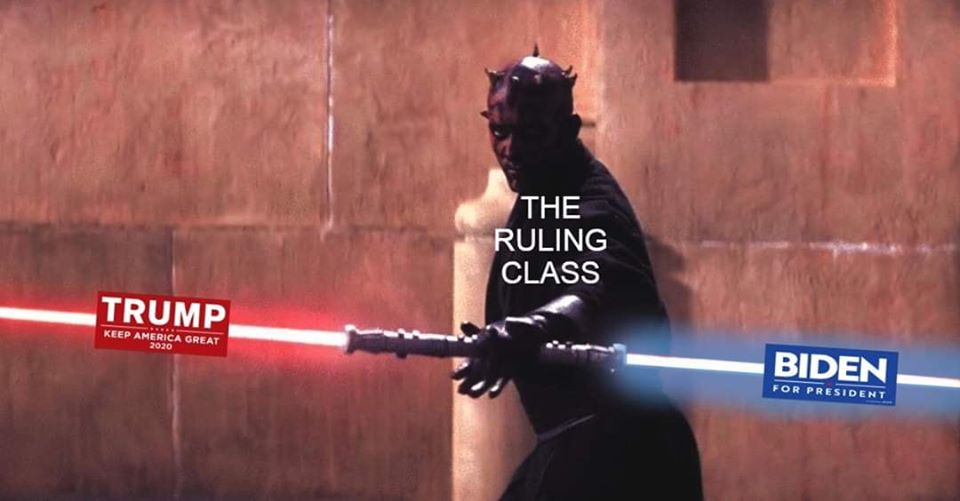
This meme is a parody of Darth Vader from Star Wars, reimagining his iconic pose with a lightsaber that shifts colors to represent the opposing political parties. The image features Darth Maul holding a weapon that glows red, labeled "Trump Keep America Great 2020," and shifts to blue, labeled "Biden For President," while the text "The Ruling Class" implies one side holds the dominant power.
simple-description (llama3.2-vision_11b)
The meme is a play on the iconic "I am your father" line from Star Wars, but with a humorous twist. The image shows a split-screen comparison between two characters, with a caption that reads "When you're trying to be the chosen one but you're actually the chosen one's dad". The meme is poking fun at the idea that a character's intentions are often overshadowed by their family connections.
detailed-analysis (gemma3-27b-vision)
Okay, here's an analysis of the image broken down into the requested theoretical frameworks, addressing each where relevant. I'll make it clear when a section doesn't apply.
Image Description
The image features Darth Maul from Star Wars in a dramatic pose, wielding a red lightsaber. He is shown in a corridor with a warm, reddish-brown tone. A superimposed text reads “THE RULING CLASS” in a bold, capitalized font. Significantly, a red "TRUMP: KEEP AMERICA GREAT 2020" banner is horizontally placed on the left and a blue "BIDEN FOR PRESIDENT" banner is horizontally placed on the right, visually dividing the image and suggesting a political conflict. The lightsabers visually represent the political divide. The composition creates a sense of power, menace, and a stark contrast between opposing sides.
Foucauldian Genealogical Discourse Analysis
This image lends itself well to a Foucauldian analysis. The image itself constructs a discourse around power, control, and the ruling elite.
- Power/Knowledge: The use of Darth Maul, a figure embodying power and authoritarianism from a widely known cultural text (Star Wars), immediately establishes a connection between the "ruling class" and the exercise of force. The association isn't literal but relies on the knowledge embedded within popular culture about this character. The text “THE RULING CLASS” performs the act of defining and labeling a group, establishing a discourse around them.
- Genealogy: Tracing the "genealogy" of the "ruling class" (as depicted here) would involve examining how the concept has been historically constructed and how narratives of power have evolved. The visual link to Star Wars draws on a relatively recent cultural formation of "evil empires" and centralized control, while simultaneously referencing older narratives of aristocracy and governance.
- Discipline and Panopticism: While not explicit, the image evokes a sense of surveillance and control. Darth Maul’s imposing presence and weapon suggest an ability to impose order through force. It implies that the "ruling class" disciplines society.
- Discourse & Truth: The image presents a specific interpretation of the ruling class as aggressive, menacing, and potentially corrupt. It isn't claiming objective "truth," but rather constructing a specific narrative about power and authority.
Critical Theory
This image engages with core themes of Critical Theory, particularly those related to ideology and the reproduction of power.
- Ideology: The image isn't simply describing the ruling class; it’s subtly legitimizing a particular way of understanding it. The association with Darth Maul, even if meant as negative, can reinforce the idea that power is inherently aggressive and domineering.
- Hegemony: The image suggests that the ruling class maintains power not just through force, but through the construction of dominant narratives. By linking the ruling class to a popular culture icon, it taps into pre-existing beliefs and associations.
- Critique of Domination: The image can be interpreted as a critique of the ruling class, portraying them as villainous and oppressive. However, the effectiveness of this critique depends on the viewer's interpretation. It's a potentially subversive image, but it could also reinforce existing power dynamics if misinterpreted.
- Culture Industry: The image's use of Star Wars imagery demonstrates how culture is used to convey political messages. The culture industry plays a role in shaping our perceptions of power and authority.
Marxist Conflict Theory
This image is deeply aligned with Marxist Conflict Theory.
- Class Struggle: The image directly references "the ruling class," immediately framing the image in terms of class relations. The use of the opposing campaign banners emphasizes the ongoing conflict between opposing political ideologies and the inherent struggle for power.
- Bourgeoisie vs. Proletariat: While the banners do not directly reference these terms, the use of two polarized political figures suggests an inherent conflict between those in power and the people.
- Means of Production: Although not explicitly displayed, the image points to control over the means of political discourse and the shaping of narratives as a form of control.
- Ideological Hegemony: The image suggests that the ruling class uses cultural imagery (Star Wars) to maintain its dominance.
Postmodernism
While not overtly postmodern, some elements lend themselves to this analysis.
- Simulacra and Simulation: The image is a constructed representation of power—a simulacrum. It doesn't present a direct reality, but rather a representation built on cultural signs and symbols.
- Intertextuality: The image relies heavily on intertextuality—the relationship between texts. It draws meaning from the Star Wars universe and combines it with current political discourse. The meaning isn’t contained within the image itself, but emerges from the viewer’s understanding of these different texts.
- Deconstruction: The image challenges a simplistic understanding of the "ruling class" by associating it with a fictional character. It deconstructs the concept, highlighting its constructed nature and exposing its potential for manipulation.
- Loss of Grand Narratives: The image suggests a skepticism towards traditional notions of power and authority, implying that the "ruling class" is not necessarily benevolent or legitimate.
Queer Feminist Intersectional Analysis
This framework is the least directly applicable, but can still provide some insight.
- Power Dynamics: The image fundamentally reveals and perpetuates power dynamics. While not explicitly gendered or queer, the figure of Darth Maul embodies a traditionally masculine form of power and dominance.
- Intersectional Oppression: While not directly addressed, it's important to acknowledge that the "ruling class" often disproportionately impacts marginalized communities (based on race, gender, sexual orientation, class, etc.). The image implicitly acknowledges that power structures often create systems of oppression.
- Subversion of Norms: The image itself can be seen as a subversive act, challenging conventional representations of power and authority. The use of a fictional character to symbolize the ruling class disrupts traditional political imagery.
- Representation: The image highlights the lack of diverse representation within the "ruling class." The image doesn’t feature any marginalized groups.
I hope this comprehensive analysis provides a thorough understanding of the image through multiple theoretical lenses. Let me know if you'd like me to elaborate on any specific point.
simple-description (llama3.2-vision)
This meme is a play on the iconic "I find your lack of faith disturbing" line from the Star Wars franchise. The image depicts a scene from the movie with Darth Vader holding a lightsaber, but instead of his iconic line, he says "I find your lack of memes disturbing". The meme is captioned "I find your lack of memes disturbing" with the text "I am the meme lord" and "I will meme you".
tesseract-ocr
4 ‘WHihie , Fi K: 1 H , til ous :, pe i ; . : re i ‘% | THE ULING ae } CLASS F