First Seen
2023-05-10T21:03:41+00:00
simple-description (qwen3.5_2b-q8_0)
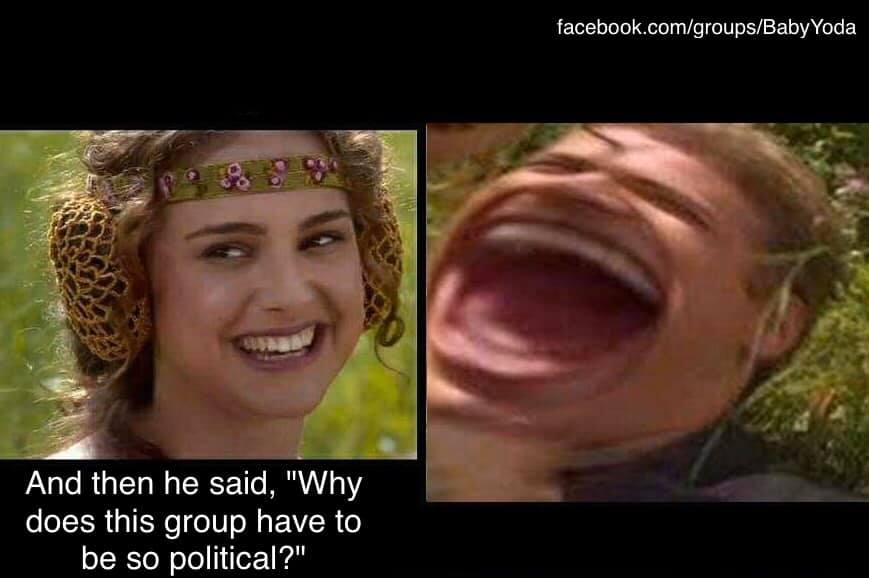
This is a "Jokescape" meme popular among Star Wars fans, designed to express frustration with specific group dynamics or conspiracy theories. On the left, a character appears to be pleading or asking a question, while on the right, the "Scream King" image represents a dramatic, hysterical reaction to the complaint. The caption provides the reason: "And then he said, 'Why does this group have to be so political?'" The image implies that the screaming man is reacting with extreme shock or anger to a complaint about how dramatic or overly conspiratorial a certain group is.
simple-description (llama3.2-vision_11b)
This meme is from the Star Wars category. The image shows Princess Leia from the Star Wars franchise, with her iconic hair buns and a shocked expression. The text "Help me, Obi-Wan Kenobi. You're my only hope." is overlaid on the image, but it's actually replaced with "Help me, I'm stuck in a meeting. You're my only hope."
detailed-analysis (gemma3-27b-vision)
Okay, here's an analysis of the image, broken down by the requested theoretical frameworks. Keep in mind that applying all of these frameworks to a single meme is somewhat expansive, but it’s a good exercise to explore their application.
Visual Description
The image is a two-panel meme.
- Panel 1: Displays a close-up of a man with a green crown, with a slightly forced/manic smile. He seems to be in an outdoor setting. The image quality appears to be a still from a television program or movie.
- Panel 2: Shows an extreme close-up of the man’s eye, appearing slightly bloodshot, and conveying an intensity.
- Text: Below the panels is the phrase: "And then he said, 'Why does this group have to be so political?'"
- Facebook Link: In the upper right corner, a link to a Facebook group named "Baby Yoda" is provided.
Foucauldian Genealogical Discourse Analysis
This meme lends itself well to a Foucauldian analysis. The query "Why does this group have to be so political?" represents a power dynamic and an attempt to normalize a specific discourse.
- Power/Knowledge: The question itself implies a belief that groups (likely online communities) shouldn't be "political." This statement is not neutral. It's a claim about how knowledge and discourse should be organized. It suggests an attempt to impose a "natural" boundary between "acceptable" discussion and "political" agitation.
- Genealogy: A genealogical approach would ask how the idea of separating "political" from "non-political" arose. What historical forces and discourses have constructed this categorization? The meme might be responding to a specific instance of this assertion within the "Baby Yoda" group, but the underlying assumption is a broader historical formation. The assertion attempts to impose a specific order through what is deemed acceptable.
- Discipline: The question is a form of disciplinary action. By questioning the political nature of the group, the questioner is attempting to regulate and control what is discussed. It is an attempt to ensure conformity.
Critical Theory
Critical Theory explores how power structures and ideology are embedded in cultural products and everyday life.
- Ideology: The meme suggests a critique of a naive or willfully ignorant stance toward political engagement. The question implies an expectation that certain spaces (like a group devoted to "Baby Yoda") should be safe from political discourse. This desire for a "safe space" can be seen as a reflection of broader ideological assumptions about the proper boundaries of public and private life. The assumption can also reveal an unwillingness to examine power dynamics.
- False Consciousness: The questioner may be exhibiting a form of "false consciousness," unaware of how their own assumptions are shaped by dominant ideologies. They might believe they are simply advocating for neutrality, but they are actually reinforcing existing power structures by denying the political nature of everyday life.
- Culture Industry: The meme itself is a product of the "culture industry" (Adorno & Horkheimer). It’s a fragment of meaning circulated through social media, contributing to the ongoing negotiation of cultural values and political positions.
Marxist Conflict Theory
While not directly representing class struggle, the meme can be understood through the lens of conflict.
- Ideological Struggle: The question represents a conflict between different ideological positions. One position is that spaces like online groups should be apolitical. The other is, implicitly, that everything is political, and even a group devoted to a cute character is subject to power dynamics and social commentary.
- Hegemony: The question could be seen as an attempt to maintain hegemonic control over the discourse within the group. The questioner is trying to normalize a particular viewpoint and suppress alternative perspectives.
Postmodernism
The meme embodies several postmodern characteristics.
- Deconstruction: The meme deconstructs the idea of a neutral space. It challenges the assumption that there is a separation between the "political" and the "non-political." By placing the question within the context of a “Baby Yoda” group, it exposes the constructed nature of this division.
- Fragmentation and Pastische: The image, and the internet meme format in general, are examples of fragmentation and pastiche. The image is taken out of context and reassembled to create a new meaning.
- Meta-Narratives: The meme can be read as a critique of grand narratives that attempt to define the proper boundaries of social life. It challenges the idea that there is a single, universal way to organize discourse.
Queer Feminist Intersectional Analysis
This is the most challenging framework to apply directly, but relevant points can be made.
- Silencing and Exclusion: The question – "Why does this group have to be so political?" – can be interpreted as a demand for silence. In many contexts, marginalized groups are asked to "tone it down" or not discuss political issues that directly impact their lives. This demand reinforces systems of oppression.
- Intersectionality: The "political" issues discussed within the group could intersect with various forms of oppression, such as racism, sexism, or homophobia. The questioner might be attempting to shut down discussions about these issues.
- Safe Spaces & Boundaries: The desire for a “non-political” space can be a way to avoid difficult conversations about power and privilege. While safe spaces are important for marginalized groups, they shouldn’t be used to silence or exclude dissenting voices.
I hope this comprehensive breakdown is helpful. Let me know if you'd like me to elaborate on any of these points or analyze the meme from a different theoretical perspective.
simple-description (llama3.2-vision)
This meme is a humorous image of a woman from the TV show "Game of Thrones" looking confused and puzzled. The text above her reads "In Westeros, when you're asked to explain the plot of your favorite show to your grandma." The meme is poking fun at the complexity and depth of the show's storyline, implying that even the characters themselves might struggle to explain it to someone outside the fandom.
tesseract-ocr
facebook.com/groups/Baby Yoda re 7 = ae “ aa a =e | ; ms ee Ke —> a: - nl \eeae My , A - Se O , eR As ~~ : ae | lox t F a pet pee a > ge es = q 5 % 7 i PA * « And then he said, "Why —_— ee does this group have to be so political?"