First Seen
2023-05-10T21:03:41+00:00
simple-description (qwen3.5_2b-q8_0)
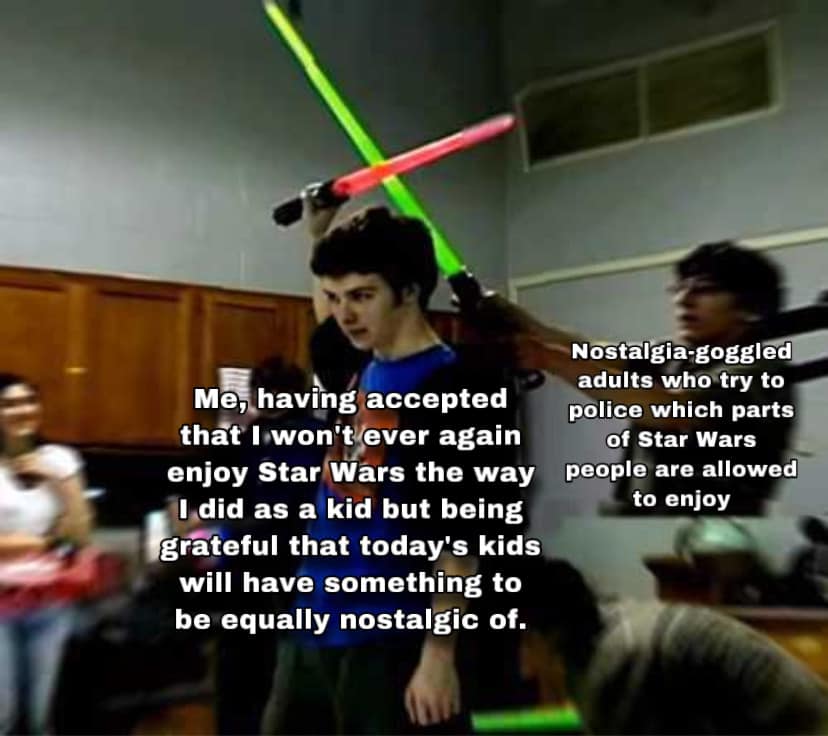
This meme uses the imagery of Jedi training to satirize current censorship in the Star Wars franchise. It features a young man wielding his lightsabers, while the caption notes his acceptance that he missed the pure magic of the show as a kid. He concludes that while today's adults try to police what is allowed to watch, kids now have something to be equally nostalgic of because they can enjoy all parts of Star Wars.
simple-description (llama3.2-vision_11b)
This meme is from the category "Star Wars" and features a humorous image of a person with a nostalgic expression, holding a lightsaber. The text overlaid on the image reads: "I'm not saying I'm a Jedi, but I used to love watching Star Wars as a kid. Now I'm a cop." The meme pokes fun at the idea that someone who was once enthusiastic about Star Wars as a child is now a police officer, implying a sense of irony or incongruity between their past and present selves.
detailed-analysis (gemma3-27b-vision)
Okay, let's break down this image and the overlaid text through various critical lenses.
Visual Description
The image appears to be a still from a mid-1990s television show or movie, judging by the quality and color saturation. It shows a young man, seemingly around 10-12 years old, intensely engaged in a mock lightsaber battle, illuminated by a vibrant green glow from the toy weapon. He's surrounded by other children, blurry in the background, suggesting a crowded play area, possibly a school or daycare. The setting seems indoor, likely a hallway or common room. The low resolution and somewhat grainy quality add to a sense of pastness and nostalgia. The overall aesthetic points to a specific cultural moment – the height of “Star Wars” nostalgia after the release of the special editions.
Foucauldian Genealogical Discourse Analysis
The text layered on the image—"Me, having accepted that I won't ever again enjoy Star Wars the way I did as a kid but being grateful that today’s kids will have something equally nostalgic”—presents a fascinating subject for Foucauldian analysis.
- Discourse and Power: This statement reveals a discourse surrounding nostalgia itself, particularly relating to mass media franchises. The speaker acknowledges a loss of initial joy (a shift in power from the original experience to a mediated, perhaps critical, adult understanding). The text implies that nostalgia is not simply a benign emotion but a constructed one, shaped by a cycle of consumption, expectation, and eventual disillusionment. The framing of “today’s kids” perpetuates the cycle; someone else will be subjected to the same process.
- Genealogy of Nostalgia: Tracing the genealogy of nostalgia would require examining the historical conditions (rise of consumer culture, marketing tactics, media saturation) that led to Star Wars becoming an object of nostalgic attachment. It's not a natural response, but a product of specific social and economic forces.
- Disciplinary Practices: This statement implicitly acknowledges a "disciplinary" element to fandom. There's an expectation to move on from childhood enjoyment, to become more "sophisticated" in one's appreciation. The speaker is performing a self-discipline – acknowledging a loss, but framing it as a positive because it allows for the continuation of the cycle.
Critical Theory (Frankfurt School)
From a Frankfurt School perspective, this image and text speak to the culture industry’s capacity to manufacture desire and ultimately, disappointment.
- Commodification of Affect: Star Wars is not just a film; it's a commodity that sells not just entertainment, but feelings—specifically, the warm, fuzzy emotions of childhood. This image captures a moment of that affective labor at work.
- False Consciousness: The speaker's acceptance of not enjoying Star Wars in the same way as a child could be seen as a kind of internalized "false consciousness." They are accepting the limitations of consumer culture and the inevitability of disillusionment, rather than challenging the system that perpetuates it.
- Loss of Authenticity: The text implicitly laments the loss of "authentic" childhood joy. The speaker is aware that the experience is mediated, curated, and ultimately, finite.
Marxist Conflict Theory
While not directly a focus, a Marxist reading could see this image as a reflection of generational struggle and the reproduction of consumer culture.
- Commodity Fetishism: The Star Wars lightsaber is a material object (a commodity) that takes on symbolic value. The conflict—or at least the dynamic—between generations is centered around access to and enjoyment of this commodified symbol.
- Ideology and Control: The continued popularity of Star Wars serves to perpetuate the ideologies of consumerism. New generations are inducted into this system through repeated exposure and the promise of nostalgic fulfillment.
Postmodernism
The image and text are very much steeped in postmodern sensibilities.
- Hyperreality and Simulation: The nostalgic feeling itself is a simulation—a copy of an original experience that never truly existed in the pristine form we remember. The image is a past, mediated experience.
- Loss of Grand Narratives: There's a recognition of the decline of unifying cultural narratives. The individual's personal relationship to Star Wars is prioritized over any sense of shared cultural meaning.
- Self-Referentiality: The text is self-aware about the process of nostalgia itself. It’s acknowledging the artificiality of the emotional experience. The speaker is analyzing their own emotional response.
Queer Feminist Intersectional Analysis
This lens is less directly applicable without further context, but we can still make some observations.
- Gendered Nostalgia: While not explicitly shown, the historical marketing of Star Wars and the demographics of its initial fandom have been largely male-dominated. A queer analysis could examine how nostalgia for Star Wars reinforces traditional gender roles and exclusions.
- Exclusionary Nostalgia: The image and statement, while not inherently exclusionary, invite consideration of who gets to participate in and benefit from this nostalgic cycle. Whose childhood experiences are privileged? Whose are marginalized?
Let me know if you'd like me to elaborate on any of these sections or explore a different critical lens!
simple-description (llama3.2-vision)
This meme is a humorous comparison between two groups of people. The image is of a group of adults, likely in a meeting or conference setting, who are dressed in business attire and holding lightsabers. The text reads: "Me, having accepted that I'll never be a Jedi, but being grateful that my kids will have that experience."
tesseract-ocr
N a S re ps . | “To et eatin Re aeee) A ) Te Pee mC) — Wo eee) police which parts ss that th T again Case eid CAT eG EU CRE NOU UC] Cie tts Pa elt RY eae that today's kids ena De to / be CUTE ie Cy a io