First Seen
2023-06-03T02:56:40+00:00
simple-description (qwen3.5_2b-q8_0)
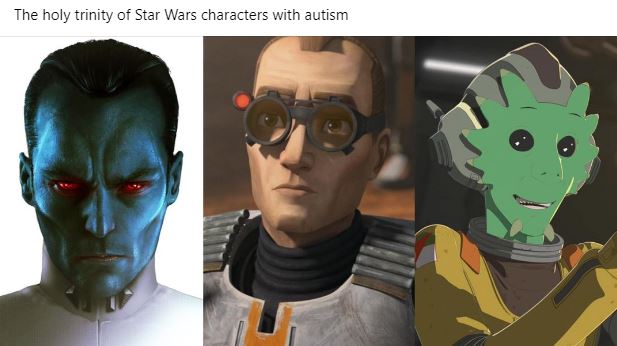
The meme humorously claims that specific, recognizable Star Wars characters are autism diagnoses. The text at the top identifies this specific trio as "The holy trinity of Star Wars characters with autism," showing the blue-skinned character Tarkin (K-2SO) on the left, a Star Destroyer pilot in the middle, and a green alien on the right.
simple-description (llama3.2-vision_11b)
The meme is a humorous comparison between the Star Wars characters, specifically the three main characters, Anakin, Obi-Wan, and Yoda, and the three main characters from the TV show "The Office", Michael, Dwight, and Andy. The meme is saying that the Star Wars characters are the "holy trinity" of Star Wars, just like the three main characters from "The Office" are the "holy trinity" of that show.
detailed-analysis (gemma3-27b-vision)
Okay, let's break down the image and then apply the requested theoretical frameworks (where appropriate). This is a complex task and some frameworks will be more applicable than others.
Image Description:
The image presents a side-by-side comparison of three characters from the Star Wars universe:
- Asajj Ventress: A Dathomirian Zabrak female, with pale blue skin, striking red eyes, and distinctive facial markings. She is depicted in a close-up, serious expression.
- Captain Rex: A Clone Trooper with a weathered appearance, wearing Clone Trooper armor. He is shown with distinctive goggles perched on his forehead, and a serious, focused expression.
- Hondo Ohnaka: A Pyke Syndicate leader, a green-skinned, humanoid alien, presented with a broad, cheerful, slightly mischievous smile.
The image is titled "The holy trinity of Star Wars characters with autism." This suggests the poster's interpretation that these characters exhibit traits often associated with autism.
Foucauldian Genealogical Discourse Analysis
This framework is particularly applicable. Foucault examines how knowledge and power are intertwined, shaping our understanding of things through discourse. Here's how it applies to this image's context:
- The Construction of "Autism": Foucault would argue that "autism" isn’t a natural, objective category, but a discursive formation. That means it's a concept created by medical, psychological, and societal discourses over time. This image participates in that discourse. It proposes a reading of these characters as autistic, relying on particular understandings of autistic traits.
- Power and Normalization: The discourse around autism often centers on deficit models (what individuals lack). By identifying these characters as autistic, the poster may be implicitly challenging the typical way autism is understood or framed within the wider Star Wars fan community.
- Genealogy of Traits: A Foucauldian genealogy would look at how certain behaviors (intense focus, difficulty with social cues, special interests) came to be defined as “autistic.” Within the Star Wars narrative, these characters display traits that could be interpreted through an autistic lens, but were originally presented within the context of character development, trauma, or personal history.
- The Image as Intervention: The image itself acts as a discursive intervention. It challenges traditional readings of these characters by re-framing them within the context of neurodiversity.
Critical Theory
Critical Theory, rooted in the Frankfurt School, focuses on power structures and ideology. Here's how it can be applied:
- Deconstructing Narrative Representations: Critical theory would analyze how these characters, within the Star Wars universe, are positioned within the dominant narratives of heroism, villainy, and loyalty. Are their traits (those perceived as autistic) used to reinforce or subvert these narratives? Does the fandom’s interpretation change that?
- Ideological Function of Representation: Does the representation of these characters as autistic serve a specific ideological function within the Star Wars fandom or the broader culture? For example, does it contribute to a more inclusive understanding of neurodiversity, or does it reinforce stereotypes?
- Exclusion and Marginalization: Critical theory would explore how neurodivergent individuals are often marginalized within society and how this representation in popular culture could contribute to either further exclusion or greater inclusion.
- Hegemony: How does the representation of these characters challenge or reinforce the dominant cultural understanding of "normal" and "deviant" behavior?
Marxist Conflict Theory
This is less directly applicable, but can still be considered:
- Power Dynamics Within the Star Wars Universe: Marxist theory focuses on class conflict and power struggles. While not directly about neurodiversity, one could analyze how the characters’ traits affect their positions within the hierarchical structures of the Star Wars world. For example, does a character’s intense focus (a potential autistic trait) help or hinder their ability to navigate the political landscape?
- Fandom as a Site of Struggle: The emergence of this image and the discussion around it within the fandom can be seen as a form of cultural struggle. Fans are actively reinterpreting characters and challenging dominant readings, potentially contesting the power structures that shape how these characters are understood.
Postmodernism
Postmodernism emphasizes subjectivity, fragmentation, and the rejection of grand narratives.
- Deconstruction of Character Meaning: Postmodern analysis would question the idea of a fixed or essential "meaning" of these characters. The image is an example of how meaning is constructed and negotiated through interpretation and fan engagement.
- Rejection of Universal Truths: Postmodernism rejects the idea of a universal definition of autism. It would emphasize that different individuals experience autism in different ways, and that the interpretation of these characters as autistic is itself a subjective and contingent process.
- Hyperreality & Simulation: One could argue that the fandom’s interpretation of these characters has become a form of “hyperreality,” where the simulated understanding of their neurodiversity becomes more real than the original narrative depiction.
Queer Feminist Intersectional Analysis
This framework emphasizes the interconnectedness of social categorizations such as race, class, and gender, creating overlapping systems of discrimination or disadvantage.
- Neurodiversity and Social Marginalization: This framework would explore how neurodiversity intersects with other forms of marginalization (e.g., gender, race, class) to create unique experiences of disadvantage. The poster's choice of characters – a female villain, a clone trooper, and an alien – could be seen as a deliberate attempt to highlight the intersectionality of neurodiversity.
- Challenging Normative Ideals: This framework would critique the ways in which societal norms and expectations exclude neurodivergent individuals and other marginalized groups. By celebrating these characters as autistic, the poster is challenging those norms and advocating for a more inclusive understanding of identity.
In summary:
This image is a fascinating point of intersection between fandom, identity, and theoretical frameworks. Foucauldian analysis offers the most direct and powerful lens for understanding how the concept of autism is constructed and circulated through discourse. Other frameworks, like Critical Theory and Queer Feminist Intersectional Analysis, provide valuable insights into the broader social and political implications of this representation.
simple-description (llama3.2-vision)
The meme is a humorous comparison of the character of Jar Jar Binks from the Star Wars franchise to the character of C-3PO from the same franchise. The text "The holy trinity of Star Wars characters with autism" appears above the three images, implying that these characters are somehow representative of autism, although this is likely a joke or a stereotype.
tesseract-ocr
The holy trinity of Star Wars characters with autism >. = aN P rN ] , 7 ae 26! § P| vs 1 yo ta ; nd | my) : Ra if . - (Aa