First Seen
2023-05-10T21:03:41+00:00
simple-description (qwen3.5_2b-q8_0)
This meme features the dark, hooded Sith Lord Darth Maul holding a green Mountain Dew can. The text "Dew it" is written in white in the upper right corner. In Star Wars, "Dew it" is a command to dry out or cool down a target with alcohol, so this character appears to be threatening to incapacitate an enemy with the soda.
simple-description (llama3.2-vision_11b)
This meme is a play on the iconic Star Wars character Darth Vader, who famously says "I find your lack of faith... disturbing." In this meme, Darth Vader's voice is being used to promote a popular 90s soft drink, Mountain Dew. The text "I find your lack of Dew... disturbing" is a humorous twist on the original quote, poking fun at the idea that someone's lack of Mountain Dew is somehow disturbing.
detailed-analysis (gemma3-27b-vision)
Okay, let's break down this meme with analyses as requested. It's a fairly simple meme, but we can still pull out some interesting threads using these theoretical lenses.
Visual Description
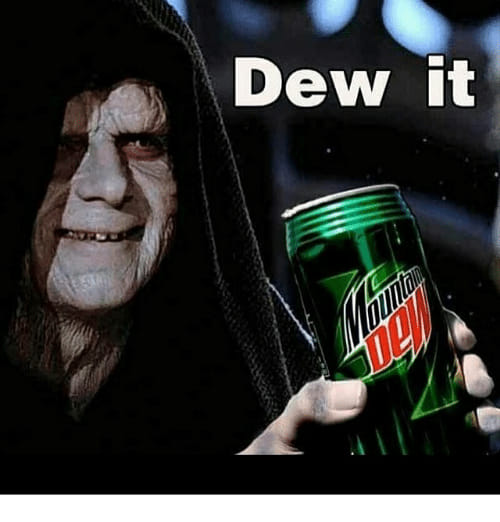
The image depicts Emperor Palpatine (Darth Sidious) from the Star Wars saga. He is shown in close-up, with a sinister expression. In his outstretched hand, he is holding a can of Mountain Dew soda. Above the image is the text "Dew it" which is a play on words referencing the soda and the phrase "Do it." The background is dark, emphasizing the contrast between Palpatine and the bright green of the soda can. The overall aesthetic is darkly humorous, combining the menacing imagery of Star Wars with a consumer product.
Foucauldian Genealogical Discourse Analysis
This meme provides a fascinating example of how power and knowledge are constructed and deployed through discourse, as discussed by Michel Foucault.
- Genealogy of "Doing": The phrase “Do it” has evolved into a cultural meme, often associated with extreme, subversive, or impulsive actions. Linking this phrase to “Dew it” (Mountain Dew) is a discursive disruption. It subverts the expectation of gravitas or danger. Foucault would be interested in how this linguistic shift occurred. What cultural currents allow a villainous figure and a sugary drink to be connected through a shared phrase? The power of the phrase shifts from being tied to action and decision, to the commercialization of that power through a brand.
- Power/Knowledge: Palpatine represents power, control, and manipulation. Mountain Dew, as a consumer product, represents capitalism, marketing, and consumer desire. The meme's humor comes from juxtaposing these concepts. Foucault would argue that this juxtaposition doesn't reveal a hidden truth, but rather constructs a new relationship between power and consumption. The image frames the act of buying or consuming Mountain Dew as an act with a similar kind of sinister energy as Palpatine's manipulations.
- Discursive Formations: The meme is a specific discursive formation - a way of talking about power, consumption, and humor that's specific to internet culture. It relies on shared knowledge of both Star Wars and the Mountain Dew brand.
Critical Theory
Using a critical theory lens, we can examine how the meme reinforces or challenges dominant ideologies.
- Culture Industry: The meme is a product of the "culture industry" (Adorno & Horkheimer). It repurposes imagery from a massively popular franchise (Star Wars) and a commercial brand (Mountain Dew) for humorous effect. This demonstrates how culture is commodified and circulated. The meme doesn’t necessarily critique the culture industry, but it participates in it.
- False Consciousness: One could argue that the meme represents a form of "false consciousness." It distracts from real power dynamics and problems by framing them as humorous or trivial. By associating a villain with a consumer product, it potentially obscures the harmful aspects of capitalism or political manipulation.
- Domination and Resistance: While seemingly innocuous, the meme could be seen as a subtle form of resistance. By subverting the seriousness of Palpatine and associating him with a mass-produced beverage, it challenges the authority he represents. This is, however, a very limited form of resistance, one that ultimately reinforces the existing system by engaging with its products and imagery.
Marxist Conflict Theory
From a Marxist perspective, this meme highlights the contradictions inherent in capitalist society.
- Commodity Fetishism: The Mountain Dew can is an example of "commodity fetishism" (Marx). Its value is not based on its actual utility (it's just a sugary drink), but on the symbolic meaning and desire attached to it. The meme elevates this fetishism by associating the can with the powerful figure of Palpatine.
- Ideology and Hegemony: The meme subtly reinforces the ideology of consumerism. By associating a powerful figure with a consumer product, it suggests that consumption is a source of power or pleasure. This reinforces the hegemonic (dominant) cultural norms that promote consumerism.
- Class Struggle (Limited): While not directly addressing class struggle, the meme can be interpreted as a commentary on the way consumer culture affects everyone, regardless of social class. Even a powerful emperor needs a soda! However, this is a superficial interpretation.
Postmodernism
This meme is a prime example of postmodern sensibilities.
- Intertextuality: The meme relies heavily on intertextuality - the relationship between texts. It draws on Star Wars, Mountain Dew advertising, and internet meme culture. Its meaning is dependent on the viewer’s ability to recognize and understand these references.
- Pastiche and Parody: The meme is a form of pastiche - a playful combination of different styles and elements. It parodies both Star Wars and advertising.
- Simulacra and Simulation: (Baudrillard) The meme blurs the lines between reality and representation. It creates a "simulacrum" of power and consumption that has no real grounding in reality. The image is the experience.
- Deconstruction: The meme deconstructs the seriousness of Palpatine’s character by associating him with a mundane consumer product. It challenges the idea of fixed meanings and identities.
Queer Feminist Intersectional Analysis (Less Applicable, but Possible)
This analysis is the weakest fit, but we can attempt to find some points of connection.
- Subversion of Masculinity (Weak): Palpatine, traditionally a figure of hyper-masculine power, is playfully diminished by being associated with a brightly colored beverage. This can be seen as a subtle subversion of traditional gender roles.
- Commodification of Culture: The meme participates in the commodification of popular culture, and this commodification can disproportionately affect marginalized groups. The meme doesn’t directly address this issue, but it’s important to acknowledge.
- Intersectionality (Strained): Finding connections to intersectionality is challenging. One might argue that the meme, through its playful subversion, could be interpreted as challenging dominant power structures, and therefore supporting marginalized voices. However, this is a very tenuous connection. The meme is primarily focused on humor and pop culture, and doesn't explicitly address issues of race, class, gender, or sexuality.
I hope this detailed analysis gives you a comprehensive understanding of this meme through different theoretical lenses! Let me know if you'd like me to elaborate on any of these points.
simple-description (llama3.2-vision)
This meme is a play on the classic "I can see for miles" song by The Proclaimers, but with a humorous twist. The image features a character from the Star Wars franchise, likely Darth Vader, with a modified version of the song's lyrics: "I can see for miles and miles and miles... and I can see the Death Star... I can see it's going to be a long, long time... before I see it".
tesseract-ocr
ed _ , Dew it’ e Ny ° * i \ 4 i OO