First Seen
2023-05-10T21:03:41+00:00
simple-description (qwen3.5_2b-q8_0)
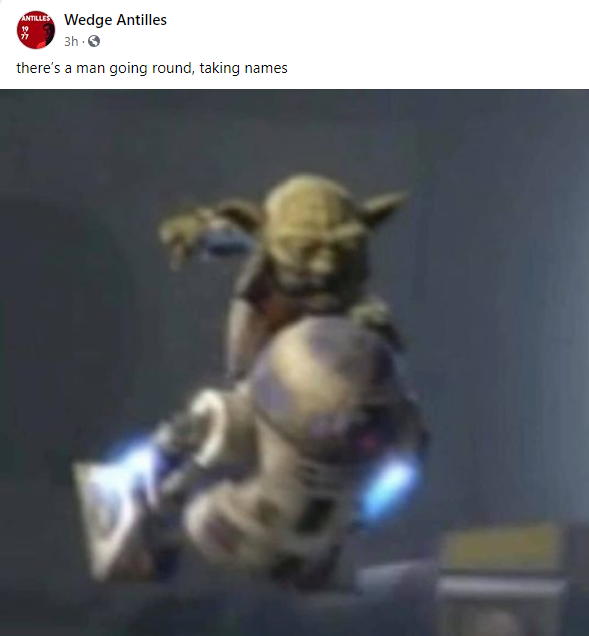
The image depicts a humorous, low-resolution scene from a Star Wars simulation where the famous green Jedi, Yoda, is perched atop the astromech droid, R2-D2. The caption reads "there's a man going round, taking names," playing on the visual of Yoda riding on top of the droid and the droid's actual designation. This references the famous joke from Star Wars: The Clone Wars, where Yoda is often seen riding on top of the robot, implying he has taken him by the throat.
simple-description (llama3.2-vision_11b)
This meme is from the Star Wars category and features a screenshot of Yoda from the Star Wars franchise. The image shows Yoda riding a motorcycle and saying "Do. Or do not. There is no try." However, the meme has been modified to replace Yoda with a character from a different franchise, making it humorous.
detailed-analysis (gemma3-27b-vision)
Okay, let's break down the image and the accompanying caption ("there's a man going round, taking names") through the lenses you've requested. Please note that applying these complex theories to a simple image can feel a bit of a stretch in some cases, but I'll do my best to provide thoughtful analysis.
1. Visual Description
The image appears to be a photograph taken in a potentially dark or dimly lit environment. The primary subject is a figure strongly resembling Yoda from the Star Wars franchise, but it seems to be an action figure or costume. The figure is positioned in a dynamic pose, seemingly mid-action or moving quickly. It is not clear if this is an action figure or a person in costume.
The lighting is dramatic, with a bright blue light source illuminating the figure's front and leaving the background in shadow. This creates a sense of energy and possibly intimidation. There is a blurred or indistinct background, possibly a shelf or a room, but details are difficult to discern. The image is slightly blurry, suggesting movement or a quick capture.
2. Foucauldian Genealogical Discourse Analysis
- Discourse & Power: The image and caption invoke the “Star Wars” franchise, a powerful cultural discourse that has shaped perceptions of heroism, villainy, and even concepts of “the Force.” The caption, "there's a man going round, taking names," directly echoes a famous line from the film The Matrix, but the visual presence of Yoda alters the context entirely. Foucault would argue that such a line and the image together establish a discourse around authority, challenge, and the power to name/categorize.
- Genealogy of "Authority": The connection to both Star Wars and The Matrix highlights a genealogy of the “powerful figure” trope. Yoda and Neo, though very different, both represent individuals with unique skills and who challenge established power structures. The image fractures these narratives. The blurring of Yoda and the reference to the line from The Matrix create a composite figure.
- Panopticism/Surveillance: The image’s dark, somewhat grainy quality could be interpreted through a panoptic lens. The figure seems to be "watching" the viewer, even if it's just a perception created by the framing.
3. Marxist Conflict Theory
- Commodification & Culture: The fact that the figure is likely a collectible action figure is central. In a Marxist framework, this represents the commodification of culture. The "essence" of Yoda (a narrative character, a symbol of wisdom and power) has been reduced to a material object to be bought and sold.
- Hegemony & Rebellion: The caption “taking names” can be seen as a symbolic rebellion against established power structures. However, the fact that this rebellion is expressed through a commodity (an action figure) complicates the analysis. It can be interpreted as a co-optation of rebellious sentiment by the capitalist system.
- Class & Spectacle: The image, if shared on social media, contributes to a culture of spectacle, where individuals present carefully curated images of themselves and their interests. This spectacle can function as a distraction from underlying economic inequalities.
4. Postmodernism
- Intertextuality & Pastiche: This is perhaps the strongest fit for the image. The combination of Yoda (Star Wars) and the line from The Matrix is a clear example of intertextuality – referencing and blending elements from different cultural texts. The result is a pastiche – a collage of disparate elements that lack a unifying style or meaning.
- Deconstruction of Narrative: The image actively undermines any coherent narrative. Yoda, a figure associated with wisdom and peace, is presented in a dynamic, aggressive pose, while the phrase “taking names” subverts his traditional role.
- Simulacra & Simulation: The image could be seen as a simulacrum – a copy of a copy, lacking an original reference point. Yoda, as an action figure, is already a simulation of the character, and the image further abstracts and distorts that simulation.
5. Queer Feminist Intersectional Analysis
This is a more challenging application, but we can explore it:
- Deconstruction of Masculinity/Heroism: The image challenges traditional notions of masculinity and heroism. Yoda, while a powerful figure, is not traditionally presented as a hyper-masculine character. The aggressive pose and the phrase “taking names” disrupt these expectations.
- Subversion of Expectations: The image subverts expectations about how cultural symbols (like Yoda) should be represented.
- The Politics of Play: The fact that this is likely an action figure raises questions about how we construct and reinforce gender roles through play. What does it mean to "play" with Yoda in this way?
Important Note: These analyses are interpretations, and others are possible. The image is relatively simple, but it’s surprising how much can be unpacked using these different theoretical frameworks. The strength of each analysis varies, as some theories fit the image better than others.
simple-description (llama3.2-vision)
The meme is a screenshot of a Star Wars character (Darth Vader) from the movie "Star Wars: The Force Awakens" (2015) with a caption: "In 2-3 sentences, describe this meme for someone who cannot see it."
tesseract-ocr
e , 4 oa