First Seen
2023-05-10T21:03:41+00:00
simple-description (qwen3.5_2b-q8_0)
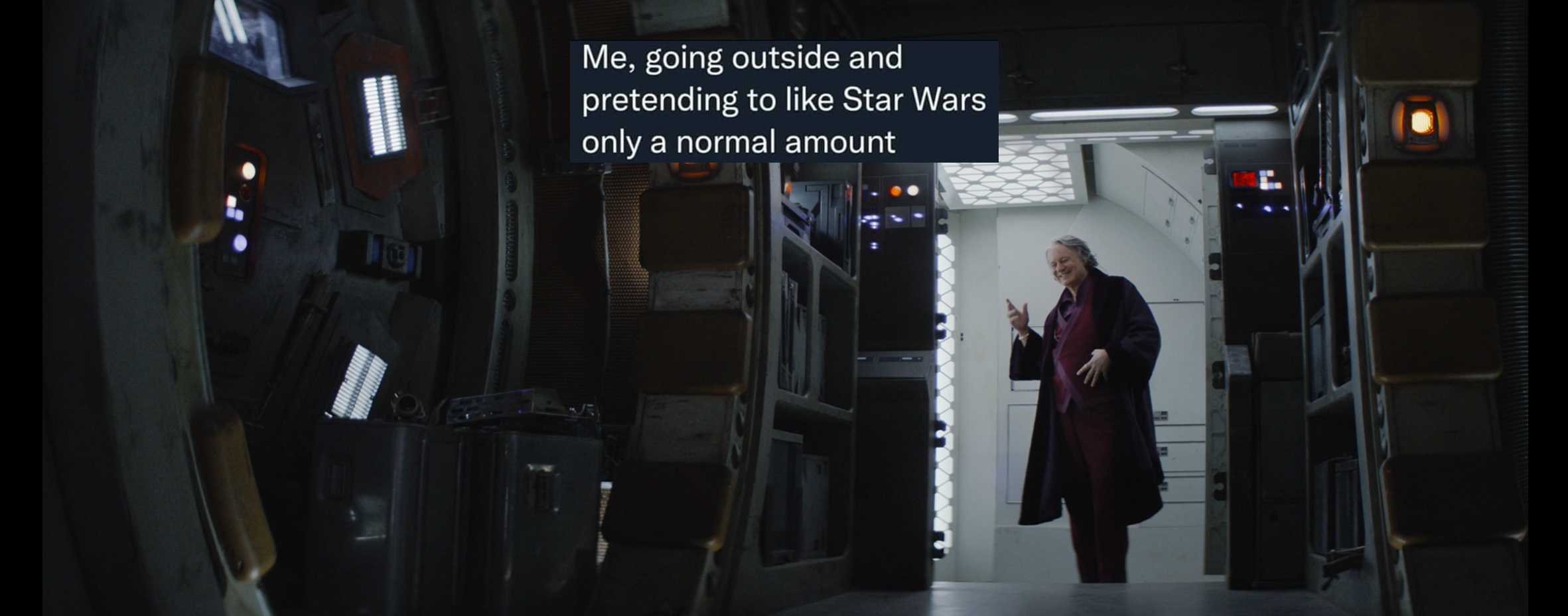
This meme features the actor George Lucas standing inside a futuristic spaceship. The text overlaid on the image reads, "Me, going outside and pretending to like Star Wars only a normal amount." Because the subject is the creator of the franchise, the joke implies that even the mastermind behind the series is pretending to just be a regular fan.
simple-description (llama3.2-vision_11b)
The meme is a screenshot from the Star Wars film "The Rise of Skywalker" where Emperor Palpatine is standing in a dark room, and the text "I am not the one who's going to bring balance to the Force" is displayed on the screen. The meme is humorous because it's a quote from the movie, but it's being used in a completely unrelated context, implying that someone is trying to bring balance to their life, but it's actually a reference to the movie, and the tone is ironic.
detailed-analysis (gemma3-27b-vision)
Okay, let's break down this image with the overlaid text using the frameworks you requested. Please note that applying all of these lenses to a single image requires some interpretation and extrapolation. I’ll indicate where those extrapolations are being made.
Visual Description
The image appears to be a still from a film, likely a science fiction production due to the highly detailed and futuristic interior. The composition focuses on a man, dressed in a long dark coat, walking through a bright doorway. The environment around him is dimly lit, metallic, and filled with technological details—pipes, panels, and glowing lights—suggesting the interior of a spaceship or space station. The lighting creates strong contrast between the darkness of the corridor and the bright doorway, focusing the viewer’s attention on the man and his movement towards the light. The man seems to be gesturing with one hand, perhaps explaining or making a point. The text overlay, “Me, going outside and pretending to like Star Wars, only a normal amount,” is positioned near the top-left of the image. The image has a very cinematic, high-quality look.
Foucauldian Genealogical Discourse Analysis
The text “Me, going outside and pretending to like Star Wars, only a normal amount,” offers rich ground for a Foucauldian analysis. The statement reveals an internal struggle with a discourse around “normalcy” and fandom. Foucault would examine how the category of “normal” is constructed, not as an inherent truth, but through historical power relations.
- Power/Knowledge: The need to pretend to like Star Wars suggests that liking or disliking it has become a marker of social belonging or acceptability. The "normal amount" indicates a regulated standard of enthusiasm—an expectation placed upon individuals. The power to define "normal" resides in the wider social context, potentially in media, peer groups, or cultural expectations.
- Genealogy of 'Normal': Tracing the genealogy of "normal" in this context would investigate how this expectation of liking Star Wars arose historically. Was there a point where it transitioned from a simple preference to a social expectation? What forces (media marketing, cultural trends, peer pressure) contributed to this shift?
- Disciplinary Power: The internal pressure to conform to this perceived “normal” implies a form of disciplinary power. The individual internalizes the expectation and polices their own behavior (pretending) to avoid social repercussions. The "normal amount" functions as a limit—a boundary beyond which deviation is considered unacceptable.
Critical Theory
The image and text lend themselves well to a Critical Theory lens, specifically examining how culture shapes identity and experience.
- Culture Industry: We can view Star Wars itself as a product of the culture industry (drawing on Adorno and Horkheimer). Its widespread appeal and commercialization have created a cultural landscape where acknowledging or enjoying it is almost a social requirement. The text implies that the individual’s genuine preference is less important than adhering to this culturally constructed expectation.
- False Consciousness: The “pretending” could be interpreted as a manifestation of false consciousness. The individual may be unaware of how the dominant culture has shaped their desires and perceptions, leading them to believe that liking Star Wars is a natural inclination when it's actually a socially constructed preference.
- Alienation: The act of pretending to like something suggests a disconnection between one's true self and their social presentation. This can be seen as a form of alienation—feeling estranged from one's authentic feelings and experiences in order to fit in.
Postmodernism
The image and text exhibit several hallmarks of postmodern thought:
- Simulation and Hyperreality: The act of “pretending” blurs the line between reality and simulation. The individual is performing a role—playing the part of someone who likes Star Wars—rather than expressing genuine emotion. This aligns with Baudrillard’s concept of hyperreality, where simulations become more real than reality itself.
- Fragmentation of Identity: The text suggests a fragmented identity—a tension between the individual’s internal feelings and their external presentation. This reflects the postmodern emphasis on the fluidity and instability of identity, where individuals are not fixed entities but rather constructed through multiple influences.
- Irony and Parody: There’s a layer of irony in the statement. The acknowledgment that their enthusiasm is merely “normal” undercuts any genuine emotional connection to Star Wars. This reflects the postmodern tendency to embrace irony and parody as a means of questioning established norms.
Let me know if you'd like me to elaborate on any of these analyses or explore additional frameworks!
simple-description (llama3.2-vision)
This meme is a screenshot from the movie "Star Wars: The Force Awakens" where a character is standing in front of a door that says "Blast Doors" and a sign that says "Authorized Personnel Only". The meme is captioned "I'm not arguing, I'm just explaining why I don't like Star Wars".
tesseract-ocr
i Me, going outside and : \ pretending to like Star Wars sar ie) only a normal amount : ai \\ ae d g a ; jae | i % | : A Se = s {' - : | S . a ned a 3 i Eas | | _ = ’ 4’ iY ;