First Seen
2023-05-10T21:03:42+00:00
simple-description (qwen3.5_2b-q8_0)
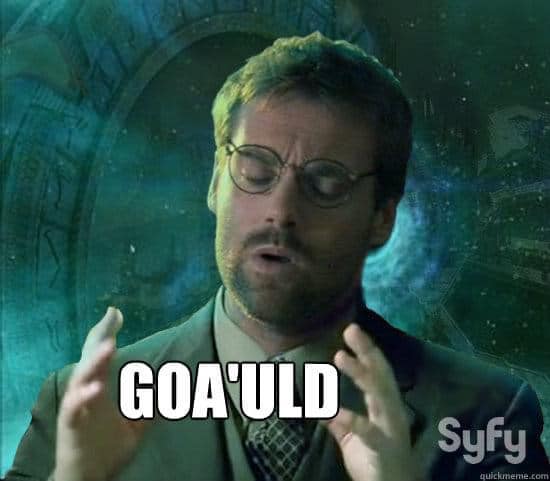
This meme features the character Go'uld from the sci-fi TV series Stargate. He is dressed formally in a suit and tie, making a gesture as if he is trying to explain something complex or bewildering. The word "GOA'ULD" appears prominently in white text over his face. The image serves as a funny reaction shot for viewers who cannot read or who don't know the show, humorously depicting shock or confusion at seeing the word Go'uld for the first time.
simple-description (llama3.2-vision_11b)
The meme features a screenshot from the TV show Stargate, with the character Dr. Daniel Jackson (played by Michael Shanks) looking confused and saying "Go 'head, I'm goin' in!" The meme is captioned with the phrase "Go 'head, I'm goin' in!" but with the words "Go 'head" replaced with "Go '..." and the rest of the phrase "I'm goin' in" replaced with "I'm goin' in...". The meme is poking fun at the idea that the character is saying "Go 'head, I'm goin' in" but is actually saying "Go '..." and "I'm goin' in...".
detailed-analysis (gemma3-27b-vision)
Okay, let's break down this image through the requested theoretical lenses.
Image Description
The image features Daniel Jackson (played by Michael Shanks) from the sci-fi series Stargate SG-1. He appears shocked and/or awestruck, with hands raised in a gesture of revelation. He's wearing a formal outfit, a dress shirt, tie, and dark suit jacket. Behind him is a large, ancient, stone structure with intricate carvings, suggesting an alien or ancient Egyptian-like setting. The background is blueish and a bit hazy, creating an atmosphere of mystery and antiquity. Superimposed over the image in large, white, bold letters is the word "GOA'ULD". A "Syfy" network logo and "quickmeme.com" are in the lower right corner. The overall impression is one of discovery, shock, and the unraveling of a monumental secret.
Foucauldian Genealogical Discourse Analysis
The image lends itself to Foucault's genealogical approach. The word “GOA’ULD,” represents a discourse – a system of thought, language, and practice that constitutes a specific way of understanding power. In the Stargate universe, the Goa'uld are parasitic aliens who pose as gods, exerting control through religious manipulation and technological dominance.
- Archaeology of Knowledge: A Foucauldian analysis would trace how the "truth" of the Goa’uld as gods was constructed and disseminated. Daniel Jackson’s expression signifies the moment the established 'truth' is challenged. The image represents a moment of uncovering a pre-existing power structure. The ancient structure in the background is the archive where the 'knowledge' is held and revealed.
- Power/Knowledge: The Goa'uld exercise power through knowledge. They control populations by presenting themselves as divine and manipulating sacred texts. Revealing the truth about the Goa'uld—that they are not gods but parasitic beings—is a disruption of this power structure.
- Disciplinary Power: Examining how the Goa’uld enforce their rule through control over bodies and minds would be crucial. This image is a challenge to that control.
Critical Theory
The image speaks to key themes within Critical Theory, particularly concerning ideology and domination.
- Ideology: The Goa'uld represent a potent ideology – a system of beliefs that masks relations of power. They present themselves as benevolent gods, legitimizing their exploitation of human populations. Daniel Jackson’s shock represents the dismantling of this false consciousness.
- Hegemony: The Goa'uld achieve dominance not just through force but through the consent of those they rule, who are deceived into believing in their divinity. The image signifies a break in this hegemonic control, the beginning of resistance.
- Emancipation: The revelation of the Goa’uld's true nature opens up the possibility of emancipation—freeing humanity from the shackles of their false gods.
Marxist Conflict Theory
From a Marxist perspective, the image is rife with class conflict and exploitation.
- Oppressor and Oppressed: The Goa’uld are the clear oppressors, exploiting human populations as hosts and slaves. Humanity functions as the oppressed class.
- Means of Production: The ancient structures represent the means of production – the technology and resources the Goa'uld use to maintain their power.
- False Consciousness: The belief in the Goa'uld as gods is a form of false consciousness that prevents humanity from recognizing its own exploited condition. Daniel Jackson’s discovery shatters that illusion.
- Class Struggle: The image hints at the potential for class struggle—the conflict between the oppressed and the oppressors—as humanity begins to question the Goa’uld’s authority.
Postmodernism
Postmodern analysis might focus on the destabilization of grand narratives and the questioning of objective truth.
- Meta-narratives: The idea of "gods" is itself a grand narrative, a universal explanation for the world. The revelation of the Goa'uld undermines this narrative, revealing it to be a constructed fiction.
- Deconstruction: Daniel Jackson's shock can be seen as a deconstructive moment—breaking down the established meaning of "godhood" and revealing the underlying power dynamics.
- Relativism: Postmodernism would suggest that there is no single "truth" about the universe. The Goa'uld’s existence demonstrates that “truth” is often a matter of perspective and power.
Queer Feminist Intersectional Analysis
(This is the most challenging application to this specific image, but it's possible to draw connections).
- Power Dynamics and Domination: The Goa’uld’s parasitic relationship with humanity can be viewed as a metaphor for other forms of domination, including patriarchal control. They take and exploit resources (bodies, labor, belief) without consent, mirroring dynamics of sexual or colonial exploitation.
- Deconstructing Binary Oppositions: The image challenges the binary opposition of “god/human.” The Goa’uld present as gods, but are demonstrably not. This blurring of categories can be seen as queer.
- Intersectional Lens: If the series explored how the Goa’uld differentially oppressed certain groups within humanity (based on gender, race, etc.) this image could be interpreted as a moment of uncovering systemic oppression.
Hopefully, this detailed breakdown provides a multi-layered analysis of the image through these various theoretical lenses! Let me know if you’d like me to elaborate on any specific aspect.
simple-description (llama3.2-vision)
The meme is a screenshot of a character from a TV show or movie, with a surprised and confused expression. The character is holding up a "D'oh!"-style gesture, as if to say "I don't know what to say" or "I'm shocked". The text "I... I don't even..." is written below the character, but the most prominent text is "GO" with a red circle and line through it, followed by "A" and then "LD" in a similar style, implying "GO AHEAD, LEAD" is being crossed out.
tesseract-ocr
an ae ' 4 a {GUNG m a