First Seen
2023-05-10T21:03:42+00:00
simple-description (qwen3.5_2b-q8_0)
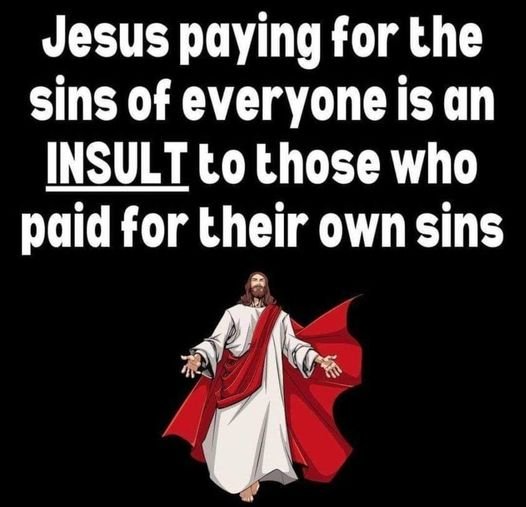
This image is a common meme used to mock or criticize government policies regarding debt, such as Student Loan Forgiveness. It suggests that when the government takes on debt to pay for loans, it is essentially punishing people who were responsible for borrowing money in the first place for failing to repay it. The text underlines the word "INSULT," highlighting that the government's act of paying debts is viewed as a punishment for the original act of borrowing.
simple-description (llama3.2-vision_11b)
The meme is a humorous take on the student loan forgiveness program, a topic of controversy in the US. The image depicts a cartoon of Jesus Christ with a caption "I forgave the sins of others, but not my student loans" - a play on Jesus' famous phrase "Forgive them for they know not what they do" - implying that the government's forgiveness of student loans is a double standard.
detailed-analysis (gemma3-27b-vision)
Okay, let's break down the image and the statement within it, using the requested theoretical frameworks. I'll only include sections where the frameworks are applicable to the content.
Visual Description
The image features a digital illustration of Jesus Christ. He is depicted with long brown hair and a beard, wearing a white robe and a dramatic, flowing red cloth draped around his arms and body, giving the impression of sacrifice or suffering. His arms are outstretched in a manner reminiscent of crucifixion, but he is standing. The background is solid black. The text, in bold white capital letters, boldly states, "Jesus paying for the sins of everyone is an INSULT to those who paid for their own sins." The font is impactful and designed to grab attention, emphasizing the claim.
Critical Theory
This image directly engages with concepts central to Critical Theory, particularly regarding power dynamics and ideology. The statement challenges the traditional Christian doctrine of atonement – the idea that Jesus’s death ‘pays’ for the sins of humanity. This doctrine, as the image suggests, can be seen as a form of ideological control.
- Ideology and False Consciousness: The image posits that accepting Jesus as a sin-bearer diminishes individual responsibility and agency. It implies that believing in a 'savior' who takes on others' burdens is a way to avoid confronting one's own actions and their consequences. This is a criticism of how dominant ideologies can lull individuals into a state of ‘false consciousness,’ preventing them from understanding and challenging the true sources of oppression or harm.
- Subversion and Resistance: The image's statement represents a direct critique of a deeply ingrained belief system. It's an attempt to subvert the established narrative and challenge the power structures that uphold it. The 'INSULT' framing demonstrates a strong sense of moral indignation, suggesting that the traditional doctrine is not merely inaccurate but harmful.
- Power Dynamics: The original doctrine can be viewed as positioning a divine figure as holding ultimate authority and power over sin and redemption. The image reverses this dynamic by emphasizing individual responsibility and potentially empowering those who take ownership of their actions, framing the 'sin-bearer' concept as a form of diminishing agency.
Marxist Conflict Theory
While the image doesn't overtly address economic or class struggle, a Marxist interpretation can be applied through the lens of alienation and the transfer of accountability.
- Alienation: The image suggests that accepting a 'sin-bearer' promotes a form of alienation from one's own actions. Instead of owning up to the consequences of those actions and taking responsibility, an individual can attribute 'redemption' to an outside force. This diminishes self-determination.
- Transfer of Accountability: The Marxist framework would focus on how the idea of a sin-bearer allows the ruling class or dominant power structures to avoid accountability for their actions. It suggests that the focus on 'sin' and individual morality can distract from systemic injustice and structural inequalities.
- Ideological Control: The traditional doctrine could be seen as an ideology used by those in power to maintain control and discourage resistance.
Postmodernism
A postmodern interpretation centers around the dismantling of grand narratives and the subjectivity of truth.
- Deconstruction of Metanarratives: The image directly challenges the grand narrative of Christian atonement. It questions the universal claim that Jesus's sacrifice is the sole solution to human sin.
- Subjectivity and Individual Experience: The image prioritizes individual responsibility and ‘paying for one's own sins’. It asserts that each person has a unique moral experience, and that attempting to generalize redemption through a single figure diminishes that uniqueness.
- Challenge to Authority: The image asserts that the narrative of atonement should not be accepted as authority. This aligns with a postmodern rejection of all universal truths.
Queer Feminist Intersectional Analysis
This analysis is the most applicable when interpreting this image as relating to accountability and empowerment.
- Intersectional Accountability: Feminist and queer theory often emphasize the importance of accountability for harm, particularly within communities. The image aligns with this by centering the act of ‘paying for one’s own sins.’ This emphasizes the agency and power that come with being accountable.
- Resisting Victim-Blaming: Traditional atonement narratives could be seen as implicitly absolving individuals from owning up to harmful actions. The image resists this by rejecting the idea that an external savior can 'fix' one's transgressions.
- Empowerment through Ownership: By emphasizing the importance of individual accountability, the image promotes a sense of self-determination and agency, particularly for marginalized groups who have historically been denied the power to define themselves and their experiences.
Let me know if you'd like me to elaborate on any of these interpretations or explore other perspectives.
simple-description (llama3.2-vision)
This meme is a humorous take on the idea that Jesus Christ, the central figure of Christianity, is often portrayed as a moral authority who would not tolerate blasphemy or disrespect. The image likely features a cartoon or illustration of Jesus, with the text "Jesus is judging you" or a similar phrase, implying that he is displeased with the user's language or behavior.
tesseract-ocr
AED TU Ry mC sins of everyone is an INSULT to those who paid for their own sins a ¢