First Seen
2023-05-10T21:03:42+00:00
simple-description (qwen3.5_2b-q8_0)
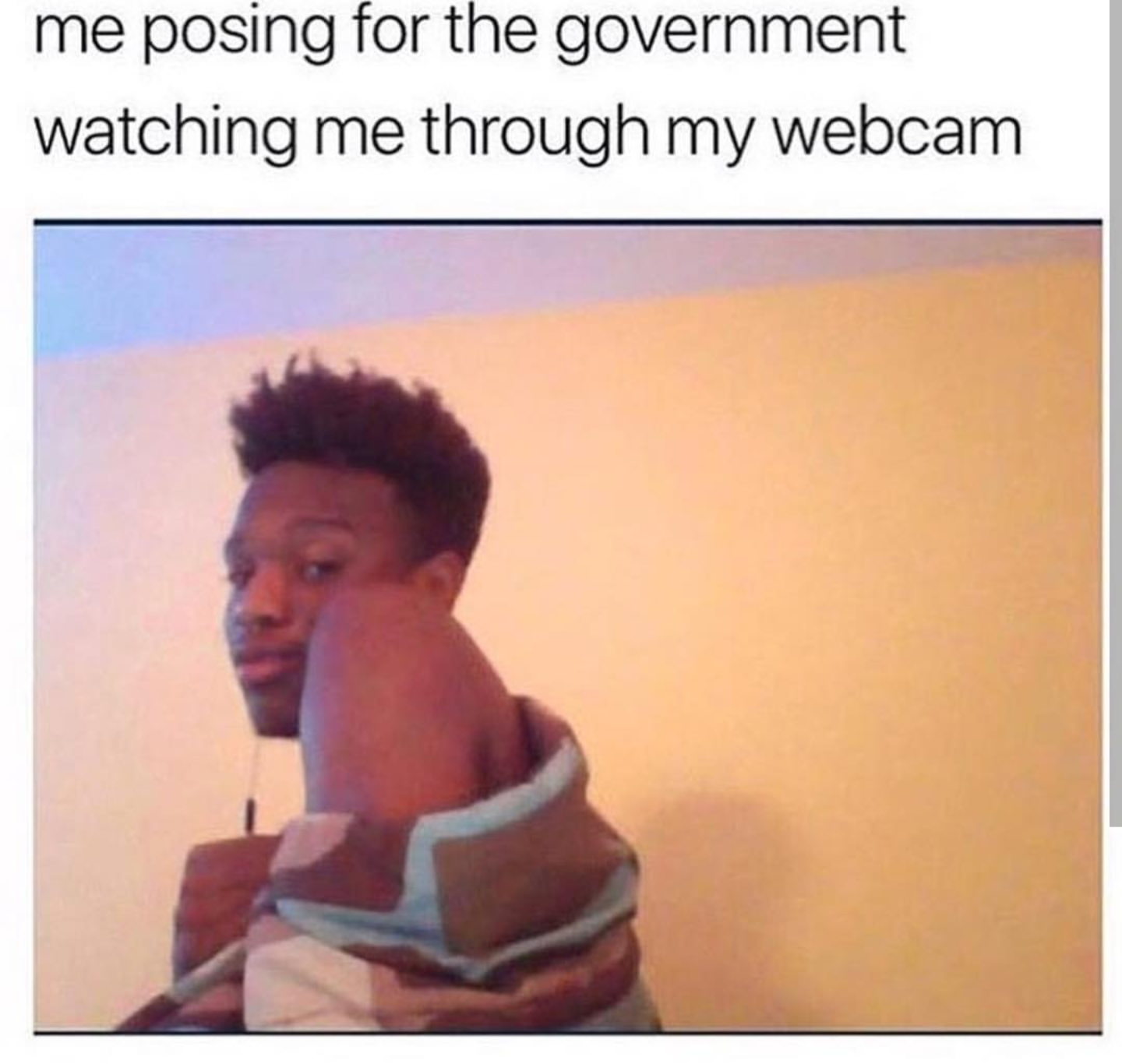
This meme satirizes the absurdity of government surveillance. It features a person posing while looking into a webcam, accompanied by text that reads, "me posing for the government watching me through my webcam." The humor lies in the contrast between the intense, watchful gaze of the government camera and the simple, non-existent task the subject is fulfilling.
simple-description (llama3.2-vision_11b)
The meme is a humorous commentary on the idea that people are more concerned with being liked and approved by others online than with being honest and authentic. It shows a person pretending to be someone they're not, using a selfie filter to look more attractive, and then pretending to be a government official to get a job. The text "I'm a government official" is written on the screen, but the person is clearly not one, and the selfie filter is a giveaway that they're just pretending.
detailed-analysis (gemma3-27b-vision)
Okay, let's break down this meme through the lenses you've requested. It's important to note that memes are layered, playful, and inherently invite multiple interpretations. I'll aim to provide analyses relevant to the visual and textual elements, leaning into the concepts you've prompted.
Visual Description
The image shows a partially exposed Black man, likely recently out of the shower, wrapped in a towel, looking over his shoulder. He appears somewhat vulnerable, caught in a moment of private routine. The background is blurred, suggesting an interior space. The lighting is warm, and the overall composition focuses on the man's body, particularly the curve of his back and shoulder. The meme text states, "me posing for the government watching me through my webcam." The juxtaposition of the intimate, vulnerable visual with the paranoid, surveilled text is key to understanding the meme's impact.
Foucauldian Genealogical Discourse Analysis
This meme is highly relevant to Foucault's work, specifically his concepts of panopticism and power/knowledge.
- Panopticism: The meme evokes the panoptic structure – the idea of a constantly observed subject, internalizing the gaze of an unseen authority. The webcam represents this "tower" of surveillance, though the authority is generalized to "the government." The man isn't necessarily being actively watched at this precise moment, but the possibility of constant surveillance induces self-regulation and a sense of being always under scrutiny.
- Power/Knowledge: Foucault argues that power and knowledge are inextricably linked. The government’s (presumed) ability to monitor individuals via webcams (whether real or imagined) grants it a form of power. This power is reinforced by the discourse surrounding surveillance – the constant media reports, political debates, and fear-mongering that normalize it. The meme's humor is born out of recognizing this power dynamic. The “posing” suggests a performative acceptance or ironic compliance with the surveillance.
- Genealogy: A genealogical approach would explore how this culture of surveillance emerged. It wouldn't simply condemn it but would trace its historical development – from early forms of state control to modern digital tracking – revealing the contingent and constructed nature of this power relationship.
Critical Theory
From a broad Critical Theory perspective (drawing from the Frankfurt School), this meme embodies anxieties around the modern state and the erosion of privacy.
- Commodification of the Private: This meme touches on the growing trend of the commodification of personal data. The constant collection of information through technology is seen as a form of exploitation, turning individual lives into resources for corporations and government agencies. The “posing” suggests a resignation to this state of affairs, as if the individual's agency has been diminished.
- Instrumental Rationality: The government’s surveillance (as presented in the meme) can be viewed as an example of instrumental rationality—using individuals as means to an end (e.g., security, control) rather than recognizing their inherent dignity.
- The Culture Industry: The meme itself participates in the "culture industry," reflecting and reinforcing anxieties about surveillance. It's a form of social commentary packaged within a shareable, humorous format.
Marxist Conflict Theory
While not the most direct application, a Marxist lens can see the meme as highlighting a power imbalance. The "government" represents the dominant class/state apparatus, while the individual represents the proletariat or those subject to its control.
- Surveillance as Control: Surveillance, in this context, functions as a tool of social control, ensuring compliance and preventing dissent. It's a way to maintain the existing power structure.
- Alienation: The meme suggests a feeling of alienation – a separation between the individual and their own privacy, as well as a sense of powerlessness in the face of an all-powerful state.
- False Consciousness: The “posing” could also be interpreted as a form of false consciousness – the individual accepting their subjugation as natural or inevitable.
Postmodernism
This meme aligns with postmodern themes of skepticism, simulation, and the blurring of boundaries.
- Hyperreality & Simulation: The meme suggests a world where the line between reality and simulation is increasingly blurred. The fear of surveillance may be as potent as the actual surveillance itself, creating a hyperreal sense of being watched.
- Deconstruction of Authority: The meme challenges the traditional notion of governmental authority. By presenting the government as an all-seeing, potentially intrusive force, it deconstructs the idea of the benevolent, trustworthy state.
- Irony & Parody: The use of humor and irony is a hallmark of postmodernism. The meme doesn't offer a straightforward condemnation of surveillance; it presents it as an absurd, almost comical situation.
Queer Feminist Intersectional Analysis
This is where the analysis becomes particularly rich. While seemingly general, the meme's anxieties about being watched and the vulnerability of the body are magnified for marginalized groups.
- The Gendered & Racialized Gaze: Black men, historically, have been subjected to heightened surveillance and scrutiny, particularly within systems of power (policing, law enforcement). The meme taps into this history. The visual of the vulnerable, partially exposed body is particularly fraught, given the historical objectification and control of Black bodies.
- Intersectionality: Surveillance disproportionately impacts marginalized communities (Black, Brown, LGBTQ+, disabled, etc.). The meme can be seen as a commentary on the ways in which these groups are already subjected to greater levels of scrutiny and control. The body in the meme can represent a site of intersecting vulnerabilities.
- Body Autonomy: The implied violation of privacy by constant surveillance is inherently tied to the denial of bodily autonomy. For LGBTQ+ and other marginalized individuals, this denial is compounded by existing experiences of societal control over their bodies and identities.
Important Considerations:
- Context: The meaning of the meme can vary depending on the individual and their experiences.
- Humor as Resistance: While the meme highlights anxieties, its humorous tone can also be a form of resistance. It allows individuals to acknowledge these concerns while simultaneously subverting the power dynamics at play.
Let me know if you'd like me to elaborate on any of these points or explore other theoretical frameworks.
simple-description (llama3.2-vision)
This meme is a screenshot of a viral video of a man named Keaton Jones, who was filmed crying and ranting about being bullied at school. The text overlayed on the image reads: "I don't owe you people anything. I don't owe you my life and you will never take it. I owe you nothing. We don't owe you anything. We don't owe you our lives and you will never take it. I don't owe you my life and you will never take it. I don't owe you my life and you will never take it." The image is often used to express frustration or anger, implying that someone is fed up with being asked for something or being bothered by others.
tesseract-ocr
me posing for the government watching me through my webcam ,