First Seen
2023-05-10T21:03:35+00:00
simple-description (llama3.2-vision_11b)
The meme is a screenshot of a Star Wars character, specifically Grand Moff Tarkin, with the caption "When a program starts running in an infinite loop and refuses to stop". The image is a humorous take on the frustration of dealing with technical issues, where the program is like a stubborn character who refuses to listen to orders.
detailed-analysis (gemma3-27b-vision)
Okay, here's a breakdown of the meme using the frameworks you requested, covering only those that are applicable. It's quite a rich meme for its simplicity, so there's a lot to unpack!
Visual Description
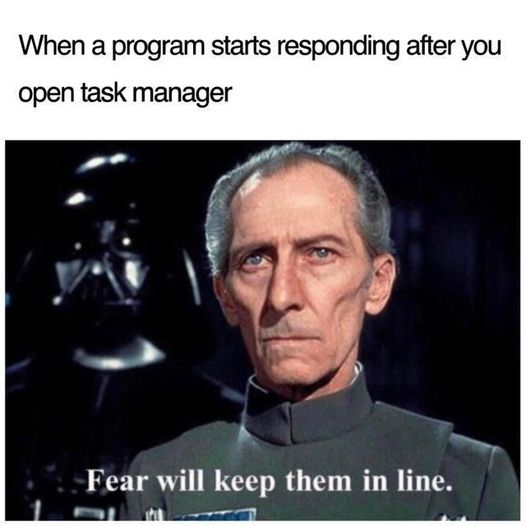
The meme presents an image of Grand Moff Tarkin, a character from Star Wars: A New Hope. He is shown in a medium close-up, with a stern and imposing expression. Behind him, and slightly out of focus, is the Death Star, a massive space station and symbol of Imperial power. The text overlay reads, "When a program starts responding after you open Task Manager," and a caption below Tarkin states, "Fear will keep them in line." The visual composition emphasizes Tarkin’s authority and the power he wields, coupled with the ominous presence of the Death Star.
Foucauldian Genealogical Discourse Analysis
This meme lends itself very well to a Foucault-inspired analysis. Foucault’s work focuses on the interplay of power, knowledge, and discourse.
- Power Dynamics: The meme highlights a particular type of power dynamic – the user's perceived control over a computer program. The act of opening Task Manager is essentially an assertion of dominance over the software. The program’s ‘response’ after Task Manager is opened suggests it's been ‘brought in line’ by the threat of being closed or forced to comply.
- Discipline & Surveillance: Task Manager acts as a panoptic tool. The user is subtly surveilling the program's resource usage, and the program, in a sense, ‘knows’ it is being watched. This creates a disciplinary effect: the program operates more efficiently because it's under observation. Tarkin’s quote about "fear" is crucial – it's not direct force, but the threat of intervention that controls the program’s behavior.
- Genealogy of Control: Examining the history of task management tools reveals an increasing desire to exert control over computational processes. Early operating systems provided minimal control; later systems, with Task Manager and Activity Monitor, granted users significant power to monitor and intervene, demonstrating a shift in the relationship between humans and machines.
- Normalizing Power: Task Manager doesn’t eliminate problematic programs; it "normalizes" their behavior through user intervention. The meme suggests that many programs only truly function properly when under the threat of being managed, normalizing a state of controlled functionality.
Critical Theory
The meme can be analyzed through a critical lens, specifically examining the concept of technological domination.
- Domination & Control: The core of the meme resides in the user’s ability to exert control over an unresponsive program. It can be viewed as a microcosm of broader power dynamics where technology—designed for efficiency and convenience—becomes a source of frustration, and the user must reassert control.
- Alienation: The meme touches upon a sense of alienation inherent in our relationship with technology. We create these tools, but they often seem to operate according to their own logic, leading to frustration when they deviate from our expectations. The need to "discipline" the program through Task Manager highlights a disconnect between the user and the technology.
- The Illusion of Control: The meme subtly hints at the illusion of control. While Task Manager allows users to monitor and intervene, it doesn't fundamentally change the program’s underlying functionality. The user feels empowered, but that empowerment is largely superficial.
Marxist Conflict Theory
While not the most prominent theme, a Marxist interpretation can be present:
- Program as "Labor": The malfunctioning program can be seen as a metaphorical worker who is not performing as expected. The user, as the "owner" or manager, intervenes to force the program to comply and increase its "productivity" (i.e., respond).
- Class Struggle: The conflict between the user and the unresponsive program can be framed as a micro-level class struggle, with the user exercising power over the 'labor' of the program.
- Alienation of Labor: The initial unresponsiveness of the program can be interpreted as a form of alienation, where the program is not functioning in accordance with the user's needs.
Note: While queer feminist intersectional analysis could be attempted, it feels largely inapplicable to the primary meaning and core themes of this meme. It's possible to stretch a connection by exploring the idea of controlling/managing something (the program) as a metaphor for oppressive social structures, but that would be a rather tenuous connection.
I hope this analysis is helpful! Let me know if you'd like me to elaborate on any particular aspect.
simple-description (llama3.2-vision)
This meme is a screenshot from the Star Wars franchise, specifically a scene where Darth Vader is about to kill a Rebel officer who has defied him. The officer says "I find your lack of faith disturbing" and then is about to be killed. The meme is a humorous take on this scene, with a caption that says "When a program starts responding again after you've been waiting for hours".
tesseract-ocr
When a program starts responding after you open task manager po ta man le a), ball iS = reco mom LC