First Seen
2023-08-20T16:58:06+00:00
simple-description (qwen3.5_2b-q8_0)
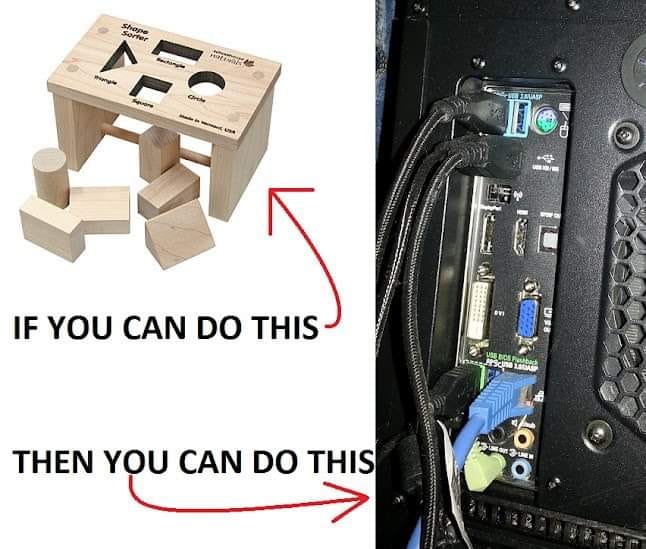
This meme uses a "Shape Sorter" puzzle as a metaphor for computer hardware assembly. Just as a child sorts wooden blocks into specific geometric shapes, a computer's motherboard connects various devices—represented here by the USB and power cables—to the CPU via the black chassis. The text "USB 3.0 (4800 Mbit/s) Controller..." on the puzzle board highlights the specific hardware component (the "controller" card) responsible for the connection shown in the real-world shot.
simple-description (llama3.2-vision_11b)
This meme is a play on the classic "if you can read this" joke, but with a technology twist. It shows a picture of a computer motherboard with a label that says "If you can read this, you're too close to the motherboard" and a humorous warning about the dangers of getting too close to the computer's internal components.
detailed-analysis (gemma3-27b-vision)
Okay, let's break down this image through a series of lenses, as requested. It's a complex image with many layers of possible interpretation, especially given the prompt's theoretical demands. It's important to acknowledge that applying these theories is interpretive and can be subjective.
Visual Description
The image is a diptych, presenting two contrasting scenes side-by-side.
-
Left Side: A wooden shape sorter for young children. It has holes cut in a lid corresponding to different geometric shapes – circles, squares, triangles – and associated wooden blocks. The scene implies a focus on early childhood development, spatial reasoning, and matching skills.
-
Right Side: The rear panel of a computer case, revealing the motherboard with various ports and connections. Cables are visibly connected, and it appears to be a more advanced or gaming computer.
-
Text Overlay: The text “IF YOU CAN DO THIS” is placed next to the shape sorter. “THEN YOU CAN DO THIS” is written next to the computer panel. This creates a direct correlation between the two activities, implying a conditional relationship.
Foucauldian Genealogical Discourse Analysis
This image is deeply resonant with Michel Foucault's concepts of power/knowledge and genealogy. The image positions shape-sorting as a “primitive” or foundational skill, and computer configuration/operation as a more advanced one. This is a discourse in itself – a system of thought, language, and practice that constructs our understanding of competence and intelligence.
-
Genealogy of Skill: The image implies a historical trajectory of skill acquisition. The shape sorter represents the very early stages of developing cognitive abilities (shape recognition, problem-solving), while the computer panel represents a complex, technologically-mediated skill developed through education and exposure. Examining how these skills are valued and defined across time is a genealogical exercise.
-
Power/Knowledge: The implicit assertion that one must master the simple (shape sorter) to move onto the complex (computer) reinforces a power dynamic. The very act of defining one as "basic" and the other as "advanced" establishes a hierarchy of knowledge. Those who can confidently configure a computer are positioned as more knowledgeable, capable, or even intelligent. This is not an inherent truth, but a constructed one, maintained through societal discourses.
-
Disciplinary Power: The implicit progression from shape sorter to computer panel mirrors how educational systems often discipline individuals by breaking down complex tasks into smaller, manageable steps. This process not only imparts skills but also instills norms and expectations about competence and what it means to be “educated”.
Critical Theory
The image invites a critical examination of technology, childhood, and the construction of ability.
- Commodification of Development: The shape sorter, as a mass-produced toy, speaks to the commodification of early childhood development. Parents are encouraged to purchase specific toys designed to “maximize” their child’s potential, participating in a capitalist system that frames development as a measurable and marketable process.
- Technological Determinism: The image could be interpreted as subtly promoting technological determinism—the idea that technology shapes society rather than the other way around. By framing the computer panel as the “next step” from the shape sorter, it implies a linear progression toward a technologically-driven future.
- Hidden Curriculum: The perceived 'logic' of the image (master the simple, then the complex) is an example of a 'hidden curriculum' – unspoken assumptions and values embedded within our culture that are passed on through seemingly neutral practices (like toy selection or skill categorization).
Marxist Conflict Theory
The image can be examined through the lens of class and the division of labor.
- Digital Divide: The ability to navigate and configure a computer is increasingly essential for participation in the modern economy. The image implies that this skill is not universally accessible, and thus reinforces existing inequalities. Those lacking access to technology or education may be excluded from opportunities.
- Skill as Capital: The ability to build/configure a computer is a form of cultural capital – a non-economic asset that confers status, power, and opportunity. This capital is unevenly distributed, and its possession can exacerbate class divisions.
- Alienation of Labor: On a more abstract level, the image could highlight the alienation of labor in the digital age. While the shape sorter requires physical manipulation and engagement, the computer panel represents a more abstract, mediated form of work. This could be seen as a symbolic representation of the loss of direct connection to the products of one’s labor.
Postmodernism
The image deconstructs the idea of a linear progression of skill acquisition and challenges grand narratives about education and intelligence.
- Deconstruction of Mastery: The image juxtaposes two seemingly disparate activities, inviting us to question the very definition of “skill” and “mastery”. Is configuring a computer truly “more” skillful than matching shapes? The image suggests that skill is contextual and culturally constructed.
- Fragmentation of Knowledge: The image reflects the fragmentation of knowledge in the postmodern era. The shape sorter represents a focused, embodied skill, while the computer panel represents a complex network of interconnected systems. This fragmentation challenges the idea of a unified body of knowledge.
- Irony and Parody: The image has a touch of irony, as the implied correlation between the two tasks feels somewhat absurd. This absurdity challenges the seriousness with which we often approach questions of intelligence and competence.
Queer Feminist Intersectional Analysis
This analysis is perhaps the most challenging to apply directly, but it offers a unique perspective.
- Challenging Normative Skillsets: Traditionally, STEM fields (including computer building) have been dominated by men. The image could be seen as subtly reinforcing this gendered division of labor, implicitly associating technical skills with masculinity and early childhood toys with femininity. A queer feminist lens would challenge this assumption.
- Intersection of Privilege: Access to technology and education is not equal across all social groups. Race, class, gender, and ability all intersect to create barriers to participation in the digital world.
- Reclaiming "Simple" Skills: From a feminist perspective, the “simple” act of shape sorting could be re-evaluated as a valid and important skill. This challenges the patriarchal tendency to devalue activities traditionally associated with caregiving and early childhood education.
It's important to reiterate that these are just interpretations. The beauty of postmodern analysis is that there isn't one "correct" answer. The image is open to multiple readings, and its meaning is shaped by the perspective of the viewer.
simple-description (llama3.2-vision)
This meme is a play on the classic "if you can read this" sign that is often placed at the bottom of a staircase or a long hallway. In this version, the text is "if you can read this" but it's actually on a computer keyboard and is being typed out on a screen. The punchline is that the keyboard is so small that the text is being typed out on a tiny screen that's embedded in the keyboard itself.
tesseract-ocr
\ ~~. iz | a fie 1 © vy Vs, : VT = -— | /¢ PAI i a Fe | \ a a ps =| \ FS fo: ma IF YOU CAN DO THIS~ Mim) Iie EES 4 y > p f.) be ; THEN YOU CAN DO THISHBAA “roam