First Seen
2023-11-09T21:11:26+00:00
simple-description (qwen3.5_2b-q8_0)
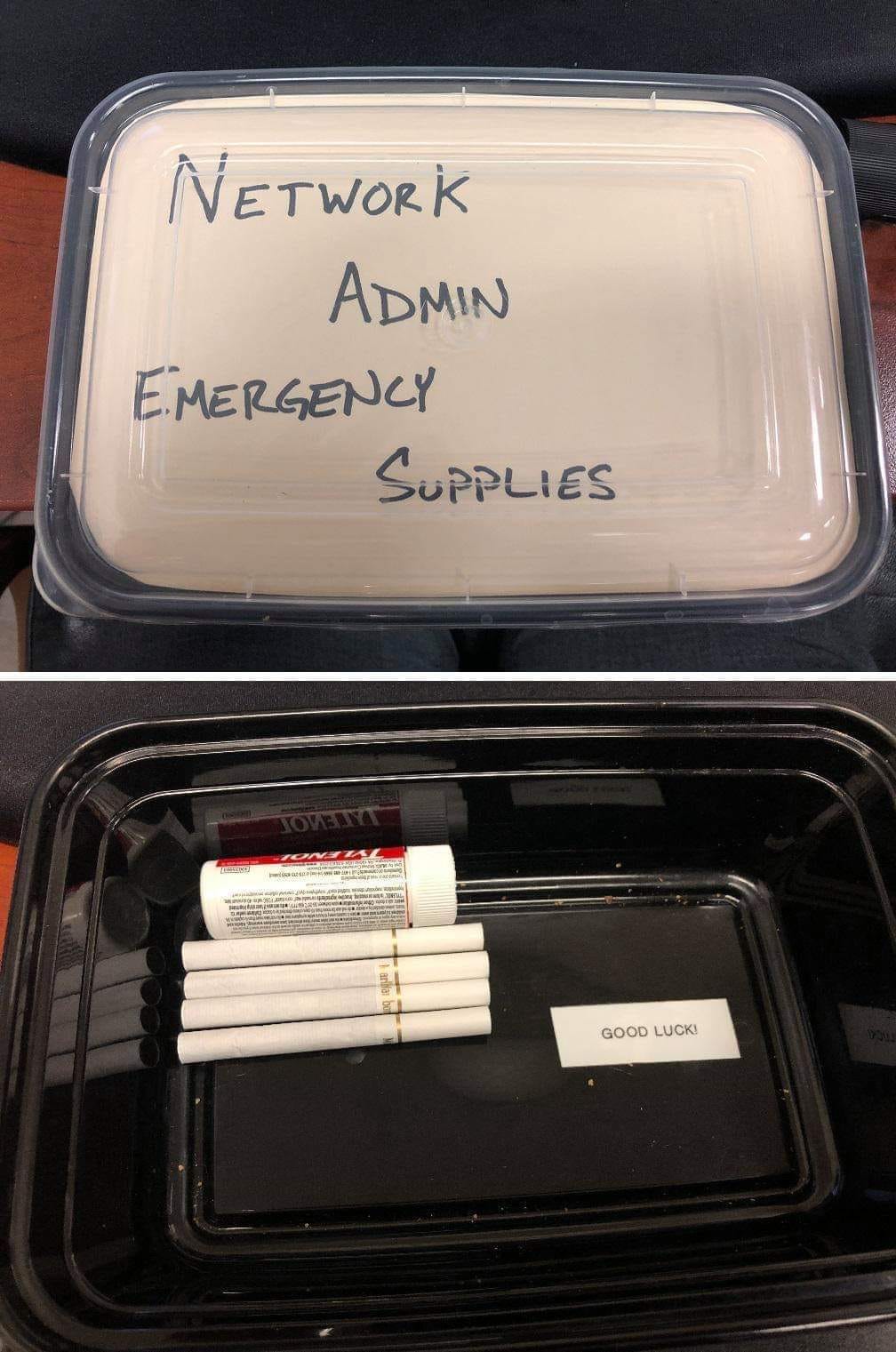
This meme is a dark joke about the IT industry. The text "Network Admin Emergency Supplies" implies the person was prepared for a cyber attack, but the "Good Luck" label reveals the irony that the person who needed supplies had already died. The bottom container shows a single cigarette, humorously suggesting that the network administrator was the only one standing when things got dangerous.
simple-description (llama3.2-vision_11b)
This meme is a humorous take on the concept of a "tech emergency kit" that's supposed to be a joke about the absurdity of the tech industry. The image shows a container labeled "Tech Emergency Kit" with items like a stapler, a roll of tape, and a "help" button, implying that these are the only things that would be needed to "save" a tech company in a crisis. The text on the label reads "In case of emergency, break glass" and "Tech Emergency Kit: Because we can't actually fix anything".
detailed-analysis (gemma3-27b-vision)
Okay, here's an analysis of the image broken down into the requested theoretical sections, as applicable. I will indicate when a section doesn't really "fit" the image’s content.
Visual Description
The image consists of two parts, presented as a before-and-after. The top image shows a transparent plastic storage container with a handwritten label on the lid. The label reads "NETWORK ADMIN EMERGENCY SUPPLIES," using capital letters and varying handwriting size/emphasis. The second image shows the same container, now open and containing a few white marker pens and a small label reading "GOOD LUCK!" These are simply placed inside the container. The container appears to be standard black plastic. The entire image has a utilitarian, slightly ad-hoc aesthetic.
Foucauldian Genealogical Discourse Analysis
This image is ripe for a Foucauldian reading. The labeling of “NETWORK ADMIN EMERGENCY SUPPLIES” performs a specific, power-laden act. The label isn't simply a descriptive aid; it constitutes the contents as “emergency” supplies, thereby framing a potential situation as a crisis requiring specialized tools and knowledge. This emphasizes the discourse of network administration – the language, knowledge, and practices that define and legitimize this role.
The "emergency" designation positions network administrators as essential for maintaining societal function, reinforcing the importance of this profession in the current information age. The handwritten nature of the label, though seemingly casual, highlights the improvisational nature of maintaining the network infrastructure, hinting that even in a highly technical field, there is an element of contingency and unpredictable demands. The inclusion of “GOOD LUCK!” seems to further acknowledge the contingency—the administrator must go into the repair with hope and good fortune, highlighting the unpredictable nature of technology. The fact that the emergency supplies are simple marker pens reveals the specific nature of the network admin work - the job is about fixing things by hand, not always about the hardware, but the labeling of devices.
The genealogy of this situation would trace how the concept of a “network administrator” emerged as a vital role, how "emergency" became associated with network failures, and how simple tools like markers became essential for dealing with those failures.
Critical Theory
From a Critical Theory perspective, the image can be understood as a symptom of the increasing dependence on technology and the hidden labor required to maintain it. The "emergency" framing draws attention to the fragility of our technological systems and the vulnerability of our reliance on them.
The fact that the “emergency supplies” are mundane markers highlights the often-invisible, practical work that underpins digital infrastructure. We rarely think about the manual labor involved in labeling cables, identifying ports, or troubleshooting physical connections. This image reveals a disconnect between the seemingly seamless digital world and the messy, physical reality that supports it. The “GOOD LUCK!” label can be interpreted as a cynical acknowledgement of the pressures faced by those who maintain these systems, the fact that they are often left to fix problems with limited resources and an overwhelming sense of responsibility.
Marxist Conflict Theory
This image, while not overtly portraying class struggle, can be read through a Marxist lens by focusing on the division of labor and the control of technology. The network administrator, represented by these supplies, is a specialist, a member of a relatively privileged class with the knowledge and skills to control a vital component of modern production and communication.
The “emergency supplies” represent the tools necessary to maintain the existing power structures that rely on the network. If the network goes down, it disrupts the flow of capital, communication, and control. The fact that the supplies are simple tools speaks to the exploitation of the administrator’s labor – they are tasked with maintaining a complex system with limited resources. The "GOOD LUCK!" label could also signify the anxiety and precarity inherent in a labor market that demands constant uptime and reliability from its technical workers.
Postmodernism
The image aligns with certain postmodern themes. The label, "NETWORK ADMIN EMERGENCY SUPPLIES," is a self-referential statement—it describes the contents in a way that is almost absurdly literal. The image deconstructs the idea of “emergency” and “supplies” by presenting them in such a mundane context. The disconnect between the grandiose label and the simple contents exemplifies the postmodern tendency to question grand narratives and expose the arbitrariness of meaning.
The handwritten nature of the label and the ad-hoc arrangement of the supplies further underscore the fragmentation and lack of fixed meaning characteristic of postmodern aesthetics. The “GOOD LUCK!” label is a playful, ironic gesture that acknowledges the lack of control and predictability in a technological world.
Queer Feminist Intersectional Analysis
This section is the least applicable to the image. However, one could stretch it by considering the ways in which technical fields like network administration have historically been dominated by men, and the ways in which women and other marginalized groups may be excluded or face additional challenges in these professions. The ad-hoc, improvisational nature of the "emergency supplies" could be interpreted as a reflection of the lack of institutional support or resources for those who do not fit the traditional mold of the network administrator. The "GOOD LUCK!" label could be read as a sardonic comment on the systemic barriers faced by marginalized groups in STEM fields, implying that success often relies on luck rather than equal opportunity. However, this is a very loose interpretation.
Let me know if you'd like me to elaborate on any of these sections, or explore different theoretical frameworks!
simple-description (llama3.2-vision)
The meme is a picture of a container labeled "In Case of Emergency: Break Glass" with a few items inside, including a first aid kit, a fire extinguisher, and a small notebook. However, the items inside are actually a bottle of whiskey, a pack of cigarettes, and a box of "Emergency" chocolate. The text on the label reads "In Case of Emergency: Break Glass / For Emergency Use Only: Break Glass / In Case of Emergency: Break Glass".
tesseract-ocr
SSS SE — ay . : : | VETWORK | | ADMIN | | | EMERGENCY \ | 2 ss) ae a i oUuUrretrges | | . . = — mo = A LLL LLL AOA TOO DST ne = - - wil Sn