First Seen
2024-10-10T06:03:12.989325+00:00
simple-description (qwen3.5_2b-q8_0)
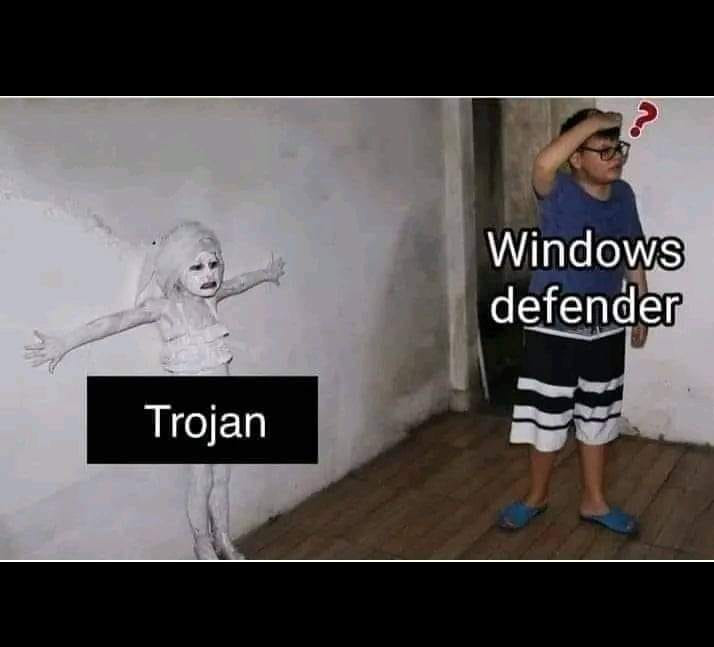
This image uses a creepy ghost to personify a scary computer virus. On the left, a figure labeled "Trojan" represents the malicious software designed to infect and steal information from computers. On the right, a confused boy stands next to the text "Windows defender," which is a real antivirus program specifically created to catch and stop these dangerous threats.
detailed-analysis (gemma3_27b-it-q8_0)
Okay, let's break down this meme from a technology perspective, incorporating relevant theoretical frameworks where applicable.
Visual Description
The meme employs a juxtaposition of two images. On the left, a grayscale, slightly unsettling illustration depicts a figure with outstretched arms – heavily implying a depiction of the Trojan Horse from Greek mythology. The image is labeled “Trojan”. On the right, a color photograph shows a young boy, looking confused and questioning, scratching his head. He is labeled “Windows Defender.” The juxtaposition is intended to create a humorous (and slightly cynical) contrast.
Foucauldian Genealogical Discourse Analysis
Michel Foucault's work on power/knowledge, discourse, and genealogy is very relevant here. This meme functions within a discourse about cybersecurity, and specifically, the historical development of threat detection.
- Genealogy of 'Trojan': The term 'Trojan Horse' originates from the historical/mythological story, then became a metaphor for deception and hidden threats. In computing, the term has been repurposed to describe malicious software disguised as legitimate programs. This demonstrates how historical narratives are mobilized to define new technological concepts.
- Discourse of Security: The meme highlights the inherent asymmetry in the power/knowledge relationship in cybersecurity. The “Trojan” represents a cunning, stealthy power, while "Windows Defender" represents the often reactive, and sometimes inadequate, power of defense.
- Discipline & Control: The existence of threats like Trojans and the resulting need for antivirus software (like Windows Defender) contribute to a regime of surveillance and control. Users are disciplined into adopting security measures to protect their systems—a form of technological self-regulation. The meme suggests this is not always effective, poking fun at the reactive nature of these defenses.
Critical Theory
The meme subtly engages with elements of Critical Theory, specifically in questioning the claims of technological neutrality.
- Ideology of "Protection": Windows Defender presents itself as a protector, a benevolent force against malice. However, the meme undermines this by presenting it as bewildered by the "Trojan." This prompts a critical examination: Does security software truly empower the user, or does it simply reinforce an ongoing cycle of threat and response that benefits software vendors and security industries?
- Commodification of Security: Antivirus software is a commodity. Critical Theory would ask, does the constant need for updates and "protection" perpetuate a system where fear is manufactured and monetized? Is "security" just another product being sold?
- Critique of Rationality: The meme mocks the assumed rationality of security systems. A sophisticated Trojan can often bypass even sophisticated defense mechanisms, suggesting the limitations of purely technical solutions.
Postmodernism
The meme's humor derives, in part, from a postmodern sensibility of questioning grand narratives and embracing irony.
- Deconstruction of the Binary: The binary of "attacker" (Trojan) vs. "defender" (Windows Defender) is presented as fundamentally unstable. The Trojan is inherently deceptive, operating outside of the intended norms. Windows Defender, in the meme, seems powerless to fully comprehend this deception, rendering the binary less clear-cut.
- Simulacra & Simulation: The whole concept of 'security' within a digital landscape is arguably a simulation. We are attempting to create a safe environment within a space that is inherently vulnerable and mutable. The meme plays on this by highlighting the artificiality of the defense.
In Summary
This meme, at its core, is a humorous commentary on the ongoing "arms race" between cybersecurity threats and defenses. It’s a cynical acknowledgment that even the most established security software can often feel outmatched and bewildered by the ingenuity of malicious actors. By framing this dynamic within the historical context of the Trojan Horse, the meme suggests that deception and vulnerability are fundamental aspects of the technological landscape. The meme does not represent the efficacy of these technologies, but the constant need to maintain them.
Let me know if you'd like me to expand on any of these points or explore other theoretical angles.
simple-description (llama3.2-vision_11b)
The meme is a play on the common frustration of dealing with malware and viruses on computers. It depicts a child trying to protect a younger sibling from a monster, with the child representing a Windows Defender (a type of antivirus software) and the monster representing malware. The text "Windows Defender vs. Malware" is written on the image, highlighting the struggle between the two entities.
detailed-analysis (gemma3-27b-vision)
Okay, let's break down this image using the frameworks you've requested. This is a very strange image, so interpretations can be expansive. I'll indicate when a framework doesn't really apply.
Visual Description
The image is a juxtaposition of two elements. On the left, a dark, highly textured drawing depicts a ghostly figure, seemingly a child, with arms outstretched in a pose suggesting distress or a crucifixion. The drawing style is dramatic and unsettling, creating a sense of unease. A black banner labeled “Trojan” is overlaid on the drawing. On the right, a young child stands in what appears to be a hallway, looking confused and holding a laptop with the words "Windows Defender" on the screen. The room has a somewhat drab, institutional feel, with bare walls and flooring. The overall effect is jarring and raises questions about the relationship between the two elements. The image is digitally constructed, likely a meme or a piece of digital art with commentary.
Foucauldian Genealogical Discourse Analysis
This framework is surprisingly strong here.
- Discourse of Security/Threat: The image immediately sets up a discourse around security and threat. "Trojan" references the mythological Trojan Horse and, more importantly, computer malware. "Windows Defender" is a system designed to protect against these threats. The image visualizes this binary – threat (Trojan, depicted as a vulnerable, haunting figure) versus defense (Windows Defender).
- Power/Knowledge: Foucault argues that power and knowledge are inextricably linked. The "Trojan" figure becomes defined by the very systems meant to combat it. It is a product of the discourse of cybersecurity. Likewise, Windows Defender gains its power by defining what constitutes a "threat."
- Genealogy: We can trace the history (genealogy) of this imagery. The Trojan Horse itself has a history in mythology and warfare, now re-imagined as digital malware. The visual tropes of ghostly figures and vulnerability have a long history in art and horror, now linked to the anxieties surrounding digital security.
- Surveillance and Discipline: Windows Defender, and by extension, the software industry, functions as a form of digital surveillance and discipline, constantly monitoring for threats and enforcing security protocols. The image can be read as a visualization of this process. The child with the laptop is a participant in, and subject to, this system.
Critical Theory
- Alienation: The image evokes a sense of alienation. The "Trojan" figure is isolated and spectral, representing something that has been excluded or marginalized. The child with the laptop, while seemingly in control, is also disconnected from this ghostly presence and reliant on technology for protection.
- Commodification of Fear: The image suggests that fear is being commodified. The computer security industry profits from creating and perpetuating the perception of threat. Windows Defender is a product sold to alleviate anxiety.
- The Spectacle: Borrowing from Debord, the image can be seen as a fragment of the spectacle. It presents a simplified, highly mediated representation of a complex issue (digital security), focusing on the appearance of threat and defense rather than the underlying realities.
Marxist Conflict Theory
While a bit of a stretch, Marxist principles can be applied.
- Class Struggle (Digital Divide): Access to technology and the ability to afford security software create a class-based digital divide. Those who can afford protection are better positioned against digital threats.
- Control of Means of Production: The software industry (Microsoft in this case) controls the means of "digital production" (the technology and security protocols that govern our online lives). This creates a power imbalance.
- Commodification of Security: As noted in Critical Theory, security itself has become a commodity, reinforcing capitalist structures. The sale of antivirus software benefits the owning company, even if the perceived threat is exaggerated.
Postmodernism
- Simulacra and Simulation: The image blurs the line between reality and representation. The "Trojan" is not a literal horse, but a digital virus. The "defense" is not a physical shield, but a software program. We are dealing with simulations of threat and protection.
- Fragmentation and Juxtaposition: The image is deliberately fragmented and juxtaposes seemingly unrelated elements (a ghostly drawing and a child with a laptop). This reflects the postmodern characteristic of challenging traditional narratives and creating new meanings through unexpected combinations.
- Deconstruction of Meaning: The image resists easy interpretation. It throws into question the very idea of “security” and “threat” by presenting them in such an abstract and unsettling way.
Queer Feminist Intersectional Analysis
This framework is the weakest fit, but some connections can be made:
- Vulnerability and Exposure: The ghostly figure's pose suggests vulnerability and exposure. This can be read through a feminist lens as a representation of the societal vulnerabilities faced by marginalized groups, particularly women, who are often subjected to digital harassment and surveillance.
- Digital Spaces as Sites of Harm: Digital spaces (where malware and security software operate) can be sites of harm for marginalized groups, including queer and trans individuals.
- Intersectionality: The image could be interpreted as highlighting the intersection of digital security vulnerabilities with broader societal inequalities, although this reading requires a significant leap in interpretation.
Let me know if you'd like me to expand on any of these sections, or if you'd like me to explore other theoretical frameworks!
simple-description (llama3.2-vision)
This meme is a play on the common Windows security software "Windows Defender". It shows a child being chased by a monster, but instead of running away, the child is calmly watching the monster and says "I've got Windows Defender".