First Seen
2023-05-10T21:03:42+00:00
simple-description (qwen3.5_2b-q8_0)
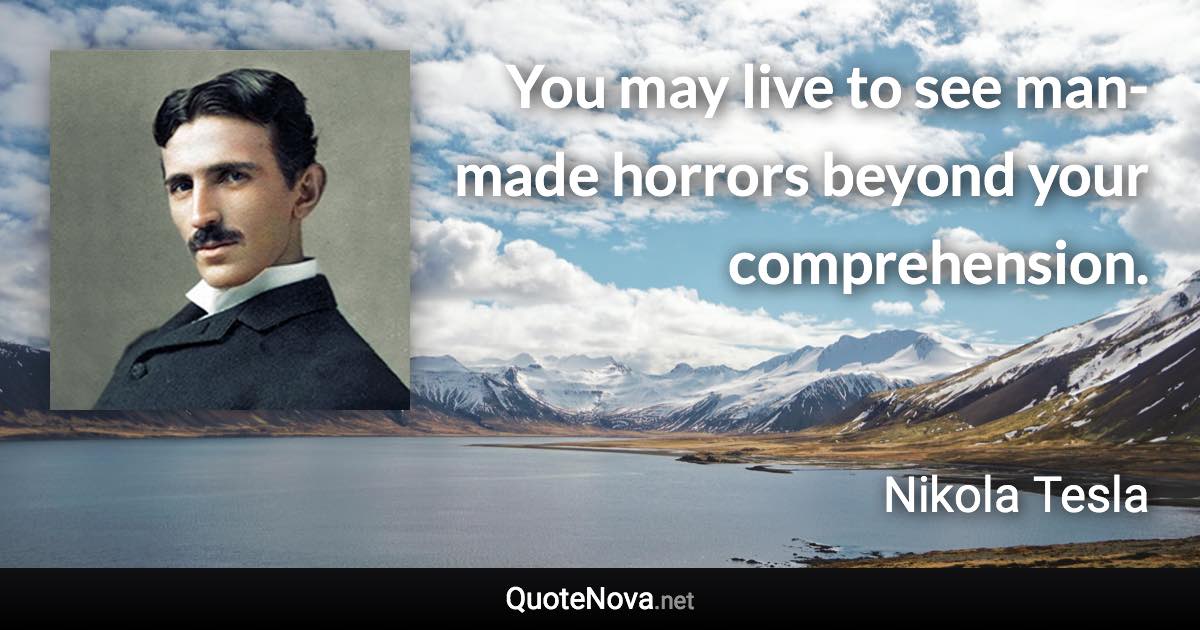
This is a humorous quote attributed to Nikola Tesla, played on his serious and intellectual reputation. He is sarcastically suggesting that humans are so stupid they might survive a future nuclear war, because they simply won't understand or comprehend the scale of the destruction coming. The text reads: "You may live to see man-made horrors beyond your comprehension."
simple-description (llama3.2-vision_11b)
The meme is a play on Nikola Tesla's quote "When I die, they will say: 'In death, the world loses a man of extraordinary gifts.' " The meme replaces "man" with "man-child" to poke fun at Tesla's eccentricities and make a humorous comment about his reputation. The image likely shows a photo of Tesla with a caption like "When I die, they will say: 'In death, the world loses a man-child of extraordinary gifts.'"
detailed-analysis (gemma3-27b-vision)
Here's an analysis of the image, broken down by the requested theoretical lenses, only including sections where the theory applies.
Visual Description
The image is a digitally constructed composite, featuring a portrait of Nikola Tesla alongside a landscape background.
- Portrait: A sepia-toned, close-up portrait of Nikola Tesla. He’s dressed in a dark suit, and his gaze is directed slightly off-camera, appearing thoughtful or pensive. The portrait has a vintage, historical quality, suggesting a connection to the past.
- Background: Behind Tesla is a wide shot of a mountainous landscape with a body of water (likely an ocean or large lake) in the foreground. Above the mountains are dramatic, heavily clouded skies. The background is more vibrant in color than the portrait.
- Text: White text overlays the image. The primary quote, “You may live to see man-made horrors beyond your comprehension," is prominently displayed. Below this is "Nikola Tesla," the attributed author, and at the very bottom, the website “QuoteNova.net.”
- Overall Impression: The image aims to evoke a sense of foreboding and the power of human invention. The juxtaposition of Tesla, a celebrated innovator, with the phrase "man-made horrors" creates a tension. The dramatic landscape adds to this sense of looming threat.
Foucauldian Genealogical Discourse Analysis
This image and quote offer a strong starting point for a Foucauldian analysis.
- Discourse on Progress: The image participates in a historical discourse surrounding technological progress. Tesla is historically positioned as a 'genius' inventor, embodying the potential for advancement. However, the quote actively disrupts this celebratory narrative. It doesn’t reject progress outright, but suggests a dark side to it – a potential for horrors that exceed human understanding.
- Power/Knowledge: The image reveals the relationship between power and knowledge. The quote implies that the knowledge and power acquired through human innovation aren’t inherently benevolent. There's a sense that these forces can escape control, creating new forms of dominance and suffering. The framing of “horrors” as exceeding comprehension suggests a loss of control, a loss of epistemic access. It points to the dangers of unchecked technological development and the potential for tools created with good intentions to be used for harm.
- Genealogy of "Horror": A genealogical approach could trace the historical development of the concept of "horror." What constitutes a "horror" changes over time, shaped by social, political, and technological shifts. This image asks us to consider what new forms of horror might emerge from future advancements, forms that are alien to our current understanding.
- Discipline and Control: The "horrors" mentioned could also be interpreted through a Foucauldian lens of discipline and control. Technology often enables new forms of surveillance, punishment, and social control, potentially creating a horrifying future of intensified power dynamics.
Critical Theory
The image readily lends itself to a critical theoretical analysis.
- Technological Rationality: The image critiques the idea of unbridled technological rationality – the belief that technological advancement is inherently good. Tesla’s association with the quote suggests that even the most brilliant minds can foresee the dark consequences of innovation.
- Instrumental Reason: The quote alludes to the dangers of instrumental reason – the tendency to treat everything, including people and the environment, as a means to an end. If technological progress is pursued solely for its own sake, without ethical considerations, it can lead to horrifying outcomes.
- Alienation: The image can be read as a critique of the alienating effects of technology. As technology becomes more complex and pervasive, it can disconnect us from our own humanity and from the natural world. The "horrors" alluded to might be the result of this alienation, the loss of empathy and connection.
- Domination: The “horrors” could be interpreted as manifestations of broader societal patterns of domination—of nature, of other people, of entire cultures—that are amplified by technological power.
Marxist Conflict Theory
While not as explicit as in the previous analyses, a Marxist reading can be applied:
- Technological Development as a Tool of Class Power: From a Marxist perspective, technological development isn't neutral. It's often driven by the interests of the ruling class and used to consolidate their power. The "horrors" mentioned could be forms of oppression or exploitation enabled by advanced technology.
- Alienation and the Labor Process: The quote might allude to the alienating effects of technology on the working class. As technology automates jobs and changes the nature of work, it can create a sense of powerlessness and dehumanization.
- The Commodification of Innovation: In a capitalist system, innovation is often driven by profit rather than human need. This can lead to the development of technologies that are harmful or unsustainable, contributing to the "horrors" mentioned.
Note: It's important to remember that these analyses are interpretations. The image is open to multiple readings, and the theoretical lenses provide frameworks for exploring its meaning.
simple-description (llama3.2-vision)
The meme features a picture of Albert Einstein with a caption that reads: "In 2-3 sentences, describe this meme for someone who cannot see it. Include any text that appears in the image." The text is a clever self-referential joke, poking fun at the idea of describing a meme to someone who can't see it.
tesseract-ocr
Soe: i 4 . fe)i Aa TAY eyo aa ele am _ =madenorrors peyond yot : “, COMmprenension. +} 4 ty 2 ’ h aly vl She el etn a Nikola Tesla QuoteNova.net