First Seen
2023-11-07T20:42:20+00:00
simple-description (qwen3.5_2b-q8_0)
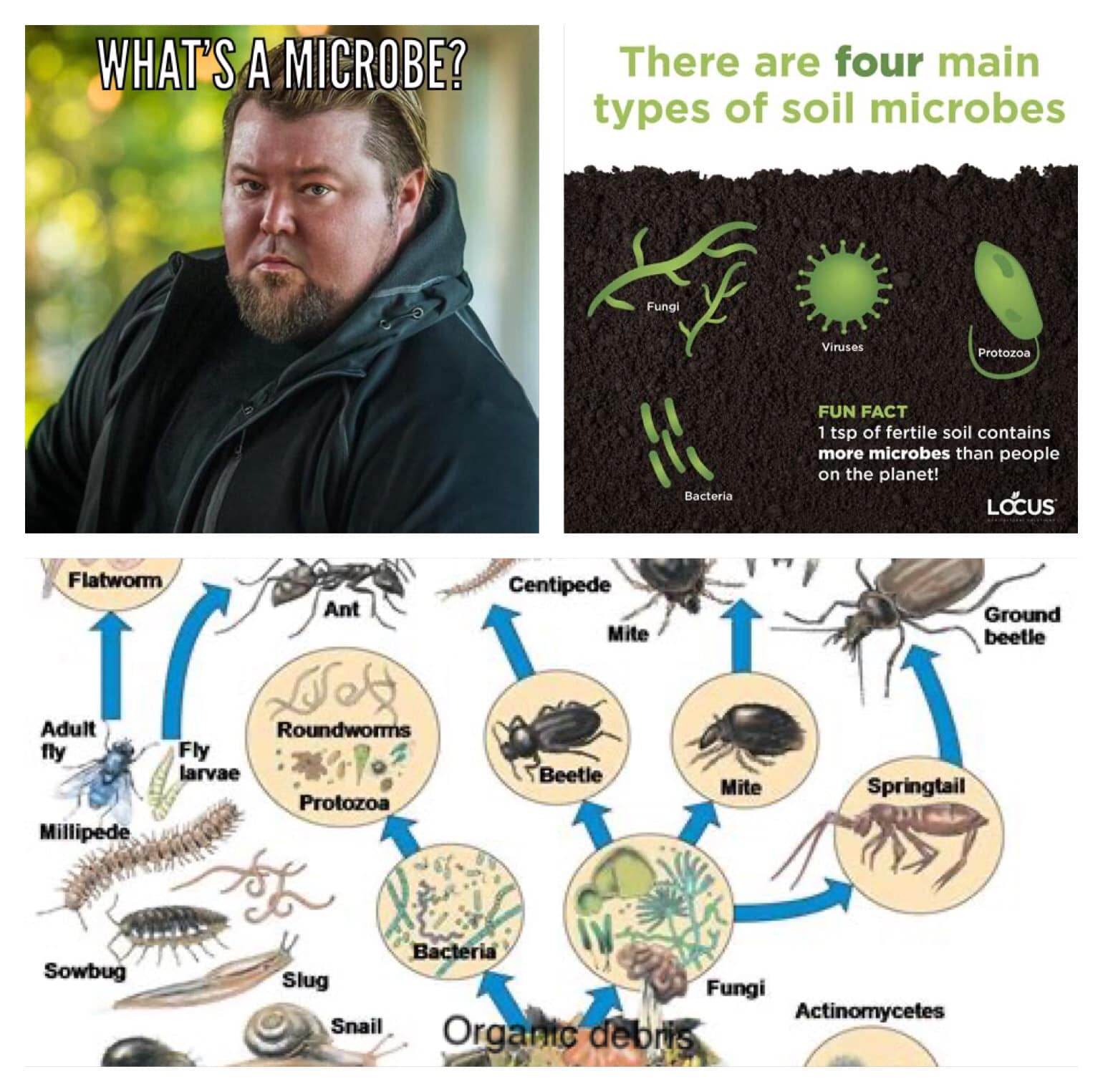
This meme asks a curious viewer to define a microscopic creature, because "What's a Microbe?" sounds like a question for someone with no gardening experience. The chart illustrates how garden soil is a busy ecosystem where bacteria, fungi, and tiny animals like springtails, centipedes, and ground beetles all work together to break down organic debris into nutrient-rich compost. This process turns the dirt under your feet into rich soil ready to be replanted.
simple-description (llama3.2-vision_11b)
The meme is a humorous illustration of a fungus (a type of organism) with a sarcastic caption. The image depicts a fungus with a smug expression, implying that it's superior to other organisms. The text "I'm not a fungus, I'm a fungus-astrophysicist" is a play on words, poking fun at the idea of a fungus being a scientist.
detailed-analysis (gemma3-27b-vision)
Okay, let's break down this image with the requested theoretical lenses. It's a fascinating task, as the image seems simple on the surface but opens up intriguing possibilities when subjected to complex analysis.
Visual Description
The image is a composite of three sections. The top left features a portrait of a man with long hair and a beard, wearing a dark jacket and looking directly at the viewer. Above his head is the text "What's a microbe?". The top right displays a graphic of four types of microbes (Fungi, Viruses, Protozoa, and Bacteria) alongside the claim "1 tsp of fertile soil contains more microbes than people on the planet!" and the Lotus logo. The bottom half is a detailed illustration of soil organisms, including various worms, insects, snails, and microbes with arrows denoting a sort of ecosystem cycle. It's labeled "Organic debris." The color scheme is primarily earthy tones – browns, greens, and blacks – consistent with the theme of soil and life. It appears to be a marketing/educational image, possibly related to soil health or gardening products.
Foucauldian Genealogical Discourse Analysis
This image can be read through Foucault's lens as constructing a discourse around "microbes" and soil health.
- Power/Knowledge: The image asserts the authority of scientific knowledge about the microscopic world, yet this knowledge isn’t necessarily neutral. It's presented as a “fun fact” that is positioned as objective truth. The "Lotus" logo suggests a commercial interest in framing this knowledge. This is a subtle way of claiming power through expertise.
- Genealogy: The question "What’s a microbe?" isn’t an innocent request for information. It implies an origin story—a history of how we have come to define and categorize these tiny life forms. The emphasis on the vast number of microbes within a teaspoon of soil subtly establishes microbes as the primary inhabitants of our world, dwarfing the human population. This challenges anthropocentric views.
- Disciplinary Practices: The image subtly encourages a disciplinary gaze. It prompts viewers to think about soil not as inert matter but as a teeming ecosystem governed by microscopic life. This gaze potentially leads to practices of soil management that are informed by this “microbial” perspective.
The image is part of a larger discourse about environmentalism, sustainability, and the understanding of life itself. It attempts to position the "Lotus" brand as knowledgeable in this discourse.
Critical Theory
From a Critical Theory perspective (drawing on the Frankfurt School), the image can be seen as reinforcing a specific worldview that serves certain interests.
- Instrumental Reason: The emphasis on the quantity of microbes (“more than people”) highlights a focus on measurement and quantification – hallmarks of instrumental reason. This approach reduces complex ecological relationships to numbers, potentially obscuring qualitative aspects of soil health and biodiversity.
- Domination of Nature: While seemingly celebrating microscopic life, the image subtly positions soil as a resource to be understood and managed. This reflects a broader pattern of Western thought that seeks to control and dominate nature.
- Reification: The image reifies "microbes" into a distinct category, separating them from the larger web of life. This can lead to a fragmented understanding of ecosystems, where individual components are prioritized over their interconnectedness. The emphasis on “types” of microbes encourages categorization and classification.
The image, therefore, isn’t simply about celebrating microbes but also about subtly reinforcing a technocratic and controlling relationship with the environment.
Marxist Conflict Theory
From a Marxist lens, this image can be examined in terms of power dynamics and resource control.
- Control of Means of Production: Soil is a fundamental means of production, essential for agriculture and food security. The image, potentially marketing a product related to soil health, implicitly involves the capitalist control of these resources. The Lotus brand positions itself as a supplier of tools or knowledge to “improve” soil, thus participating in the commodification of nature.
- Alienation from Nature: The image presents a microscopic view of soil, abstracting it from the lived experience of farming or gardening. This abstraction contributes to a sense of alienation from the natural world, where soil is seen as a technical problem to be solved rather than a living ecosystem to be nurtured.
- Class Conflict: Access to healthy soil and sustainable agricultural practices is often unevenly distributed. Products or knowledge promoted in this image might be accessible only to those with financial resources, exacerbating existing inequalities.
The image, therefore, can be seen as participating in the capitalist logic of extracting value from nature, potentially at the expense of ecological sustainability and social justice.
Postmodernism
A postmodern reading of the image would focus on the instability of meaning and the deconstruction of grand narratives.
- Simulacra and Simulation: The image presents a “representation” of soil life (the illustration) that is separate from the “real” thing. This creates a simulacrum – a copy without an original – where the representation becomes more important than the actual lived experience of soil.
- Deconstruction of Categories: The image attempts to categorize microbes into “types,” but postmodern thought would question the validity of these categories. The boundaries between these categories are likely fluid and arbitrary, and the very act of categorization imposes a false order on a complex system.
- Fragmentation and Play of Signifiers: The image is a fragmented composition, juxtaposing a human face with abstract representations of microbes and an ecosystem illustration. This fragmentation reflects a postmodern sensibility that rejects the notion of a unified and coherent worldview.
The image, therefore, can be seen as a playful deconstruction of traditional scientific representation, highlighting the constructed nature of knowledge and the instability of meaning.
Queer Feminist Intersectional Analysis
This is the most challenging lens to apply directly, but we can approach it by considering how the image reinforces or disrupts dominant power structures through gender, sexuality, and intersectionality.
- Anthropocentric Bias: The focus on soil health for human benefit inherently centers the human experience and often overlooks the intrinsic value of all life. This aligns with a patriarchal worldview that prioritizes human dominance.
- Nature as Feminized: Historically, nature has been feminized and viewed as something to be conquered and controlled by men. The image, while celebrating microscopic life, subtly perpetuates this dynamic by positioning soil as a resource to be managed.
- Intersectional Connections to Land: Indigenous cultures and other marginalized groups often have deep spiritual and practical connections to the land. This image, potentially promoting a commercial product, risks appropriating or displacing these traditional knowledge systems.
- The man in the image – his presence reinforces a traditional, masculine authority in the domain of science/expertise. A more diverse representation could challenge these norms.
The image, therefore, implicitly reinforces patriarchal and colonial power structures by centering human needs and prioritizing control over nature. It would need to be critically examined within the context of broader systems of oppression.
I hope this detailed breakdown is helpful. Let me know if you’d like me to elaborate on any of these points or explore other theoretical lenses.
simple-description (llama3.2-vision)
The meme is a humorous image of a person with a puzzled expression, accompanied by the text "What is a microbe?" at the top. The image is paired with a caption that says "It's a tiny living thing, duh." The meme is likely poking fun at the idea that the question "What is a microbe?" is so obvious that it's almost laughable.
tesseract-ocr
UTE SAMI User four *.e8i @ “ : : se y SENS : 4 ; . «Shed \ \ fess porn soil contains NS boro ann ae than people ya Locus a i OR SP | - : \ Mite ’ T mag \ beetle _ | | HM@ ee a , ae * ee ~ wt Springtai Sow) | _ LO Siag 3 Ky Fungi a Bm ibe