First Seen
2023-11-13T06:18:59+00:00
simple-description (qwen3.5_2b-q8_0)
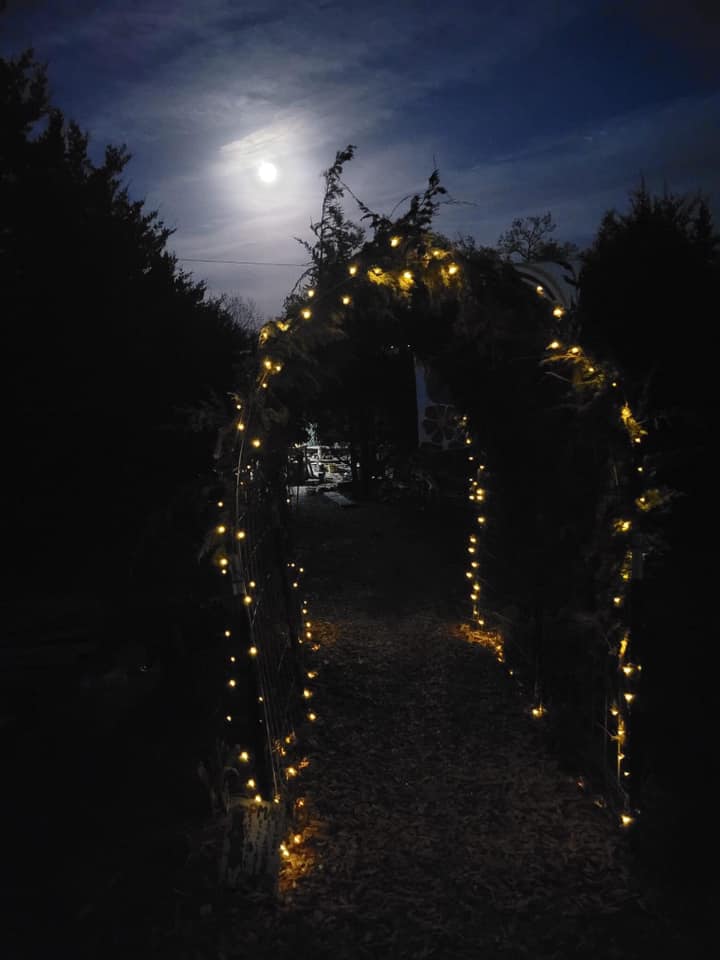
This cozy night meme captures a serene garden path at night, featuring a vine-covered archway illuminated by warm fairy lights against a dark sky with a bright full moon. The image evokes a dreamy, magical atmosphere often used to represent relaxation or fantasy, utilizing the classic "fairy light" aesthetic.
Attached to the right side of the archway is a white sign featuring a flower design and text that appears to say "Guest House," though it is too blurry to read clearly. The ground is covered in a layer of dry leaves, enhancing the rustic, nighttime feel.
simple-description (llama3.2-vision_11b)
The meme is a photo of a garden at night, with a pathway lit up by twinkling fairy lights. The image is captioned "When you finally get to the garden, but it's already dark".
detailed-analysis (gemma3-27b-vision)
Okay, here's an analysis of the image, broken down into the requested sections where applicable. Given the image, some sections will be more substantial than others, and some may be minimal or not present.
Visual Description
The image presents a darkly lit outdoor scene, dominated by a rustic archway draped with strings of small, warm-toned fairy lights. The archway leads into a path that vanishes into deeper darkness, suggesting a pathway into a garden or wooded area. The background is a night sky with a prominent, slightly obscured moon, appearing as a pale, circular shape.
The predominant color scheme is darkness, accented by the warm glow of the lights and the pale luminescence of the moon. The trees on either side are silhouetted against the sky, enhancing the depth and creating a sense of enclosure. The scene evokes a feeling of mystery, tranquility, and perhaps a hint of enchantment. There appears to be a distant suggestion of structures or furniture visible beyond the archway.
Foucauldian Genealogical Discourse Analysis
This image offers a rich ground for a Foucauldian analysis focusing on the discourse around romanticization of nature and the *construction of ‘the idyllic’. *
- Historical Shift: The framing of the scene – an archway, lights, and suggestion of curated nature – can be traced back to the historical shift from viewing nature as a wild, untamed force to a resource to be ordered, controlled, and experienced as a source of aesthetic pleasure. The lights and the arch represent this imposition of order and the taming of the natural world.
- Power/Knowledge: The image isn’t simply about nature; it’s an exercise of power through the construction of a particular discourse of nature. Those who define "beautiful" and "romantic" (through garden design, aesthetics, etc.) wield a form of power. This visual representation normalizes a specific way of relating to and experiencing the outdoors.
- Genealogy of the "Romantic": Tracing the genealogy of “romantic” aesthetics reveals that the idea of “idyllic” nature is not timeless but a historically constructed concept. The notion of a curated nature scene, as presented in the image, can be traced to the garden designs of certain periods and social classes.
- Discipline and Surveillance: The archway itself could be interpreted as a framing device that subtly disciplines the gaze, guiding the viewer along a pre-determined path. This subtly mirrors the broader ways in which power structures guide and control our perceptions and experiences.
Critical Theory
Using a Critical Theory lens, we can explore the image's inherent assumptions and the ideologies it potentially reinforces.
- Commodification of Nature: The scene can be seen as an example of the commodification of nature. The curated garden, the lights, and the aesthetic framing suggest that nature is valuable only when it is made attractive and consumable through visual experience or recreational use.
- The Gaze and the Other: The pathway framed by the arch draws the viewer in. This invites a specific kind of gaze—a controlling and possessive gaze—onto the 'natural' landscape. It perpetuates a relationship where the viewer is positioned as the subject and nature as the 'other' to be observed and enjoyed.
- Ideology of Escape: The scene evokes a sense of escape from the mundane, and suggests a retreat into a idealized natural world. This can function ideologically by obscuring the complex realities of environmental issues, economic disparities, and social inequalities that exist within these spaces. It promotes a romanticized version of nature that distracts from the need for meaningful change.
Postmodernism
From a postmodern perspective, the image reveals a play of signs and a constructed reality.
- Simulacra and Simulation: The scene may be viewed as a simulacrum of nature. The carefully arranged lights and the archway create a manufactured 'natural' experience. It's a simulation, a copy that lacks a true original. The image itself becomes a layer removed from the “real” nature it is attempting to portray.
- Deconstruction of the Sublime: Traditional notions of the sublime (awe-inspiring nature) are disrupted by the artificial elements. The fairy lights, while beautiful, are undeniably human-made, and challenge the idea of an untouched, transcendent natural experience. The scene doesn’t reveal nature; it constructs it.
- Fragmented Narrative: The darkness beyond the archway suggests an incompleteness, an ambiguous narrative. The image invites interpretation but offers no definitive meaning, embracing the postmodern emphasis on subjectivity and open-endedness.
Note: The other categories (Marxist Conflict Theory, Queer Feminist Intersectional Analysis) are less directly applicable to this image without imposing interpretations that stretch beyond the available visual information. While those lenses could be applied in a more abstract way, the image doesn't contain the explicit social or political cues to make those analyses robust.
Let me know if you'd like me to expand on any particular section or explore a different theoretical angle.
simple-description (llama3.2-vision)
The meme is a darkened image of a person standing at the edge of a forest, looking out into the darkness. The text "I can see for miles and miles and miles and miles and miles" is written in a childlike handwriting style above the person's head. The image is meant to be humorous and ironic, as the person is unable to see anything in front of them despite their boastful claim.
tesseract-ocr
la * i a 2 gee i. a ES E ‘ae . iy SeegHh. SY * oa Fad y ae , . Pie ace E é *. A a Hime eS i . IP i 5 et = , 2 Wik sia | y . a ood i . a 2 os E 7 a % ee . We , a Soni ee re ra >